.png)
 2 hours ago
8
2 hours ago
8
Article content

Article content
The Swedish Women’s Hockey League (SDHL) was one of the first to reinstate legal body checking in the 2022-23 season to increase physical play and improve competitiveness.
Article content
In recent years, other leagues started following suit. Switzerland’s PFHL approved body checking in the 2025-26 season in response to the long-standing discussions and uncertainties around the interpretation of physical contact in women’s hockey.
Article content
Other European women’s leagues, including in Norway and Finland, are also now introducing rules around body checking.
Article content
So, as women’s hockey players across the globe adapt to this new style of hockey, what’s the secret to consistently landing a clean, effective check in the women’s game? Well, when Vasko heads into the corners, she takes a page right out of the PWHL rulebook.
Article content
“The key is to get the puck first and then you take the body,” she said. “Once it’s (jersey) numbers on the glass, that’s when you’re going to get called.”
Article content
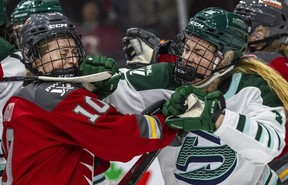
When watching the gritty fourth-liner play, it’s something you’ll see time and time again — she bursts into the corner, aligns herself with her opponent while tracking the puck first, then finishes the play with a well-timed check as the boards absorb the impact with an audible crack.
Article content
Article content
Article content
And not only is it one of the most satisfying parts of the game for Vasko, but more often than not, it’s productive.
Article content
“One of the cool parts about being physical, is it can sort of pop the puck out, so you can make plays for your teammates,” she said.
Article content
How has hitting in women’s hockey evolved?
Article content
For many players, jumping to the PWHL comes with a learning curve. Body checking is still prohibited in the NCAA, forcing many players to quickly adjust to a faster, more physical game the second they transition to the professional level.
Article content
Vasko said physicality in the women’s game has always been there – now, it’s just about figuring out what is and isn’t allowed. Players might cross that boundary once or twice and land in the penalty box, before starting to get the feel of what legal body contact feels like.
Article content
“As women’s hockey players, our game has always been aggressive, but now, we’re getting educated on it – how to protect yourself from hits, how to give hits,” Vasko said. “It’s going to ebb and flow between a game, but in the third year, the physicality has really amped up, and that means the game is even faster.”
Article content
Article content
When it comes to evolving with the PWHL’s standards for hitting, Irwin added that no one is doing any better than Vasko.
Article content
“(Physicality) was probably always part of her style, and she just couldn’t quite finish it, so I think it’s a lot of fun for her,” Irwin added. “She’s a smaller body, too, so she can really lead the example in that way, that you don’t have to be big to be physical.”
Article content

Article content
That said, size doesn’t hurt. Just ask Guilday.
Article content
“I’ve always been bigger than the other girls I played against growing up,” said the 5-foot-11 defender. “I was naturally stronger as well so that ended up being a big part of my game.”
Article content
Guilday had opportunities to work on delivering clean hits at practice during her time at Cornell University, even if it wasn’t something she could apply in collegiate games. Now in the PWHL, that experience is playing off as she’s earned a reputation as one of the most physical defenders with 53 hits – an average of almost two per game – in her rookie season.
Article content
Guilday has logged 18 penalty minutes so far though, miraculously, none have been the result of illegal checks. Most have stemmed from stick infractions like slashing or hooking.





























/https%3A%2F%2Fsportsmole-media-prod.s3.gra.io.cloud.ovh.net%2Fuploads%2F2026%2F04%2Ficonsport-362425-0006-1-69cd324521f82764565288.jpg)
 Bengali (BD) ·
  English (US) ·