.png)
 1 hour ago
8
1 hour ago
8
The federal government has made or been involved in at least half-a-dozen failed attempts to create a high-frequency or high-speed rail network in the Ontario-Quebec corridor since the late 1960s
Published Aug 01, 2026 • Last updated 18 minutes ago • 4 minute read
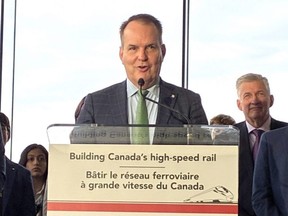
The history of federal governments touting high-speed rail projects between Ontario and Quebec has been one of false starts for more than five decades and last week we saw an example of why.
Advertisement 2

THIS CONTENT IS RESERVED FOR SUBSCRIBERS ONLY
Subscribe now to read the latest news in your city and across Canada.
- Unlimited online access to articles from across Canada with one account.
- Get exclusive access to the Toronto Sun ePaper, an electronic replica of the print edition that you can share, download and comment on.
- Enjoy insights and behind-the-scenes analysis from our award-winning journalists.
- Support local journalists and the next generation of journalists.
- Daily puzzles including the New York Times Crossword.
SUBSCRIBE TO UNLOCK MORE ARTICLES
Subscribe now to read the latest news in your city and across Canada.
- Unlimited online access to articles from across Canada with one account.
- Get exclusive access to the Toronto Sun ePaper, an electronic replica of the print edition that you can share, download and comment on.
- Enjoy insights and behind-the-scenes analysis from our award-winning journalists.
- Support local journalists and the next generation of journalists.
- Daily puzzles including the New York Times Crossword.
REGISTER / SIGN IN TO UNLOCK MORE ARTICLES
Create an account or sign in to continue with your reading experience.
- Access articles from across Canada with one account.
- Share your thoughts and join the conversation in the comments.
- Enjoy additional articles per month.
- Get email updates from your favourite authors.
THIS ARTICLE IS FREE TO READ REGISTER TO UNLOCK.
Create an account or sign in to continue with your reading experience.
- Access articles from across Canada with one account
- Share your thoughts and join the conversation in the comments
- Enjoy additional articles per month
- Get email updates from your favourite authors
Article content
That was the threat by Ontario Premier Doug Ford to withdraw provincial support from Alto – the latest multi-billion-dollar, high-speed rail project touted by the feds to connect Toronto and Quebec City.
Article content
Article content
The reason was Prime Minister Mark Carney nixing the expansion of Toronto’s Billy Bishop Airport, which was being spearheaded by Ford, because of the federal byelection in the Toronto riding of Beaches-East York on Aug. 31.
It’s a hotbed of opposition to airport expansion, which apparently spooked Carney, even though the Liberals have held the riding in every election since 1993, save for one NDP victory in the 2011 election, which resulted in a Stephen Harper Conservative majority government.
As reported by Postmedia‘s Brian Lilly, Carney and Ford had a gentlemen’s agreement that Carney would support Billy Bishop expansion in return for Ford backing Alto.
This even though Alto’s route through Eastern Ontario is unpopular in ridings held by Ford’s Progressive Conservatives, due to fears of property expropriation, destruction of farmland, environmental damage and complaints about a lack of consultation by federal planners.
By signing up you consent to receive the above newsletter from Postmedia Network Inc.
Article content
Advertisement 3
Article content
(According to the Toronto Star, Carney also ignored a report from the federal Competition Bureau that the expansion of Billy Bishop Airport would have helped consumers by lowering air fares an average of 9% on some routes, due to increased competition with Toronto-Pearson airport.)
Read More
-

LILLEY: How Mark Carney turned Billy Bishop airport into an Alto problem
-

EDITORIAL: On the horns of a unicorn dilemma
-
JARVIS: Kingston high-speed rail stop will cost taxpayers dearly


The political dispute between Carney and Ford illustrates the difficulties in bringing massive infrastructure projects like Alto into reality.
As has happened repeatedly over more than 50 years in Canada, politics gets in the way, or the costs become prohibitive, or priorities change and governments lose interest.
(A 40-year effort to establish a high-speed rail link between Calgary and Edmonton has also failed.)
Since the late 1960s, the federal government has made or been involved in at least half-a-dozen failed attempts to create a high-frequency or high-speed rail network in the Ontario-Quebec corridor.
Advertisement 4
Article content
Some were timed to coincide with elections, as was the case with Alto, announced by Justin Trudeau in February 2025, a month before Carney became PM and called the election.

Mark Carney touts Alto as nation-building project
Carney touts Alto as a nation-building project supported by his major projects office.
It envisions a 1,000-km long passenger rail network running electric trains travelling at 300 km/h along a dedicated dual-track corridor, cutting existing travel times in half between Toronto and Quebec City, a region home to 18 million Canadians producing 40% of Canada’s GDP.
Proposed stations are Toronto, Peterborough, Kingston, Ottawa, Montreal, Laval, Trois-Rivieres and Quebec City.
The estimated cost is up to $90 billion, with construction beginning in 2029 and a planned completion date 12 to 14 years later.
Alto is a publicly-owned federal megaproject partnering with a conglomerate called the Cadence Consortium consisting of six companies – CDPQ Infra, AtkinsRéalis, SNCF Voyageurs, SYSTRA Canada, Keolis Canada and Air Canada – chosen, the government says, through a competitive tendering process.
Advertisement 5
Article content
The federal ethics commissioner has ruled Finance Minister Francois-Philippe Champagne is not in a conflict of interest because his partner, Anne-Marie Gaudet, is VP of environment for Alto.
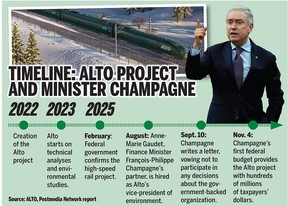
More than 50,000 high-paying jobs created during construction?
The Carney government says Alto will boost Canada’s GDP by up to $35 billion annually, creating over 50,000 high-paying jobs during the construction phase.
That’s if it ever happens because the history of Canada’s experiments with high-speed trains in the Ontario-Quebec corridor is not encouraging.
The first attempt was the Turbo Train in the late 1960s that went bust because while it could theoretically travel at 270 km/h, it had to use conventional rail tracks, limiting its top speed to 160 km/h, and it had numerous mechanical problems.
In the 1974 federal election, prime minister Pierre Trudeau, as would his son half-a-century later, promised to revitalize Canada’s rail network, leading to the creation of VIA Rail, a crown corporation that was to manage the roll-out of Bombardier’s “Light, Rapid, Comfortable” (LRC) trains.
But again, the lack of dedicated railway tracks limited their speed on tracks designed for hauling freight.
Subsequent government/private sector attempts to create high speed and/or high frequency rail corridors in 1981, 1984, 1998, 2002, 2008 and 2016, the last of which eventually morphed into the Alto project, were abandoned for reasons ranging from high costs to loss of political will.
This time, Carney and Co. say, it will be different.
Article content

























/https%3A%2F%2Fsportsmole-media-prod.s3.gra.io.cloud.ovh.net%2Fuploads%2F2026%2F07%2Fwc26-stencil-generic-1-player-email-6a5efced3be22784676779.jpg)
/https%3A%2F%2Fsportsmole-media-prod.s3.gra.io.cloud.ovh.net%2Fuploads%2F2026%2F04%2Fimago1075785696-69f1c41377d96073966575.jpg)
 Bengali (BD) ·
  English (US) ·