.png)
 1 week ago
11
1 week ago
11
Article content
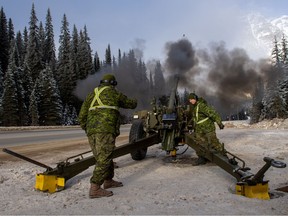
Canada’s top general is shutting down a key operation keeping avalanches under control along the Trans-Canada Highway in the Rocky Mountains because of “significant resource pressures,” according to a letter obtained by the Ottawa Citizen.

THIS CONTENT IS RESERVED FOR SUBSCRIBERS ONLY
Subscribe now to read the latest news in your city and across Canada.
- Unlimited digital access to the Ottawa Citizen.
- Analysis on all things Ottawa by Bruce Deachman, Elizabeth Payne, David Pugliese, and others, award-winning newsletters and virtual events.
- Opportunity to engage with our commenting community.
- Ottawa Citizen ePaper.
- Ottawa Citizen App.
SUBSCRIBE TO UNLOCK MORE ARTICLES
Subscribe now to read the latest news in your city and across Canada.
- Exclusive articles from Elizabeth Payne, David Pugliese, Andrew Duffy, Bruce Deachman and others. Plus, food reviews and event listings in the weekly newsletter, Ottawa, Out of Office.
- Unlimited online access to Ottawa Citizen and 15 news sites with one account.
- Ottawa Citizen ePaper, an electronic replica of the print edition to view on any device, share and comment on.
- Daily puzzles, including the New York Times Crossword.
- Support local journalism.
REGISTER / SIGN IN TO UNLOCK MORE ARTICLES
Create an account or sign in to continue with your reading experience.
- Access articles from across Canada with one account.
- Share your thoughts and join the conversation in the comments.
- Enjoy additional articles per month.
- Get email updates from your favourite authors.
Register to unlock this article — it’s free
Create an account or sign in to continue with your reading experience.
- Access articles from across Canada with one account
- Share your thoughts and join the conversation in the comments
- Enjoy additional articles per month
- Get email updates from your favourite authors
Sign In or Create an Account
or
Article content
More than 4,000 vehicles and up to 40 trains travel through the Rogers Pass corridor in British Columbia each day. The corridor is critical to Canada’s economy and the Canadian Forces has had the job for more than 50 years of using artillery to control avalanches along the high-mountain pass in the winter. It is estimated that the economic cost of the highway closing because of an avalanche can be as much as $3 million a hour.
Article content
Article content
Article content
The Canadian Forces spends around $1 million annually on Operation PALACI, which involves a small team of soldiers using artillery to reduce snow buildup by triggering controlled avalanches.
Article content
But Chief of the Defence Staff Gen. Jennie Carignan has told Parks Canada that she will not renew an agreement with the agency to conduct avalanche control operations in Glacier National Park and Roger Pass. That agreement or memorandum of understanding is set to expire on Aug. 17, 2027.
Article content
“We have given serious consideration to the importance of this operation,” Carignan wrote on Nov. 18, 2025 to Ron Hallman, then president of Parks Canada. “However, the CAF continues to face significant resource pressures while the global geopolitical situation continues to rapidly evolve. Regrettably, the situation has not improved while the demands on our resources have continued to increase despite recent investments.”
Article content

Article content
The Liberal government under Prime Minister Mark Carney is pouring billions of dollars into the Canadian Forces. On Nov. 4, 2025, the government unveiled a budget that committed to spending $81.8 billion on defence over the next five years.
Article content
Article content
Defence Minister David McGuinty’s office didn’t respond to a request for comment.
Article content
Article content
Rogers Pass has the highest avalanche hazard index rating in Canada, and third highest in North America, according to Parks Canada. It has more than 130 avalanche paths that cross the Trans-Canada Highway.
Article content
In the late 19th century, avalanches caused a significant number of fatalities in Canada. Between 1885 and 1916, more than 250 railway workers died due to avalanches, according to Parks Canada.
Article content

Article content
Department of National Defence spokesperson Daniel Blouin confirmed in an email that the memorandum of understanding between Parks Canada and the Canadian Forces is set to expire and won’t be renewed.
Article content
“In 2025, the CAF officially communicated to Parks Canada that they would not renew the avalanche control MOU beyond its expiry in August 2027 due to evolving defence modernization priorities and operational imperatives, and the planned divestment of the legacy artillery systems currently used in support of Parks Canada,” Blouin noted in the email.
Article content
“The CAF also signalled its intention to assist Parks Canada to plan this transition to meet Parks Canada’s needs while reducing pressure on the CAF before the MOU expires.”





























 Bengali (BD) ·
  English (US) ·