.png)
 1 hour ago
5
1 hour ago
5

Article content
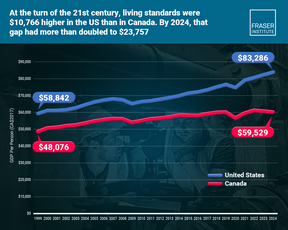
Canada’s economic performance has fallen further behind that of the U.S. over the past quarter century, with the gap in GDP per person more than doubling and the Americans pulling ahead on incomes, employment, investment and productivity.

THIS CONTENT IS RESERVED FOR SUBSCRIBERS
Enjoy the latest local, national and international news.
- Exclusive articles by Conrad Black, Barbara Kay and others. Plus, special edition NP Platformed and First Reading newsletters and virtual events.
- Unlimited online access to National Post.
- National Post ePaper, an electronic replica of the print edition to view on any device, share and comment on.
- Daily puzzles including the New York Times Crossword.
- Support local journalism.
SUBSCRIBE FOR MORE ARTICLES
Enjoy the latest local, national and international news.
- Exclusive articles by Conrad Black, Barbara Kay and others. Plus, special edition NP Platformed and First Reading newsletters and virtual events.
- Unlimited online access to National Post.
- National Post ePaper, an electronic replica of the print edition to view on any device, share and comment on.
- Daily puzzles including the New York Times Crossword.
- Support local journalism.
REGISTER / SIGN IN TO UNLOCK MORE ARTICLES
Create an account or sign in to continue with your reading experience.
- Access articles from across Canada with one account.
- Share your thoughts and join the conversation in the comments.
- Enjoy additional articles per month.
- Get email updates from your favourite authors.
THIS ARTICLE IS FREE TO READ REGISTER TO UNLOCK.
Create an account or sign in to continue with your reading experience.
- Access articles from across Canada with one account
- Share your thoughts and join the conversation in the comments
- Enjoy additional articles per month
- Get email updates from your favourite authors
Sign In or Create an Account
or
Article content
That’s according to a new study published by the Fraser Institute, which found that, in 1999, inflation-adjusted GDP per person in Canada was $48,076, while in the U.S. it was $58,842. By 2024, GDP per person had grown to $83,286 in the U.S. compared to just $59,529 in Canada — meaning the gap had widened from $10,766 to $23,757 over 25 years.
Article content
Article content
Article content
The study compared economic outcomes in the two countries by looking at measures including living standards, incomes, employment, investment, and productivity. In every category, Canada has fallen further behind over the first quarter of the century, it found.
Article content
By signing up you consent to receive the above newsletter from Postmedia Network Inc.
Article content
For example, in 2010 (the earliest year of comparable data), inflation-adjusted median employment income was $6,126 higher in the U.S. than in Canada. By 2024, that gap had increased to $8,663.
Article content
“When comparing the economic performance of Canada relative to the U.S. since the beginning of the 21st century, it’s abundantly clear that Canadian policymakers have failed to create an environment where we can prosper,” said Jake Fuss, director of fiscal studies at the Fraser Institute, in a news release.
Article content
He added that the ability to transform raw materials and other inputs into demanded goods and services increased by more than double the amount (26.7 per cent versus 67.9 per cent) in the U.S. compared to Canada, “which explains much of our languishing living standards.”
Article content
The Fraser Institute outlines three factors that explain the widening gap in economic performance between the two countries.
Article content
Article content
Article content
The first is a decline in private sector employment as a share of total employment in Canada. This decreased from 81.2 per cent to 78.5 per cent, meaning the government sector outgrew the private sector. The opposite occurred in the U.S., as private sector employment increased from 85.8 per cent of total employment to 86.5 per cent.
Article content
Article content
Meanwhile, labour productivity — a key driver of income growth — in the U.S. grew by 67.9 per cent between 1999 and 2025 compared to a 26.7 per cent increase in Canada during the same period.
Article content
Finally, business investment in Canada — which equips workers with the tools and technology they need to produce goods and services — dropped from nearly 90 cents per worker for every dollar invested in the U.S. to 54 cents between 2007 and 2024.
Article content
That said, the Fraser Institute study suggests that Canada’s trailing economic performance didn’t begin until 2014. Prior to this, Canada largely kept pace with, or in some cases exceeded, the U.S. across multiple measures, it said.
Article content
The think tank doesn’t look into the potential reasons for the change in 2014, but Grady Munro, senior policy analyst at the Fraser Institute and one of the study’s authors, offers some insight into the major factors that he says likely played a role.






























 Bengali (BD) ·
  English (US) ·