.png)
 4 hours ago
12
4 hours ago
12
Article content
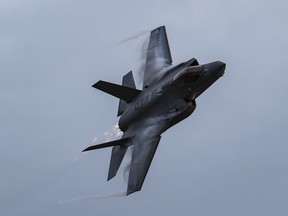
Alain Pelletier can still remember that new plane smell when he first climbed into the cockpit of a CF-18 more than three decades ago.

THIS CONTENT IS RESERVED FOR SUBSCRIBERS
Enjoy the latest local, national and international news.
- Exclusive articles by Conrad Black, Barbara Kay and others. Plus, special edition NP Platformed and First Reading newsletters and virtual events.
- Unlimited online access to National Post.
- National Post ePaper, an electronic replica of the print edition to view on any device, share and comment on.
- Daily puzzles including the New York Times Crossword.
- Support local journalism.
SUBSCRIBE FOR MORE ARTICLES
Enjoy the latest local, national and international news.
- Exclusive articles by Conrad Black, Barbara Kay and others. Plus, special edition NP Platformed and First Reading newsletters and virtual events.
- Unlimited online access to National Post.
- National Post ePaper, an electronic replica of the print edition to view on any device, share and comment on.
- Daily puzzles including the New York Times Crossword.
- Support local journalism.
REGISTER / SIGN IN TO UNLOCK MORE ARTICLES
Create an account or sign in to continue with your reading experience.
- Access articles from across Canada with one account.
- Share your thoughts and join the conversation in the comments.
- Enjoy additional articles per month.
- Get email updates from your favourite authors.
THIS ARTICLE IS FREE TO READ REGISTER TO UNLOCK.
Create an account or sign in to continue with your reading experience.
- Access articles from across Canada with one account
- Share your thoughts and join the conversation in the comments
- Enjoy additional articles per month
- Get email updates from your favourite authors
Sign In or Create an Account
or
Article content
The retired Royal Canadian Air Force lieutenant general, who was deputy commander of North American Aerospace Defense Command (NORAD) in Colorado Springs from July 2020 until June 2023, knows what it takes to get a new fleet of fighter aircraft up and running. He thinks the Royal Canadian Air Force (RCAF) would be stretched thin for pilots, technicians and trainers if ordered to double that effort for a combined fleet of American-made Lockheed Martin F-35s and Saab Gripen-E fighters.
Article content
Article content
Advertisement 1
Article content
“Having two fleets of fighters is a challenge for any air force,” Pelletier said in a recent interview.
Article content
By signing up you consent to receive the above newsletter from Postmedia Network Inc.
Article content
He is slated to speak Tuesday at The Mackenzie Institute’s Canadian Arctic Conference in Toronto to address Canada’s acquisition of new fighter aircraft, and the roles that they might play in northern defence.
Article content
Canada already has a shortage of men and women to fly and maintain its jet fighters, he said. “If they do go that route,” with a dual fleet, “the RCAF will suffer in the short (term) because you need to be able to transition to that new fleet, but now you’re transitioning not to a single fleet, you’re transitioning to two new fleets at a time when you’re just short of people. You cannot duplicate people. You cannot clone people. So, it will be a growing pain.”
Article content
With the CF-18s heading for retirement in 2032-33, Prime Minister Mark Carney’s Liberal government, in the midst of a trade war with the United States, hasn’t revealed the outcome of a review of their planned replacement — 88 F-35 fighter jets, manufactured by U.S. defence giant Lockheed Martin.
Article content
While Ottawa has placed a firm order for 16 F-35s and has begun paying for critical equipment for 14 additional aircraft, there’s no word yet on how many of the stealth fighters this country will ultimately buy.
Article content
Advertisement 2
Article content
Meanwhile, the Carney government is talking about supplementing the fighter jet numbers with Swedish defence giant Saab’s Gripen.
Article content
Article content
Canada has evaluated its options twice and chosen the F-35 both times, Pelletier said.
Article content
“I’ve had a chance to look at all the contenders that are out there on at least two occasions,” he said. “I think that the F-35 was a good decision, a decision that is reflected by our NATO partners.”
Article content
The U.S., the United Kingdom, Australia, Denmark, Finland and Norway have all gone with the F-35, he said.
Article content
“I think it is the right choice. It’s the choice that will carry operational capability for the next 30 years or so.”
Article content
The F-35 stands out, Pelletier said, for technology that allows pilots to glean information from their own fighter’s sensors, as well as those of other aircraft, warships and satellites, all “fused into a single picture,” to get a better idea of what’s going on.
Article content
“Having been a pilot, that is crucial to mission effectiveness,” he said. “You’re able to sense a threat that is out there before it can sense you.”
Article content
Pelletier, who flew combat missions in the Balkans, said the unexpected can hurt a fighter jet pilot’s survivability.



























 Bengali (BD) ·
  English (US) ·