.png)
 3 hours ago
12
3 hours ago
12
Article content
The report of the environmental assessment panel, delivered in March 1979, said bulk liquids such as petroleum hydrocarbons presented a more serious problem than bulk solids at a terminal on an estuary, referring to the Fraser River estuary.
Article content
“The bulk liquids can be readily distributed by currents over the whole delta. An oil spill of moderate size, 1,000 tonnes or more (about 7,300 barrels of oil), could, under certain conditions, put the inter-causeway area out of biological production for some months or more,” noted the panel report.
Article content
“It could also affect other parts of the delta. In spite of the most stringent controls, spills of bulk liquids inevitably occur at terminals handling such liquids,” said the six-member panel.
Article content
The proposed pipeline and oil-shipping terminal, estimated to cost up to $44 billion, will be 90 per cent owned by the Alberta government through its petroleum marketing commission and by Canada through its ownership of the pipeline company Trans Mountain. The Pembina Pipeline Corp. has taken a 10-per-cent stake.
Article content
Article content
Article content
The project has already been submitted to the recently created Major Projects Office for consideration of being designated a project of national interest, which would expedite its environmental assessment.
Article content
Canada is anticipating making that decision by Oct. 1, with construction potentially starting by Sept. 1, 2027.
Article content
Article content
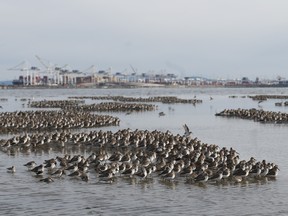
Misty MacDuffee, the Raincoast Conservation Foundation’s wild salmon program director, was unaware that there has been a prohibition on shipping bulk liquids from Roberts Bank.
Article content
“Any removal of such prohibition would have to go through an entire environmental review and a hearing process,” argued MacDuffee.
Article content
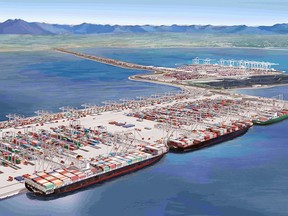
Her organization was among environmental groups that launched an unsuccessful legal challenge of a $3.5-billion second container terminal planned at Roberts Bank on a new 1.3-square-kilometre artificial island, with a hoped-for construction start in 2028.
Article content
MacDuffee said she’s concerned that if the oil pipeline and terminal project is designated to be of national interest that the normal, deep process for reviewing such a project and its impacts on the environment will be overridden, including examining the bulk-liquids ban.
Article content
Article content
The bulk-liquids prohibition at Roberts Bank was also raised by Trans Mountain in 2013 during its environmental assessment application to expand its existing pipeline between Alberta and B.C. to a terminal in Burnaby.
Article content
A report filed as part of its application, which requires proponents to consider alternative sites, noted the storage and transhipment of oil had been of concern at Roberts Bank dating to the 1970s.
Article content
The report said that while it was unclear to what degree the premise of undue risk to the environment had been tested and whether potential mitigation measures were considered, the condition was adopted in regulatory reviews and permitting in subsequent developments, and that the Vancouver Fraser Port Authority doesn’t allow the transfer, loading or storage of bulk liquids at Roberts Bank.
Article content
Article content
So far, Alberta and Canada have also not been able to answer questions on whether there is enough room for an oil-shipping terminal at Roberts Bank, which is already the location of a B.C. Ferries terminal, the Roberts Bank Superport that contains the Westshore coal terminal, and Deltaport, Canada’s largest container-handling facility.























/https%3A%2F%2Fsportsmole-media-prod.s3.gra.io.cloud.ovh.net%2Fuploads%2F2026%2F03%2Ficonsport-361551-0102-1-69b560866f7b6508942731.jpg)
 Bengali (BD) ·
  English (US) ·