.png)
 2 weeks ago
6
Article content
Fall bulb planting has changed dramatically. Gone are the days of picking up some bulbs, scattering them throughout the garden, and looking forward to a spring display.

THIS CONTENT IS RESERVED FOR SUBSCRIBERS ONLY
Subscribe now to read the latest news in your city and across Canada.
- Unlimited online access to articles from across Canada with one account.
- Get exclusive access to the Vancouver Sun ePaper, an electronic replica of the print edition that you can share, download and comment on.
- Enjoy insights and behind-the-scenes analysis from our award-winning journalists.
- Support local journalists and the next generation of journalists.
- Daily puzzles including the New York Times Crossword.
SUBSCRIBE TO UNLOCK MORE ARTICLES
Subscribe now to read the latest news in your city and across Canada.
- Unlimited online access to articles from across Canada with one account.
- Get exclusive access to the Vancouver Sun ePaper, an electronic replica of the print edition that you can share, download and comment on.
- Enjoy insights and behind-the-scenes analysis from our award-winning journalists.
- Support local journalists and the next generation of journalists.
- Daily puzzles including the New York Times Crossword.
REGISTER / SIGN IN TO UNLOCK MORE ARTICLES
Create an account or sign in to continue with your reading experience.
- Access articles from across Canada with one account.
- Share your thoughts and join the conversation in the comments.
- Enjoy additional articles per month.
- Get email updates from your favourite authors.
THIS ARTICLE IS FREE TO READ REGISTER TO UNLOCK.
Create an account or sign in to continue with your reading experience.
- Access articles from across Canada with one account
- Share your thoughts and join the conversation in the comments
- Enjoy additional articles per month
- Get email updates from your favourite authors
Sign In or Create an Account
or
Article content
Today it’s more about creating a specific look in a specific area for a specific time. There is a six-month window of opportunity and creative gardeners are doing some amazing things.
Article content
Article content
There’s also a great deal of competition for those bulbs. They’re great food for rodents, and squirrels are some of the leading culprits. Plan A is to avoid planting their favourites, and Plan B is being a lot more creative than they are.
Article content
Advertisement 1
Article content
Safe bets are the very large narcissus family, giving you many options in size and timing. The allium family is becoming very popular and offers great diversity in varieties. Since rodents are not fans of onions, they also stand a good chance of making it. Also not rodent friendly, the unique fritillaries are a good choice. They add a fun yet natural look to the garden. Surprisingly, snow drops, or Galanthus, are not on the rodent menu, giving us a mid-winter show to kick off our bulb display season.
Article content
By signing up you consent to receive the above newsletter from Postmedia Network Inc.
Article content
Planted now, your snow drops should start to appear in late December or early January, depending on the winter weather. Planted around trees and shrubs, in among ground covers like sedums and the black mondo grass, and next to dark foliaged heucheras, they make for great combinations. More folks are planting bulbs in lawn areas where they can naturalize and multiply each year all nestled in a nice green blanket.
Article content
Article content
The vibrant colours of crocus can be used in the same ways, but you’ll have some competition for these tasty bulbs. The simplest and easiest way to protect them is by covering your plantings with a small weave wire mesh. It can stay in the ground year-round as the bulbs flower through the mesh and the leaves will come and go without anyone noticing. Another deterrent is strongly scented herb leaves like mint and chives, which, when sprinkled over the plantings and covered with soil, will help repel rodents.
Article content
Advertisement 2
Article content
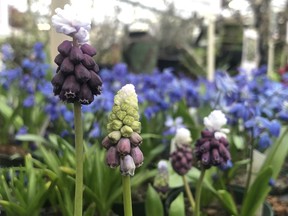
Although not actually rodent proof, the whole family of muscari, or grape hyacinths, seem to have little attraction for our bulb eating friends. Muscari multiply and naturalize easily and planted among ground covers, evergreen perennials, and evergreen shrubs like dwarf azaleas and rhododendrons, they look quite stunning. The fact they are now available in shades of blue, white, and pink further broadens their appeal. The world’s number one bulb show garden, Keukenhof in Holland, uses them everywhere as an accent. They make a stunning display initially, and then improve as they multiply each year. I would simply scatter some chives and mint leaves around them when planting for some insurance.
Article content

Article content
Article content
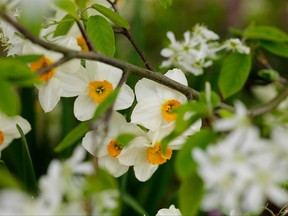
The most impressive narcissus are the smaller varieties like the bulbicodiums and Tete a Tetes. Bulbicodium bulbs are about the same size as a crocus and can be used in the same way as companions to ground covers, evergreen perennials, and low broadleafed shrubs. Tete a Tete narcissus, while one of the smallest, are the most floriferous in the world and can produce from six to nine flowers per bulb the first year. They are also the best indoor forcing mini-daffodils for containers and pots, with great lasting qualities too. These would be my number one pick for patio pots, but they might need a little protection in cold winters.





























 Bengali (BD) ·
 English (US) ·