.png)
 1 hour ago
11
1 hour ago
11
Article content
Here we go again.

THIS CONTENT IS RESERVED FOR SUBSCRIBERS
Enjoy the latest local, national and international news.
- Exclusive articles by Conrad Black, Barbara Kay and others. Plus, special edition NP Platformed and First Reading newsletters and virtual events.
- Unlimited online access to National Post.
- National Post ePaper, an electronic replica of the print edition to view on any device, share and comment on.
- Daily puzzles including the New York Times Crossword.
- Support local journalism.
SUBSCRIBE FOR MORE ARTICLES
Enjoy the latest local, national and international news.
- Exclusive articles by Conrad Black, Barbara Kay and others. Plus, special edition NP Platformed and First Reading newsletters and virtual events.
- Unlimited online access to National Post.
- National Post ePaper, an electronic replica of the print edition to view on any device, share and comment on.
- Daily puzzles including the New York Times Crossword.
- Support local journalism.
REGISTER / SIGN IN TO UNLOCK MORE ARTICLES
Create an account or sign in to continue with your reading experience.
- Access articles from across Canada with one account.
- Share your thoughts and join the conversation in the comments.
- Enjoy additional articles per month.
- Get email updates from your favourite authors.
THIS ARTICLE IS FREE TO READ REGISTER TO UNLOCK.
Create an account or sign in to continue with your reading experience.
- Access articles from across Canada with one account
- Share your thoughts and join the conversation in the comments
- Enjoy additional articles per month
- Get email updates from your favourite authors
Sign In or Create an Account
or
Article content
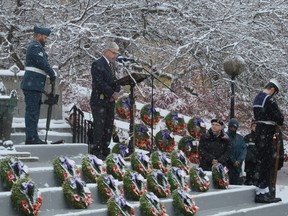
As it did in 2023, the federal government is seeking to restrict prayers by military chaplains, instead encouraging them to offer “spiritual reflections” — essentially life lessons or other inspirational bon mots.
Article content
Article content
To jog memories: A 2023 Canadian Armed Forces (CAF) directive updating a 2013 military policy told chaplains to avoid using religious symbols at public events, to filter religious expression through “Gender Based Analysis” to avoid asking anyone to remove a hat or headwear during their presentations, and, most infamously, to replace prayer with nebulous, sanitized alternatives called “spiritual reflections.” This new document, taking the form of Military Personnel Instructions, clarifies that such reflections “do not use religious specific language” but rather “reflect upon lessons learned, beliefs, values, and experiences to inspire gratitude, remembrance, hope, and integrity.”
Article content
Article content
The federal government is once again presenting this change as a more inclusive measure while achieving the exact opposite. As my colleagues said in 2023, prayers across different faith lines are not interchangeable. A spiritual reflection that applies to all ultimately applies to none. Trying to appease everyone actually makes no one happy.
Article content
By signing up, you consent to receive the above newsletter from Postmedia Network Inc.
Article content
So would more religious prayers actually be a preferable option? We believe the research says yes. Working with the Angus Reid Institute, we have polled Canadians several times on the subject of religious tolerance. The religiously committed, privately faithful, and spiritually uncertain, by and large, view most faiths positively. While a Hindu prayer might not suit the needs of a Catholic, there is a broad endurance by those who are believers or consider themselves agnostic for other people living out their faith lives. It is only atheists, representing just a third of Canadians, who hold a negative perception of all other religions.
Article content
What the government calls inclusion, in this case, is an effort to achieve neutrality that instead turns into secular uniformity, which is not the same thing.
Article content
Article content
CAF leadership in 2023 argued that this change was necessary to comply with a 2015 Supreme Court ruling that enforced “state neutrality” which said “it must neither favour nor hinder any particular belief, and the same holds true for non-belief.” Yet the policy the CAF has adopted plainly favours non-belief.
Article content
The CAF defends its policy by assuring that it “does not limit a chaplain’s personal beliefs or ability to provide spiritual or religious care,” which is a false statement. If chaplains are prohibited from praying in contexts where prayer has historically been expected, their ability to exercise their ministry has, in fact, been narrowed.
Article content
This same new policy states that “the spiritual and moral health and well-being of CAF members are essential.” How do those faithful members of the CAF feel today, I wonder, when finding out how their command structure feels towards their choice of faith?
Article content
A better approach would be one that is rooted in the pluralistic thinking that emerged from thousands of years of thought and hard-won experience by western states. A wider array of prayers, offering value and meaning to more members of the CAF and the broader community, is of greater value than a one-size-fits-all Valedictorian speech.




















/https%3A%2F%2Fsportsmole-media-prod.s3.gra.io.cloud.ovh.net%2Fuploads%2F2026%2F04%2Fimago1075785696-69f1c41377d96073966575.jpg)

 Bengali (BD) ·
  English (US) ·