.png)
 2 hours ago
13
2 hours ago
13
Article content
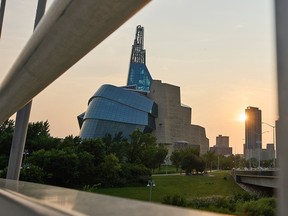
Placed along a brief 12-metre stretch of the towering seven-story museum, the Nakba exhibit includes a collection of photos, video testimonies, family heirlooms and artworks that describe the plight of Palestinian people who have fled ongoing conflict in the region. Among the artifacts are things like keys to Palestinian homes that the owners left behind, and an orange peel from a former Palestinian family-run orchard that was abandoned amid the chaos of war.
Article content
The exhibit begins at the Arab-Israeli war in 1948 — when Egypt, Lebanon, Iraq, Jordan and Syria invaded Israel in response to the United Nations partition that had established the new Israeli nation — and ends in the current day. Around 750,000 Palestinians were displaced from their homes due to the war launched by five Arab nations. The mass displacement has been dubbed the Nakba, Arabic for “catastrophe.”
Article content
Article content
Some argue that the photos, items and testimonies tell a woefully one-sided story. Mark Berlin, a former CMHR board member who quit the role over the exhibit, said Jewish people have been all but scrubbed out of the exhibit, and is calling on the museum to make corrections.
Article content
Article content
Roughly 850,000 Jews in the region have also been forced to flee their homes due to ongoing strife, Berlin points out, but those people are never mentioned in the exhibit. Berlin also notes that more than two million Arab people still live in Israel today, a fact that he said could have offered useful context.
Article content
“The story of the Nakba is a complex one,” he said. “It’s not reduced to a quick little soundbite. There’s a lot of nuance with it, there’s a lot of history that preceded it, and a lot of history that developed over the years of the Nakba.”
Article content
Berlin also takes issue with the portion related to the modern-day displacement of Palestinian people. The exhibit mentions the Oct. 7, 2023 massacre that kicked off the latest war in Gaza, but victims of the mass killing are referred to vaguely as “people,” and not as Jewish Israelis who were targeted for their Jewish heritage.
Article content
“Hamas terrorists launched the greatest large-scale massacre against Jewish civilians since World War II, where over 1,160 or so Jewish babies and children and mothers and young people were brutally murdered in the most horrific fashion,” he said. “The failure to describe that horror, and then simply say, ‘Oh, ya, these people were displaced,” is an error in judgment.”
Article content
Article content
CMHR chief executive Isha Khan defended the Nakba exhibit, saying it was explicitly designed to show the experience of a specific group of people through stories of its suffering.
Article content
“The frame, or the scope, of the exhibit is to centre Palestinian experiences of forced displacement,” she said. “So, it’s told through their stories, through their lens, and that’s an approach the museum takes in a variety of other places.”
Article content
Previous exhibits that existed in the same physical space as the Nakba had similarly focused on the experiences of specific people, Khan said. One such exhibit focused on the plight of Syrian refugees, another on the sex trafficking of two Ugandan girls.
Article content
Khan said that those displays shouldn’t be understood to come at the expense of other groups or other stories, and noted that the Nakba is just one of many exhibits in the museum — including a large gallery dedicated to the Jewish holocaust.
Article content
Khan said the museum’s leadership “share the concern around rising antisemitism,” and said they are currently reviewing some of the complaints against the Nakba exhibit. She did not confirm whether it would change the exhibit in response to those complaints. The brief texts displayed alongside photos and artifacts have been rigorously fact-checked, she said.




















/https%3A%2F%2Fsportsmole-media-prod.s3.gra.io.cloud.ovh.net%2Fuploads%2F2026%2F07%2Fwc26-stencil-generic-1-player-email-6a5efced3be22784676779.jpg)
/https%3A%2F%2Fsportsmole-media-prod.s3.gra.io.cloud.ovh.net%2Fuploads%2F2026%2F04%2Fimago1075785696-69f1c41377d96073966575.jpg)
 Bengali (BD) ·
  English (US) ·