.png)
 1 hour ago
8
1 hour ago
8
Article content
The skipper of Canada’s lone operational submarine is hoping HMCS Corner Brook’s recent sinking of a decommissioned U.S. warship off Hawaii will help attract more young people to the life subaquatic.

THIS CONTENT IS RESERVED FOR SUBSCRIBERS
Enjoy the latest local, national and international news.
- Exclusive articles by Conrad Black, Barbara Kay and others. Plus, special edition NP Platformed and First Reading newsletters and virtual events.
- Unlimited online access to National Post.
- National Post ePaper, an electronic replica of the print edition to view on any device, share and comment on.
- Daily puzzles including the New York Times Crossword.
- Support local journalism.
SUBSCRIBE FOR MORE ARTICLES
Enjoy the latest local, national and international news.
- Exclusive articles by Conrad Black, Barbara Kay and others. Plus, special edition NP Platformed and First Reading newsletters and virtual events.
- Unlimited online access to National Post.
- National Post ePaper, an electronic replica of the print edition to view on any device, share and comment on.
- Daily puzzles including the New York Times Crossword.
- Support local journalism.
REGISTER / SIGN IN TO UNLOCK MORE ARTICLES
Create an account or sign in to continue with your reading experience.
- Access articles from across Canada with one account.
- Share your thoughts and join the conversation in the comments.
- Enjoy additional articles per month.
- Get email updates from your favourite authors.
THIS ARTICLE IS FREE TO READ REGISTER TO UNLOCK.
Create an account or sign in to continue with your reading experience.
- Access articles from across Canada with one account
- Share your thoughts and join the conversation in the comments
- Enjoy additional articles per month
- Get email updates from your favourite authors
Sign In or Create an Account
or
Article content
Canada is negotiating with Thyssenkrupp Marine Systems as the preferred supplier for up to 12 submarines to replace our aging Victoria-Class fleet. But the new German subs require a crew of 28 people and, as of this past June, this country only had 193 qualified submariners working within the Canadian Submarine Force, just over half the people required to operate the new subs.
Article content
Article content
Article content
The July 12 sinking of USS Mobile Bay — a SINKEX in military parlance — was part of the U.S. Navy-led Rim of the Pacific 2026 exercise, a 30-nation, month-long set of war games that included five submarines, 30 ships, 15 national land forces, more than 190 aircraft and more than 30,000 personnel.
Article content
By signing up you consent to receive the above newsletter from Postmedia Network Inc.
Article content
“One of the things that I thought was so great about the SINKEX was the ability to demonstrate in an open way what we can bring, what we can do, and to be able to push that message to Canadians, especially at a time now when we’re a hot topic and being able to show, this is what we do,” Lt.-Cmdr. Clark Hubbard said.
Article content
He doesn’t know how Corner Brook was chosen to deliver the coup de grace.
Article content
“It wasn’t on the bucket list. It was a very happy surprise,” Hubbard said Thursday in a telephone interview from Ford Island, an islet in the centre of Pearl Harbor, Oahu.
Article content
Hubbard’s crew had to wait out some rough weather on the day they started tracking the retired warship.
Article content
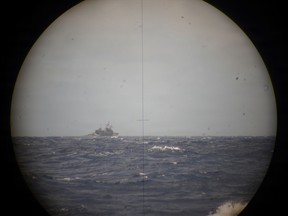
Corner Brook — among other allied vessels and aircraft shooting at Mobile Bay — launched a Mark 48 heavyweight torpedo at the warship from about a mile away. She sank in waters 15,000 feet deep, more than 50 nautical miles off the northern coast of Kauai.
Article content
Article content
“It was mostly missiles and gunfire throughout the day, and missiles and gunfire do a lot of damage. But the most reliable sinking weapon that was fired that day was obviously the torpedo at the end,” said Hubbard, who had never fired a live torpedo before.
Article content
Article content
Hubbard’s operations officer hit the button to send the weapon on its way. “I got to say ‘shoot,’ though,” he said.
Article content
Hubbard has been in the navy for 17 years. He started his career in Halifax on surface ships and switched to submarines 11 years ago.
Article content
“To me it just seemed like such a fascinating capability. No one talks about it very much and the more I asked my colleagues about what was going on, what was a submarine doing … no one knew, and that just intrigued me,” said Hubbard, who has been Corner Brook’s commanding officer for about a year.
Article content
His crew of 59 left Esquimalt, B.C., for Hawaii around the same time Prime Minister Mark Carney made the announcement about buying as many as a dozen new submarines.
Article content
“Everyone’s very excited,” Hubbard said. “The people who came down to submarines did so because they really believed in the capability, and seeing a commitment to carry on and expand that capability has got everyone in a really good mood.”
Advertisement 1
Advertisement 2
Article content
He doesn’t know how adding a dozen new subs to a predominantly surface-oriented organization is going to change the culture of the navy.
Article content
“That’s a fascinating question, and I have no good answer for you,” Hubbard said. “We talk about it ourselves and, hopefully, it’s a good change.”
Article content
They’re eager to start training for the new subs, he said.
Article content
“Every time we go to sea, we have some pretty in-depth discussions so we can optimize whatever we’re doing there to balance between our different training objectives,” Hubbard said. “Obviously we have to train people who are brand new, and we have to train people who are more advanced. And the training for those types of things can be different. So, we try to tailor the people we bring on each trip to meet the demands of the sail that we’re going on, and then by the end of the operating year we hope to have produced as many people at the different levels of production required as we can so that we can move forward with the force.”
Article content
He’s confident the navy can ratchet up the number of serving submariners to crew as many as 12 new subs. “I absolutely think we can do that.”
Article content
Article content
Hubbard’s best elevator pitch for joining the sub service goes like this: “It’s meaningful work. It’s hard work, but there’s lots of personal challenges, lots of personal accountability…. It’s a small crew size and it’s going to get even smaller. So, you know that whatever position that you’re in, you are the person who will be looked at to excel in that position.”
Article content
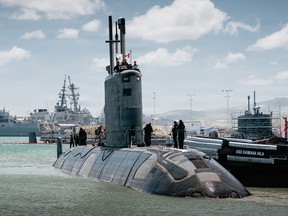
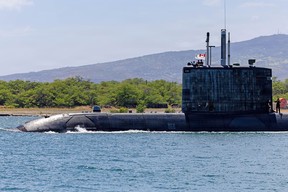
Corner Brook is one of four diesel-electric subs the Royal Canadian Navy acquired from Britain in the late 1990s to replace its Oberon-class submarines. The Victoria-class subs are expected to remain operational into the mid-to-late 2030s.
Article content
The first four new submarines are slated to be delivered in 2034.
Article content
Hubbard, 38, doesn’t know if he’ll still be a submarine captain by then.
Article content
“Depending on the timeline, I might want a desk by that point,” he said. “My back might be begging for it.”
Article content
But Hubbard didn’t discount the possibility that he might command one of the new subs. “There’s a lot of flexibility. It’s a small force, and we all know what it takes to move things forward and if I need to come back and do something out of sequence or out of the ordinary to make it happen, that’s what I’ll do.”
Article content
Article content
While the submarine force is expected to grow, Nick Drescher Brown, who speaks for National Defence, couldn’t say by how much. Nor could he put a number on the amount of support staff the subs will require in shore roles.
Article content
“The exact personnel needs will be determined as engagement with the preferred supplier continues, and as the Government of Canada progresses toward a final contract,” Brown said. “The RCN will develop a recruitment and training plan to address these personnel needs as the new submarines are delivered.”
Article content
Article content
It’s tough to put a number on how many submariners Canada will need in the future, said Paul Mitchell, a professor at the Canadian Forces College who is writing a book on the Victoria-class subs this country now operates.
Article content
“All I would add is that the submarine enterprise is much larger than simply the (Canadian Submarine Force) and includes personnel working in (the assistant deputy minister of materiel’s) Maritime Equipment Programme Management (Submarines) cell, the Fleet Maintenance Facilities on each coast, the Naval Experiment and Testing Establishment, the Canadian Forces Maritime Experimental and Test Range, and other fleet establishments like schools, liaison teams, or operational HQs,” Mitchell said.
Article content
“On top of those basic numbers are any number of slush to ensure availability and readiness and avoid pier-head jumps — the practice of assigning a sailor in one ship to another due to personnel shortages. This is complicated by the distance between our two naval bases and the family effects of moving people from one coast to the other at short notice.”
Article content
He pointed out that it can be difficult to find trained submariners to fill “niche areas like Pharmacists Mates and Galley Cooks which often limit readiness. While each trade is employed navy wide, only some are submarine qualified.”
Article content
And submarine sonar operators “require higher levels of skill than surface ship operators,” he said.
Article content
Generating qualified people to fill those jobs “is often a lengthy process made worse by the fact that some of this takes place mid-career,” Mitchell said, “meaning personnel require extensive experience before they can begin professional development. Of these, submarine captains are perhaps the most onerous in terms of generation.”
Article content
Hubbard pointed out that Canada only has four qualified submarine commanders right now. “One of them’s an admiral, so I don’t think he’s going to come back.”
Article content
Article content
Submariners with “low amounts of sea time pose hard limits on force generation and have led in the past to accusations of false dolphins, referring to the badge submariners wear on their uniform,” Mitchell said. “This reflects that getting qualified during the Oberon era meant far more time at sea than presently. There has been consistent worry about skill fade during the Victoria class. Some of this surfaced during the inquiry into the Corner Brook grounding (off Vancouver Island in 2011), and also in some potential captains failing Perisher in recent years.”
Article content
The Perisher is the informal name for the British Royal Navy’s notoriously difficult Submarine Command Course which readies naval officers to command a submarine. Other countries including Germany, The Netherlands and Norway, also run their own Perisher.
Article content
“While the navy will push to keep the Victorias as operationally ready as possible, obsolescent technology may pose hard limits to the amount of sea time they can generate,” Mitchell said. “Some of this can be ameliorated by working with allied submarines, but that too comes with a risk as those sailors may be poached by allied navies also struggling to generate their own capabilities.”
Article content
Article content
If Canada wants “to have decent bench strength once we get the TKMS boats, we can’t do all of that crew training and force generation just off exchanges with the Norwegians and Germans,” said David Perry, who heads the Canadian Global Affairs Institute.
Article content
“We need to have some of our own ability to keep a roster of people with submarine expertise, both operational from the training point of view and the maintenance point of view, in the country.”
Article content
By the time the new subs are delivered, “we’re going to have one of the largest conventional submarine forces on the planet,” Perry said.
Article content
Article content
Canada should consider borrowing one of the German submarines for training purposes, said Ken Hansen, a defence analyst and retired naval commander.
Article content
“The (Victoria-class) submarines currently are old and they’re going to be really old in another twelve years,” Hansen said.
Article content
There is no loan agreement with Germany at this time, Brown said. “However, training is top of mind as the Government of Canada continues the negotiation process. As we are still in negotiation, it is too early to discuss training arrangements for this platform.”
Article content
The navy is going to have to come up with more people willing to train as submariners, Hansen said.
Article content
“They’ll be siphoning people off to do the first bit of training and familiarization in Germany, likely, or Norway. But they’ll have to come up with people. People is the big vulnerability point right now,” Hansen said.
Article content
Canadian submariners “will be training alongside both German and Norwegian submarine forces as part of our regular Navy-to-Navy business on the international level, where we conduct training related and experiential exchange programs with allied and partner navies on a consistent basis, across the globe,” Brown said.
Article content
“Submarine training is conducted on a continuous basis to meet the demands of new submariners and to maintain the training standard for those currently serving. This requires that the Canadian Submarine Force continually re-evaluate training requirements to meet the need of current and potential future fleets.”
Article content
Mitchell said it’s unlikely the Germans would lend Canada a sub for training purposes.
Article content
“But what I do think is likely is that we’re going to see submariners going over and working with the Germans on their boats,” Mitchell said.
Article content
Article content
“We will be sending sailors over to Germany or to Norway to do training on board those boats before they show up in Canada.”
Article content
That will contribute to the additional numbers of people the navy’s going to have to generate between now and 2034, he said.
Article content
“People are the number one problem with this,” Mitchell said.
Article content
“And they’re having a hard time hanging on to the people.”
Article content
Canada’s submariners “are aging out and they’re not being replaced quickly enough,” Mitchell said.
Article content
“And then on top of that, you have industry, you know, all the companies that are going to be contributing to this.”
Article content
They’re all likely to be stealing qualified engineers from the navy, Mitchell said. “There’s three or four that I know of specifically that have just retired from the RCN and gone out to Babcock Canada (which maintains the Victoria-class subs). So, you know, you lose the talent from the navy or the fleet maintenance yards and they go into industry and they get paid more.”
Article content
It takes “a long, long time to generate all of these people, and they’re only coming from very small numbers of sources,” Mitchell said. “So, this is a problem for Canadian universities and colleges as well, you know, in terms of generating all this talent.”
Article content
Article content
The pressing need to generate more submariners is a “gigantic problem,” he said. “It’s probably going to take a decade or more to do this.”
Article content
The “enormous amount of automation” aboard the new submarines Canada’s buying will make them “an even more complex system to maintain” than the Victoria-class subs, Mitchell said.
Article content
“Keeping it at sea and making sure that you have all the resources to keep it at sea, that’s going to be the really hard one.”
Article content
There are “huge backlogs” in the U.S. now for submarine maintenance, Mitchell said. “A lot of boats just sitting around waiting to be maintained because they don’t have enough workers, they don’t have enough dry docks, they don’t have enough spare parts.”
Article content
It’s not just a Canadian problem, he said. “This isn’t just because we’re feckless Canadians who haven’t invested in their navy,” Mitchell said. “It stems from the fact that submarines are among the most complex pieces of technology that humans operate. Spaceships and F1 cars, probably the only other equivalents.”
Article content
As for Corner Brook, the sub is slated to sail the Pacific for months to come, said Hubbard.
Article content
“I’m not going to see a lot of my family for a while,” he said. “The Pacific’s a big ocean; I’ve got a lot of steaming ahead of me.”
Article content
Our website is the place for the latest breaking news, exclusive scoops, longreads and provocative commentary. Please bookmark nationalpost.com and sign up for our daily newsletter, Posted, here.
Article content























/https%3A%2F%2Fsportsmole-media-prod.s3.gra.io.cloud.ovh.net%2Fuploads%2F2026%2F07%2Fwc26-stencil-generic-1-player-email-6a5efced3be22784676779.jpg)
/https%3A%2F%2Fsportsmole-media-prod.s3.gra.io.cloud.ovh.net%2Fuploads%2F2026%2F04%2Fimago1075785696-69f1c41377d96073966575.jpg)
 Bengali (BD) ·
  English (US) ·