.png)
 1 hour ago
9
1 hour ago
9
Article content
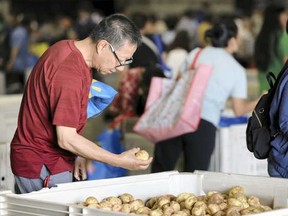
For an event named Ugly Potato Day, it offered an attractive opportunity for crowds looking for free food. On a recent sunny Saturday in Surrey, B.C., more than half a million pounds of imperfect produce filled the Cloverdale Agriplex, the yield a combined donation from 25 farms — 70 per cent of them local.

THIS CONTENT IS RESERVED FOR SUBSCRIBERS
Enjoy the latest local, national and international news.
- Exclusive articles by Conrad Black, Barbara Kay and others. Plus, special edition NP Platformed and First Reading newsletters and virtual events.
- Unlimited online access to National Post.
- National Post ePaper, an electronic replica of the print edition to view on any device, share and comment on.
- Daily puzzles including the New York Times Crossword.
- Support local journalism.
SUBSCRIBE FOR MORE ARTICLES
Enjoy the latest local, national and international news.
- Exclusive articles by Conrad Black, Barbara Kay and others. Plus, special edition NP Platformed and First Reading newsletters and virtual events.
- Unlimited online access to National Post.
- National Post ePaper, an electronic replica of the print edition to view on any device, share and comment on.
- Daily puzzles including the New York Times Crossword.
- Support local journalism.
REGISTER / SIGN IN TO UNLOCK MORE ARTICLES
Create an account or sign in to continue with your reading experience.
- Access articles from across Canada with one account.
- Share your thoughts and join the conversation in the comments.
- Enjoy additional articles per month.
- Get email updates from your favourite authors.
THIS ARTICLE IS FREE TO READ REGISTER TO UNLOCK.
Create an account or sign in to continue with your reading experience.
- Access articles from across Canada with one account
- Share your thoughts and join the conversation in the comments
- Enjoy additional articles per month
- Get email updates from your favourite authors
Sign In or Create an Account
or
Article content
As the day unfolded, roughly 30,000 people streamed in to stuff as many fruits and vegetables as they could into a maximum of two bags each. Motivational speaker Tony Robbins was on hand for the giveaway, as well as reps from Canadian produce company Odd Bunch and U.S.-based food rescue non-profit Sharing Excess.
Article content
Article content
Article content
“It was beautiful chaos,” says Evan Ehlers, founder and CEO of Sharing Excess. “We had carrots, potatoes, we had corn, we had lettuce, we had watermelon, cantaloupes, cherry tomatoes, and bins and bins of it.”
Article content
He adds that although the logistics of the day were complicated — from confirming donors to transporting the food, to ensuring a safe environment and more — watching people secure one of life’s basic necessities at no cost made it worth it.
Article content
“Everybody’s walking out like they just did a huge shop at a grocery store, and they’re kind of waddling on their way out with the food,” he recalls. “And that’s what we love to see because it’s a literal representation of how much abundance there is in our food industry, both in Canada and the U.S.”
Article content
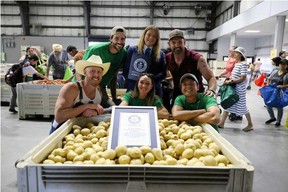
By the end of the day, Aug. 8, organizers had broken the Guinness World Record for the largest donation of fruits and vegetables in 24 hours. They gave away 246,528.61 kilograms (543,501 pounds) of produce, confirmed by an adjudicator from Guinness World Records.
Article content
“We were not sure that we had broken the record until the moment they announced it on stage,” says Ehlers. “Guinness World Records is so stringent on every single entry. So although we knew that we provided enough food to be able to break the record, it really comes down to what the officiator is able to qualify.”
Article content
Article content
The previous record was 224,064.2 kg (493,977 lbs) of produce, which the Sacramento Convention & Visitors Bureau in Sacramento, Calif., set on Sept. 7, 2016.
Article content
Article content
Aside from snagging superlatives from Guinness World Records, these types of events spotlight the intersection between food waste and food insecurity.
Article content
More than 46 per cent of all food in Canada is wasted every year, according to a 2024 report from food rescue organization Second Harvest. And when dumped into landfills, food and other organic waste create the greenhouse gas methane.
Article content
Methane comprised roughly 16 per cent of Canada’s total greenhouse gas emissions in 2023, according to Environment and Climate Change Canada, and it continues to contribute to rising global temperatures.
Article content
Meanwhile, 25.5 per cent of people in our 10 provinces lived in a food-insecure household in 2024, according to Statistics Canada. That’s about 10 million people, including 2.5 million children.
Article content
When you juxtapose those kinds of numbers, rerouting imperfect yet edible fruits and veggies from landfills to people who need them just makes sense. It’s a connection that farmer Tyler Heppell has championed for years.



























 Bengali (BD) ·
  English (US) ·