.png)
 2 hours ago
7
2 hours ago
7
Article content
Rufolo explained that the museum’s whale represents a time in Ottawa history when the land we now inhabit as Canada’s capital was indeed far beneath the Champlain Sea, an erstwhile inlet of the North Atlantic Ocean mixed with meltwater from receding glaciers at the end of the last ice age about 10,000 years ago.
Article content
The beluga, at some unknown point before then, had died and drifted down to what was likely a shallow stretch of seabed, its flesh a source of nourishment for fish and other marine creatures, before being enveloped by ever-accumulating layers of sand.
Article content
The animal’s bones today are brownish gray, about the colour of weathered wood. About five metres in length from beak to fluke, the remarkably intact skull is the fossil’s most impressive feature; four rows of peg-like teeth and an opening for its blowhole atop the braincase are telltale signs of a capital city cetacean — found nearly eight decades ago in a place where no ocean has existed for 100 centuries.
Article content
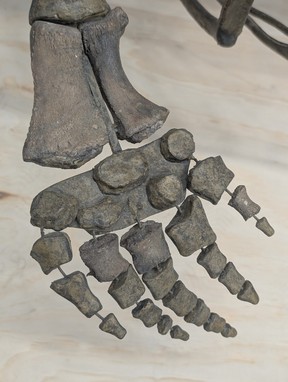
The skeletal flippers, each with five phalanges that are recognizably like human fingers, speak best to our common mammalian ancestry somewhere in the primeval depths of time. Narwhals are belugas’ closest relatives today, but we are distant cousins.
Article content
Article content
The specimen displayed here would have weighed 1,000 kilograms, more or less. Its closest modern descendants — genetically the same species as the sand pit beluga, Rufolo pointed out — inhabit the St. Lawrence Estuary, a population of perhaps 1,800 animals that munch cod, capelin, shrimp and other prey while moving seasonally no farther east than the Gulf of the St. Lawrence. This isolated group of belugas, the southernmost members of their species in the world, was declared endangered in 2014 — at high risk from pollution, noise, ship traffic and other human harms in an Anthropocene proving hazardous to most wildlife around the world.
Article content
Rufolo noted that the bones of the ancestor beluga found at Foster’s pit were mounted as part of a virtually complete composite skeleton using three separate white whale fossils from Eastern Ontario. The skull and other parts of the display specimen come from the dramatic find at Uplands in June 1948, along with the lower jaw of a second, smaller member of the species also discovered that spring at the sand pit.
Article content
Additional parts of the composite are from a third Champlain Sea beluga excavated from a bed of clay near Cornwall in 1870. That fossil was collected and documented at the time by Canada’s first official paleontologist, Elkanah Billings, in a pioneering Canadian scientific journal that began its life — would you believe it? — in the pages of the Ottawa Citizen in the 1850s.
Article content
Article content
“The length of the animal was probably about 15 feet,” Billings — a one-time editor at the Citizen — wrote in The Canadian Naturalist after securing the fossil for what eventually became a national treasure of paleontology held by the Canadian Museum of Nature. “The lower jaws are nearly perfect. The skull and upper jaws are much damaged and some of the parts lost. Thirty-five of the vertebrae, the two shoulder blades, most of the ribs, and a number of small bones were collected.”
Article content
Many of those bones were eventually added to what Sternberg, in a 1951 scientific paper, called the “splendidly preserved skull” and sundry remains of the two Uplands belugas. Generations of Ottawa museum-goers have learned about the city’s pre-human past by examining this exquisite, triply-sourced Champlain Sea whale skeleton.
Article content
Article content
***
Article content
Why think about the beluga now, as Ottawa commemorates the 200th anniversary of its birth as Bytown in 1826?
Article content
In part, to underscore the point that the history of Canada’s capital didn’t begin that year — not by a long shot. The bicentennial of Bytown’s beginnings, which coincide with the start of construction on the Rideau Canal, came at least 8,000 years after First Nations people began living — hunting, fishing, trading, toolmaking, storytelling — along the shores of the Ottawa, Rideau and Gatineau rivers. These were the major streams left behind when the land, once weighted down by mile-high glaciers, gradually rebounded and the Champlain Sea drained away.


























 Bengali (BD) ·
  English (US) ·