.png)
 22 hours ago
5
22 hours ago
5
Olivia Wilde beelines for the sprinklers, a respite from the sun on a sweltering May day in Central Park. We’ve logged some 10,000 steps since meeting at the Alice in Wonderland statue, where the actor-director snapped a picture for her son, who just played the Mad Hatter in a school production. Walking briskly around the reservoir, past elderly bird watchers, teens taking graduation photos, and a runner in a bikini, we receive subtle glances: Even in a T-shirt and jeans, Wilde is striking in the way only a movie star can be, with wide eyes and sharp cheekbones. But I suspect people are not just ogling but trying to eavesdrop, because we’re chatting conspicuously about couples counseling, open marriages, and how having children kills your libido.
Wilde thrills at the prospect of movement, setting a pace to match her buoyant mood. “I don’t belong at a desk. I don’t. I can’t. I hate it. After Don’t Worry Darling, I went right into the development of giant studio movies, a process that takes years and a lot of Zooming,” she says. She is still working on a studio comedy that is inching toward production. “After a while you think, ‘I didn’t get into this to have a desk job. I need to just go make something to remember what we actually f-cking do.’”
What she made was The Invite, an independently financed marital comedy that jump-started a bidding war at the Sundance Film Festival in January. A24, which emerged triumphant, is releasing the film on limited screens on June 26 before opening nationwide July 10. In the movie, Wilde and Seth Rogen play a couple on the rocks, Penélope Cruz and Edward Norton their intriguing upstairs neighbors who venture down for a last-minute dinner party. Wilde and Rogen’s characters have conflicting motivations for the evening: She hopes to befriend them, and he wants to complain about their noisy sex. The neighbors have their own agenda. The chamber piece plays like a comic Who’s Afraid of Virginia Woolf?, if the couple at the center were not master manipulators but depleted parents fumbling to explain why they have grown so far apart.
The filmmaking process was quick, unusual, and exactly the type of production Wilde had always dreamed of. After reading a script by longtime writing partners Rashida Jones and Will McCormack, she pitched the writers and cast on workshopping it together. Sitting around a table in the soundstage where the pilot for I Love Lucy was filmed, the six of them tailored the roles to the actors and infused the script with arguments, embarrassments, and confessions from their own relationships. Wilde brought in renowned psychotherapist Esther Perel to work with Cruz, who plays a therapist, and to offer advice on the marital ups and downs of the story. Wilde then shot the film sequentially—rare for small films and logistically impossible for larger ones—in just 21 days on a set designed to mimic a labyrinthian San Francisco apartment.
In the sprinklers, Wilde looks like a woman freed—from the demands of the studio system; from the baggage of her previous film, Don’t Worry Darling, and all the gossip it spawned; from the noise that surrounded her breakup with Jason Sudeikis and subsequent relationship with Harry Styles. “My character had this experience of heartbreak that was not foreign to me,” she says of The Invite. “The movie was in many ways plucking from experiences that I’ve had, and it was a relief to rip my heart out of my chest and plonk it on the table.”
She had not, she says, known her heart needed plonking. “Because of the safety of this ensemble, I felt capable of that. I remember being in the middle of a scene and realizing that I was releasing something that had been embedded inside me that I hadn’t even acknowledged was still there,” she says. “I thought, I’ve been extremely therapized; I’ve processed; I’ve worked through everything. But that is the power of catharsis through art.”
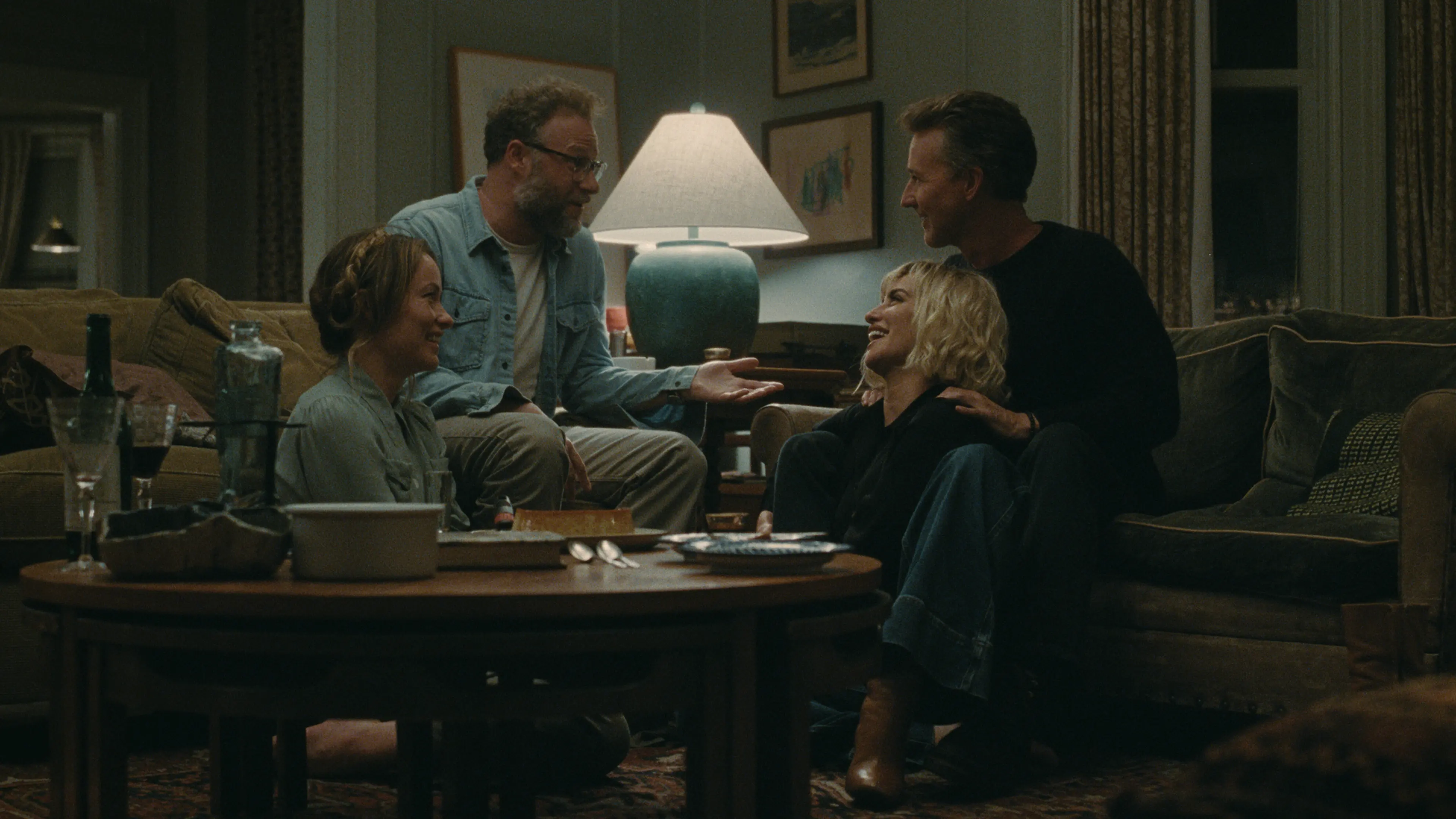
Wilde, Rogen, Cruz, and Norton as four members of two very different couples Courtesy of A24
Though she always intended to direct the film, Wilde had to be talked into starring in it too. She only agreed after the rest of the cast insisted she take the role of anxious Angela. “I had imposter syndrome,” she says. “The prospect of acting opposite Edward Norton was not something I felt was in the cards for me. Until The Invite, I had more confidence as a director than as an actor. But through this process, I’ve kind of fallen in love with acting again.”
Born in New York City and raised, mostly in D.C., by journalist parents, Wilde broke out in Hollywood as an icon of millennial television with roles on The O.C. and House. She tended to play elusive women who communicated with withering looks rather than words, a stark contrast to the bubbly and talkative artist who pauses on our walk to compliment several muddy-pawed dogs. In hopes of finding more control on set, she made her foray into directing feature films with the 2019 high school graduation comedy Booksmart. A sort of spiritual sister to the 2000s comedies Rogen made with Evan Goldberg, like Superbad, the raunchy and heartfelt film positioned her alongside peers like Greta Gerwig, Jordan Peele, and John Krasinski as a successful actor-to-filmmaker crossover story.
Her follow-up, Don’t Worry Darling, a thriller in the vein of The Stepford Wives, caused a media craze, to put it mildly. It began when Wilde was linked romantically with Styles, one of the movie’s stars; accelerated when she was served custody papers in her legal dispute with Sudeikis while onstage at CinemaCon; took another turn when she and Shia LaBeouf presented different narratives about his departure from the project; reached an apex when leading lady Florence Pugh skipped press opportunities; and came to a bizarre conclusion with internet sleuths analyzing a video of Styles allegedly spitting on costar Chris Pine at the Venice Film Festival. (Both actors deny this ever happened.) The movie itself was full of ideas, about the manosphere and (a few years ahead of its time) tradwives, that didn’t quite align with some of its promotion as an alluring romance between Pugh and Styles’ characters.
When I suggest that the drama surrounding the movie might have been a blow, career-wise, she says the personal upheavals were what most affected her—the aspects of her life that could never fully be captured in the media. “Relationships are heartbreaking in ways that people never see. There’s the synthesized tabloid version of life,” she says. “When you feel you’ve been reduced and overly synthesized for maximum sales value, it’s like judging a watermelon on watermelon candy. You haven’t really experienced watermelon. But people are sure they know, and that is a whole other type of heartbreak.”
Still, the word “comeback” popped up repeatedly in reviews of The Invite from Sundance (where Wilde also appeared in Gregg Araki’s comedy I Want Your Sex, out this summer, in a role opposite in every way to Angela: a callous, domineering, leather-clad sex fiend). After The Invite’s premiere, the director pulled two all-nighters listening to presentations from different studios vying to distribute the film. “It’s like speed dating,” she says, adding that the producers let her choose the distributor. She insisted on a theatrical release, a rarity for a comedy these days, and now feels vindicated as she watches with audiences who laugh and cringe in recognition together.
Wilde recognizes that people will inevitably draw parallels between her public breakups and the decisions made by characters in the movie. “If people sense it looks like maybe she has been through the dissolution of a relationship and heartbreak, yeah, I have, and I think that’s what gives me the muscle memory to represent this character fairly,” she says. “I don’t think I would have been able to play Angela if I hadn’t really f-cking felt myself tossed around by life and relationships. And I’m very open to the risk of confession. This sounds so pretentious, but they say great art is confession and should feel risky—that if it doesn’t feel risky then you’re not doing something worthwhile.”
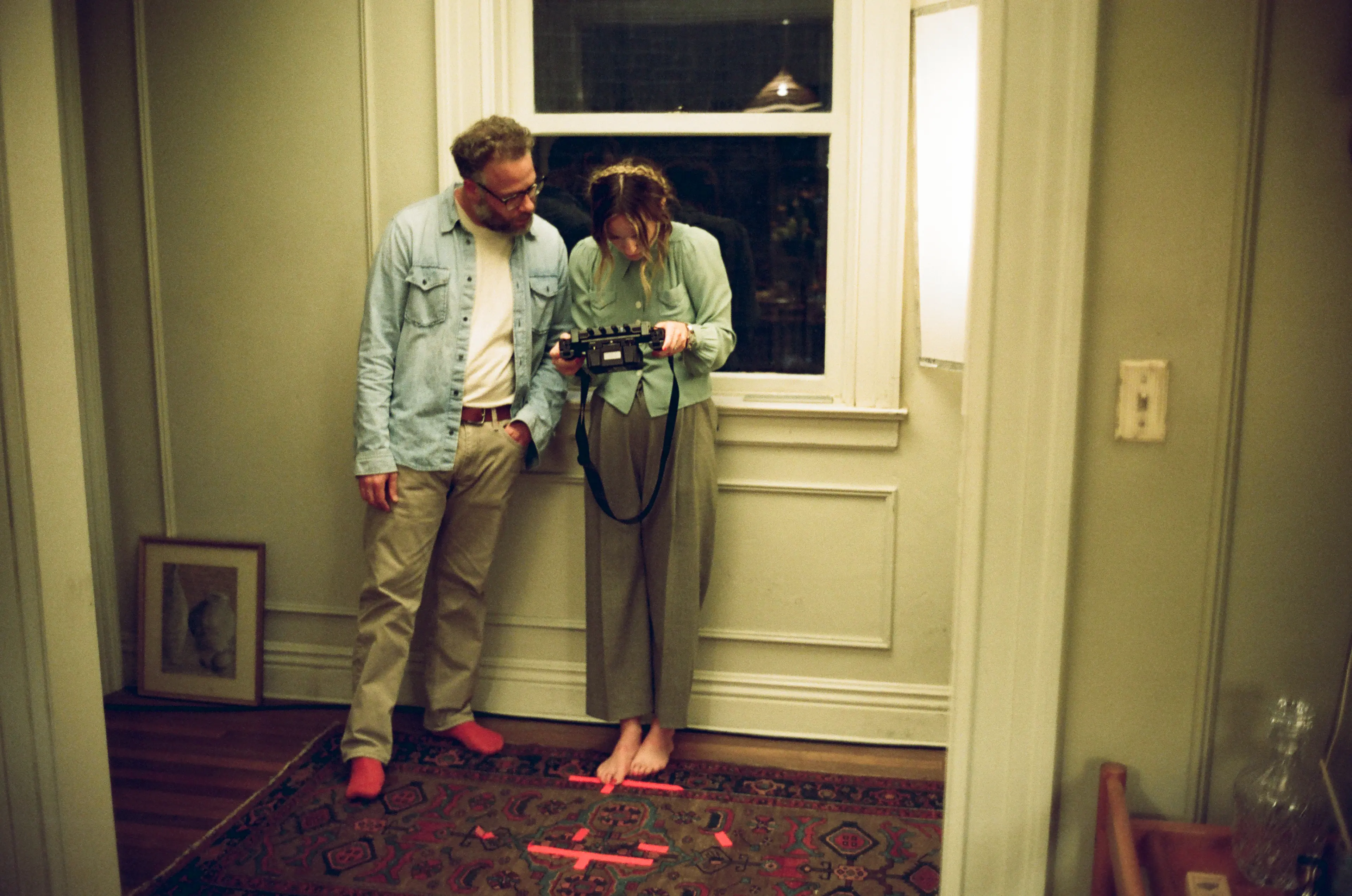
Rogen and Wilde behind the scenes of the film Courtesy of A24
Two nights before our walk, Wilde hosted a talk with Perel at the Streicker Center on the Upper East Side that was, judging from the audience members who introduced themselves at the microphone, almost entirely populated by therapists. The event was designed to cross-promote the 20th anniversary of Perel’s bestseller Mating in Captivity and Wilde’s new film, which both ask the same question: Why does sexual desire often fade in loving, committed partnerships? As Perel opined on the definition of cheating and why couples shouldn’t stay together “for the kids,” Wilde felt compelled to jump in and assure the audience, “The film is a comedy.”
And it is. There are jokes about modern marriage and our deeply psychoanalyzed society. But the trick of the movie is how it vacillates between laugh-out-loud physical comedy and somber conversations. Rogen’s character Joe is a bitter former musician who teaches at a middling conservatory. Wilde’s Angela attended art school before becoming a stay-at-home mother. Now she feels lost and a little resentful toward Joe, who is all too quick to point out that she made the choice to stop working. “What do you do all day?” he asks after we have just watched a montage of Angela manically assembling a soufflé, laying out a charcuterie board, and redecorating their home for their guests. Equally cruel is the way Angela waves off Joe’s chronic back pain, a complaint he has lodged for so long it has lost its meaning.
The actors clearly relish the conflict. Wilde widens her eyes as she aggressively presents Joe the soufflé through the oven glass. Rogen splays himself, theatrically broken, on the floor. But the battles eventually move the audience from laughter to tears. “Isn’t that how it happens?” asks Wilde as we climb up a twisting dirt path in the Ramble. “A very smart friend of mine said, we’re never as vulnerable as when we’re laughing.” (That friend was Phoebe Waller-Bridge.)
Wilde cites as inspiration not only Perel’s book but her famous TED Talk on infidelity that ends with the widely cited idea that many people today have several key romantic relationships in their lives, sometimes with the same person: “Your first marriage is over. Would you like to create a second one together?” It’s a notion that inspired debate during the making of The Invite. The cast sparred over why this miserable couple had stayed together and whether they would survive. Most at odds were Rogen and Wilde themselves. “When we shot it, Seth and I had two very different opinions about what would happen to this couple,” she says. “There was a real romantic optimism that Seth brought to it. The assumptions that everyone could make about their characters was revealing about their perspective on love.”
If Rogen was the optimist, did that make Wilde the pessimist? “I would say, ‘cynic,’” she corrects. “The more time you spend being alive, I think the more cynical you get.” It’s why she chose to open the movie with an Oscar Wilde quote: “One should always be in love. That is the reason one should never marry.” (Olivia Wilde, it should be noted, was born Olivia Cockburn and changed her name to Wilde in honor of the Irish playwright.) “I wanted to contextualize for the audience the film through my perspective on it,” she says.
Their differences again came into relief when Rogen—who is proudly child-free—refused to believe that many couples with children, like Angela and Joe, stop having sex. Wilde was stunned. “It was an opportunity to see how the human struggles in long-term relationships in some ways are consistent, and then in other ways are completely specific to the couple themselves—and in Seth’s case, a totally singular experience,” says Wilde, laughing. “Seth is a true romantic, and apparently is just nailing marriage in every single way, which is a testament to his incredible wife, Lauren.”
Unhappy couples are common. But, to paraphrase Tolstoy, each unhappy couple is unhappy in its own way. And Wilde’s couple is miserable in a way only Americans can be. The Invite is based on a Spanish play-turned-film, The People Upstairs, and has already been remade in South Korea, Italy, Switzerland, and France in the six years since its release. Wilde’s version plays up the sanctimonious nature of American parenthood, how we feel compelled to sacrifice our own happiness for the aspiration of happy children.
“Americans have a puritanical sensibility that distrusts pleasure, specifically women’s pleasure, [and] this idea of sexuality persisting beyond parenthood,” she says. As with the child in Who’s Afraid of Virginia Woolf?, Joe and Angela’s daughter is mentioned but never seen—though for less mysterious reasons than in the Edward Albee play. “Parents don’t actually consider themselves as individuals unless they are away from their kids,” says Wilde. It is only because their daughter is at a sleepover that the reckoning can take place.
Wilde calls the ambiguous finale a Rorschach test—she’s polled the audience after every early screening: Half have believed the couple has hope, the other half that they’re doomed. “The goal was to have ambiguity without being annoyingly vague. We’re all just reaching for the Graduate ending.” As for Wilde, even she has come to a different conclusion after watching the film with audiences. “I love that it can change based on your mood,” she says. And her mood today is very good.























/https%3A%2F%2Fsportsmole-media-prod.s3.gra.io.cloud.ovh.net%2Fuploads%2F2026%2F05%2Fscheffler-6a034d9fca412032057779.jpg)
/https%3A%2F%2Fsportsmole-media-prod.s3.gra.io.cloud.ovh.net%2Fuploads%2F2026%2F06%2Ficonsport-111147-0089-1-6a27d006a81d1227497324.jpg)
/https%3A%2F%2Fsportsmole-media-prod.s3.gra.io.cloud.ovh.net%2Fuploads%2F2026%2F06%2Fimago-xinhua-nestory-irankunda-celebrates-scoring-for-australia-in-the-world-cup-on-june-14-2026-6a2f348854d1b663111439.jpg)
 Bengali (BD) ·
  English (US) ·