.png)
 6 hours ago
11
6 hours ago
11

Article content
In 2009, there were only 144 reported human cases of Lyme disease in Canada. According to the most recent Public Health Agency of Canada (PHAC) data, there were 5,809 reported cases in 2024, and the preliminary number of cases for 2025 is 7,105. There’s no denying Lyme disease is on the rise.

THIS CONTENT IS RESERVED FOR SUBSCRIBERS
Enjoy the latest local, national and international news.
- Exclusive articles by Conrad Black, Barbara Kay and others. Plus, special edition NP Platformed and First Reading newsletters and virtual events.
- Unlimited online access to National Post.
- National Post ePaper, an electronic replica of the print edition to view on any device, share and comment on.
- Daily puzzles including the New York Times Crossword.
- Support local journalism.
SUBSCRIBE FOR MORE ARTICLES
Enjoy the latest local, national and international news.
- Exclusive articles by Conrad Black, Barbara Kay and others. Plus, special edition NP Platformed and First Reading newsletters and virtual events.
- Unlimited online access to National Post.
- National Post ePaper, an electronic replica of the print edition to view on any device, share and comment on.
- Daily puzzles including the New York Times Crossword.
- Support local journalism.
REGISTER / SIGN IN TO UNLOCK MORE ARTICLES
Create an account or sign in to continue with your reading experience.
- Access articles from across Canada with one account.
- Share your thoughts and join the conversation in the comments.
- Enjoy additional articles per month.
- Get email updates from your favourite authors.
THIS ARTICLE IS FREE TO READ REGISTER TO UNLOCK.
Create an account or sign in to continue with your reading experience.
- Access articles from across Canada with one account
- Share your thoughts and join the conversation in the comments
- Enjoy additional articles per month
- Get email updates from your favourite authors
Sign In or Create an Account
or
Article content
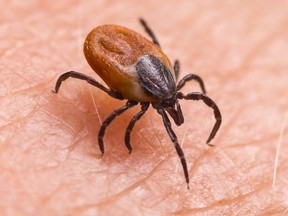
Caused by the bacterium Borrelia burgdorferi and spread through the bite of infected blacklegged ticks, the disease can cause fatigue, rash, fever, chills and muscle aches, among other symptoms. If left untreated, the infection can spread to joints, the heart and the nervous system.
Article content
Article content
Article content
Previously, a vaccine called LYMErix was administered to prevent Lyme disease. It was approved by the FDA in 1998, but withdrawn from the market just three years later, following reports of adverse reactions causing a lack of demand. Now, Lyme disease is treated with a course of antibiotics.
Article content
By signing up you consent to receive the above newsletter from Postmedia Network Inc.
Article content
But Lyme disease vaccines for dogs have been available for years, so why isn’t there one for humans?
Article content
Is there a Lyme disease vaccine for humans?
Article content
No, there currently is no Lyme disease vaccine for humans. LYMErix was shelved in 2002, and there have been no new Lyme disease vaccines approved since.
Article content
However, the pharmaceutical company Pfizer and French biotech firm Valneva are currently working together to develop a new vaccine, PF-07307405. As of March 2026, it has completed Phase 3 clinical trials.
Article content
And Moderna is working on two more potential Lyme disease vaccines, called mRNA-1975 and mRNA-1982. These vaccines are not as far along in development as PF-07307405, and are both currently in Phase 2 clinical trials.
Article content

Article content
What do we know about the Pfizer and Valneva vaccine?
Article content
In March 2026, Pfizer and Valneva announced results from Phase 3 clinical trials of the Lyme disease vaccine they are co-developing.
Article content
Article content
It demonstrated more than 70 per cent efficacy in preventing Lyme disease in individuals aged five years and above after four doses, with Pfizer now planning submissions to regulatory authorities.
Article content
Article content
Annaliesa Anderson, senior vice president and chief vaccines officer at Pfizer, said in a news release that the result is “highly encouraging” and “creates confidence in the vaccine’s potential to protect against this disease that can be debilitating.”
Article content
PF-07307405 works by causing a vaccinated person to create antibodies that are ingested by ticks when they bite them. These antibodies then inhibit the bacterium’s ability to leave the tick, preventing it from being transmitted to the human host.
Article content
Article content
Dr. Isaac Bogoch, a professor at the University of Toronto in the Department of Medicine and an infectious diseases specialist, tells National Post that while a Lyme disease vaccine is “definitely needed,” the positive results from the Pfizer-Valneva aren’t a sure indicator of success just yet.
Article content
“It’s already three doses and a booster, so let’s just call it four doses,” he says. “The more doses, the more challenges you’re going to have with uptake and adherence. And if there are annual doses, and if it’s expensive and inconvenient, I think that’s going to limit the uptake.”






























 Bengali (BD) ·
  English (US) ·