.png)
 4 hours ago
14
4 hours ago
14
Article content
What was your research leading up to the role?
Article content
I’ve had a lifelong fascination with Fiddler.
Article content
I grew up in Texas and there was a community theatre there. And so right when the movie came out, they did a production and I played a chuppah (wedding canopy) boy, when I was 10 years old in 1972. I played Tevye when I was 17 at summer camp; played him again at college when I was 21.
Article content
The role has been in my bones my whole life. So coming to the Yiddish, there were choices as an actor that I couldn’t even tell you why I made them, they were just organic.
Article content
How is the Yiddish version different?
Article content
Shraga Friedman, who was an Israeli actor and director who got permission in ’65 to do the Yiddish version by the creatives, took some liberties with the text. In a really beautiful way, made Tevye a little more knowledgeable about Talmud learning. In the Broadway show, he just refers to the “good book” — which even sounds a little Presbyterian to me.
Article content
But in the Yiddish, he’s talking about (11th century commentator) Rashi. He’s talking about Targum Onklos (2nd century Aramaic translation of the Torah). See, that’s exactly what Tevye would do.
Article content
Article content
He may not be absolutely accurate, but he has the knowledge.
Article content
So that to me was very meaningful. Another example of subtle distinctions, is in the song Sabbath Prayer: “May you be like Ruth and like Esther.”
Article content
In the Yiddish, it invokes Sara, Rebecca, Rachel and Leah. So that to me, I was able to go down a path that no other English Tevye would ever have gone down.
Article content
I kind of feel like, if it’s in Yiddish, you get that shtetl feel.
Article content
Knowing that these characters would be speaking this language feels so authentic.
Article content
What was life like as a Jew in Lubbock, Texas?
Article content
It had 100 Jewish families. Small, but we knew everybody.
Article content
And having our grandparents there, and elder members of our family, certainly instilled a complete Jewish identity that over time we found more inroads into what the religion and the learning is all about.
Article content
I have said this before and it is the truth: growing up in Lubbock, Texas, in the ’70s, I never in my life personally experienced antisemitism.
Article content
I would take matzah for show and tell to elementary school. It’s only in my adulthood that antisemitism has made such a resurgence, and in a way that I never experienced growing up in a West Texas town.
Article content
Article content
Are you surprised that Fiddler is being presented in a city amidst a spike of antisemitism?
Article content
I definitely say: go loud and proud. But, one wants to be mindful of possible security measures. Our Yiddish Fiddler in New York, when we moved uptown to 42nd Street, we had no protests, no sort of anti-Jewish protests. The musical parade, which opened after we were already on playing, had a lot of anti-Jewish protests. But the Harold Green Theatre is taking care to make sure that we’re going to feel protected and safe.
Article content
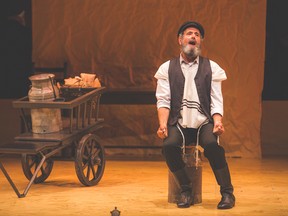
Article content
Why do you think Fiddler is so enduring?
Article content
It’s great entertainment.
Article content
It’s a perfect musical. It’s not just fluff, and it’s very funny, very light, but also very meaningful.
Article content
I performed it at the Lyric Opera of Chicago, a huge operatic version that came over from Germany in English. The tagline for that production was, “Love is the greatest tradition of all.” The play really is about love.
Article content
It’s about family love, love between suitors, and would-be brides.
Article content
I think everybody responds to that.
Article content
I think that’s what makes it so enduring, is that family is universal. Unfortunately, trouble is also universal in the world. The final scene of the musical, when the Jews of Anatevka are forced to leave their homes is absolutely specific to what was happening to Jews in 1905, Russia and Ukraine.
Article content
But we still see it today throughout the world: displaced, disenfranchised people, immigrants who are being denied access, or have challenges. I think it hits a lot of buttons.
Article content
This interview was edited for brevity.
Article content
Our website is the place for the latest breaking news, exclusive scoops, longreads and provocative commentary. Please bookmark nationalpost.com and sign up for our newsletters here.
Article content





















/https%3A%2F%2Fsportsmole-media-prod.s3.gra.io.cloud.ovh.net%2Fuploads%2F2025%2F08%2Fimago1064957868-1-68b054b89f2ee835169758.jpg)

 Bengali (BD) ·
  English (US) ·