.png)
 1 week ago
47
1 week ago
47
Article content
The gastrointestinal disease that has reportedly sickened thousands in more than half of U.S. states could possibly be in Canada, but there hasn’t been an outbreak because we’re not detecting it, says a Canadian food safety expert. Though Canadian public health officials haven’t noted an increase in cases of cyclosporiasis, “it could be an ‘if you don’t look, you don’t find’ sort of thing,” says Keith Warriner, a professor at the University of Guelph’s department of food science.

THIS CONTENT IS RESERVED FOR SUBSCRIBERS
Enjoy the latest local, national and international news.
- Exclusive articles by Conrad Black, Barbara Kay and others. Plus, special edition NP Platformed and First Reading newsletters and virtual events.
- Unlimited online access to National Post.
- National Post ePaper, an electronic replica of the print edition to view on any device, share and comment on.
- Daily puzzles including the New York Times Crossword.
- Support local journalism.
SUBSCRIBE FOR MORE ARTICLES
Enjoy the latest local, national and international news.
- Exclusive articles by Conrad Black, Barbara Kay and others. Plus, special edition NP Platformed and First Reading newsletters and virtual events.
- Unlimited online access to National Post.
- National Post ePaper, an electronic replica of the print edition to view on any device, share and comment on.
- Daily puzzles including the New York Times Crossword.
- Support local journalism.
REGISTER / SIGN IN TO UNLOCK MORE ARTICLES
Create an account or sign in to continue with your reading experience.
- Access articles from across Canada with one account.
- Share your thoughts and join the conversation in the comments.
- Enjoy additional articles per month.
- Get email updates from your favourite authors.
THIS ARTICLE IS FREE TO READ REGISTER TO UNLOCK.
Create an account or sign in to continue with your reading experience.
- Access articles from across Canada with one account
- Share your thoughts and join the conversation in the comments
- Enjoy additional articles per month
- Get email updates from your favourite authors
Sign In or Create an Account
or
Article content
Article content
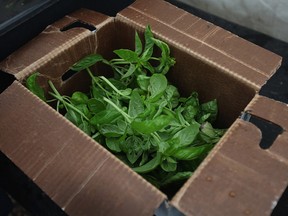
“To say that we’re protected in Canada, I’m not sure that’s quite true for the simple reason that when you get non-travel-related cyclospora, that must mean it’s a food vehicle,” says Warriner. “We could say, ‘Well, it must be strawberries. It must be raspberries. It must be herbs, like basil and cilantro,’ but no one’s actually able to identify that yet (in the U.S.). And for all we know, we could have multiple outbreaks going on at the same time.”
Article content
Article content
Article content
By signing up you consent to receive the above newsletter from Postmedia Network Inc.
Article content
Imported berries, herbs and pre-packaged salad mix have been linked to outbreaks of cyclosporiasis, but any produce in contact with people or sewage could be a vehicle. “Even oysters,” says Warriner.
Article content
Washing with water, while a sound food safety practice and effective at removing debris, insects and pesticides, “doesn’t really cut it” with pathogens such as Cyclospora, E. coli and Salmonella, says Warriner. He notes that it takes 100 to 500 cyclospora oocysts to cause illness. “To give you perspective, you can get 50,000 oocysts on a needle pinhead. (Washing) is not going to do that much.”
Article content
There’s a theory that the Cyclospora oocysts — the infectious stage of the microscopic parasite — “are extra sticky,” so they adhere to fresh produce and are carried along. “The thing about the oocysts is that they’re super tolerant,” says Warriner. They can withstand bleach, various sanitizers and even wastewater treatment.
Article content
Article content
Cooking and freezing (at -20 degrees Celsius for roughly seven days), however, can neutralize them, which doesn’t suit all purposes. Seeking “a firewall” between the source and the consumer, Warriner developed a hydroxyl radical technology that uses hydrogen peroxide, UV light and ozone to inactivate parasites on soft fruit and vegetables.
Article content
Article content
A cyclosporiasis outbreak has now reportedly sickened more than 3,000 people in 31 U.S. states, causing “watery diarrhea,” nausea and fatigue. The Centers for Disease Control and Prevention said it had received reports of 843 confirmed cases of the food- and waterborne intestinal illness, and was aware of more than 1,500 requiring further analysis. The source is still under investigation, and no deaths have been reported.
Article content
The Public Health Agency of Canada (PHAC) said in an email to National Post last week that it “is not currently investigating any Cyclospora outbreaks.” Cyclosporiasis, a gastrointestinal disease caused by the parasite Cyclospora, is most common in tropical and subtropical regions.
Article content
Though the parasite isn’t commonly found on food or in water in Canada, PHAC noted that domestic cases increase in spring and summer as people eat more imported fruit and vegetables.




























/https%3A%2F%2Fsportsmole-media-prod.s3.gra.io.cloud.ovh.net%2Fuploads%2F2026%2F03%2Ficonsport-361551-0102-1-69b560866f7b6508942731.jpg)
 Bengali (BD) ·
  English (US) ·