.png)
 1 hour ago
6
1 hour ago
6
With rain pouring, winds picking up and fans in Toronto Stadium roaring, World Cup match was halted for a hydration break.
Published Jun 17, 2026 • Last updated 14 minutes ago • 3 minute read
See more Toronto Sun on Google — save as a Preferred Source
The rain was coming down, the wind was picking up and the fans of both sides were singing in full throat despite the conditions by Lake Ontario.
Article content
Article content
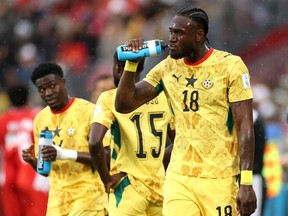
Both the Black Stars of Ghana and the Canal Men of Panama had exchanged chances for the first 22 minutes of their World Cup opener, so what happened next made perfect sense: There was a three-minute break in play.
With Ghana captain Jordan Ayew having been knocked to the pitch and the ball sent out of play, referee Glenn Nyberg blew his whistle and sent the players to the sidelines for the Powerade-sponsored, FIFA-mandated hydration break.

We apologize, but this video has failed to load.
The fans in attendance booed loudly at the announcement as the countdown began and the many watching at home were treated to some advertisements.
Advertisement 2

THIS CONTENT IS RESERVED FOR SUBSCRIBERS ONLY
Subscribe now to read the latest news in your city and across Canada.
- Unlimited online access to articles from across Canada with one account.
- Get exclusive access to the Toronto Sun ePaper, an electronic replica of the print edition that you can share, download and comment on.
- Enjoy insights and behind-the-scenes analysis from our award-winning journalists.
- Support local journalists and the next generation of journalists.
- Daily puzzles including the New York Times Crossword.
SUBSCRIBE TO UNLOCK MORE ARTICLES
Subscribe now to read the latest news in your city and across Canada.
- Unlimited online access to articles from across Canada with one account.
- Get exclusive access to the Toronto Sun ePaper, an electronic replica of the print edition that you can share, download and comment on.
- Enjoy insights and behind-the-scenes analysis from our award-winning journalists.
- Support local journalists and the next generation of journalists.
- Daily puzzles including the New York Times Crossword.
REGISTER / SIGN IN TO UNLOCK MORE ARTICLES
Create an account or sign in to continue with your reading experience.
- Access articles from across Canada with one account.
- Share your thoughts and join the conversation in the comments.
- Enjoy additional articles per month.
- Get email updates from your favourite authors.
THIS ARTICLE IS FREE TO READ REGISTER TO UNLOCK.
Create an account or sign in to continue with your reading experience.
- Access articles from across Canada with one account
- Share your thoughts and join the conversation in the comments
- Enjoy additional articles per month
- Get email updates from your favourite authors
Article content
And to help with the hydration process, the rain has started to fall at Toronto Stadium. Weather radar suggests a wet night ahead. https://t.co/WzMbkfnu0T
When play resumed, the crowd was noticeably less lively for the following few minutes and the momentum on the pitch had been dulled.
It took some pressure being applied by the Black Stars in Panama’s final third to finally bring the roars back to the shores of Lake Ontario.
But this hydration break — arguably the least-necessary one so far at the World Cup — was just the latest example of these newly mandated delays to cause issues around the tournament.
How have teams been taking advantage of the breaks?
Norway used the second-half break to make four substitutions and completely altered its strategy, moving to a system with three at the back. It paid off handsomely against Iraq, with the Nords scoring their third goal of the match not long after.
During a few games, referees were seen checking with off-field officials about when they could restart matches while players were already waiting to resume play on the field.
This was especially apparent during Germany vs. Curacao, which took place at Houston Stadium — a facility with a roof and air conditioning — where players were seen patiently awaiting the resumption of play.
By signing up you consent to receive the above newsletter from Postmedia Network Inc.
Article content
Advertisement 3
Article content
What have people been saying about hydration breaks?
American commentators have slipped on more than occasion as well, referring to matches being broken down into quarters instead of halves.
“I think for the neutral watchers on TV it’s also not great. If it’s really hot, obviously it would be good to put them in. But I think you have to look at it in every game, separately, in my opinion,” Netherlands captain Virgil van Dijk said after his team’s draw with Japan on Sunday.
“But I think I’ve said enough already for that.”
Players, managers, fans and pundits have spoken out about these controversial breaks in play, which FIFA claims to have instituted for every game at the tournament out of fairness — if one game requires these breaks, then all should have them, the organization said.
Why does the World Cup have hydration breaks?
Last December, FIFA announced that it again would use these breaks to help “prioritize player welfare,” during the tournament.
Advertisement 4
Article content
The organization said it would use a “streamlined and simplified version” of the breaks that had been incorporated during some previous tournaments, including the FIFA Club World Cup, which took place in the U.S. last summer.
Referee will stop games roughly 22 minutes into each half allowing players to rehydrate and will take place in every game, no matter the conditions.
Read More
-

Canada’s FIFA World Cup opener draws huge TV numbers. How high can they go?
-

Ghana vs. Panama: World Cup energy set to light up Toronto


“For every game, no matter where the games are played, no matter if there’s a roof, (or) temperature-wise, there will be a three-minute hydration break. It will be three minutes from whistle to whistle in both halves,” said Manolo Zubiria, Chief Tournament Officer, USA, for the FIFA World Cup 2026.
How much are TV network making from these added breaks?
A report from Front Office Sports exposed just how much these mandated breaks are benefitting one group of people in particular: TV execs.
The outlet reported on Wednesday that Fox and Fox Sports stand to earn an additional $250 million US from the added ad time during matches.
Fox already has been called out for abusing the breaks to pipe in full-screen ads to fans at home, but have not faced any formal discipline from FIFA at this time.
Article content

























/https%3A%2F%2Fsportsmole-media-prod.s3.gra.io.cloud.ovh.net%2Fuploads%2F2026%2F06%2Frio-ngumoha-email-sportmole-6a27b73e9a471352625861.png)
 Bengali (BD) ·
  English (US) ·