.png)
 6 hours ago
12
6 hours ago
12
Article content
When lots of rain hits the ground, she said it can exceed the volumes and flows the infrastructure is designed to handle, causing water to back up into the streets and residents’ basements.
Article content
Such was the case for Andre and Jolene Bard, who were emptying the contents of their basement into a large dumpster in their driveway after a basement flood July 1 devastated the Nepean home they’d bought less than a year ago.
Article content
“If they don’t fix the infrastructure, this will happen again,” Andre said. “This is not a resident’s problem to fix. It’s definitely a major infrastructure problem to ensure that everything drains.”
Article content
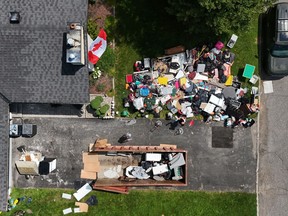
Article content
The challenges associated with living in older neighbourhoods isn’t new for residents who have called the area home for decades. Marina Petrovic, who still lives in her childhood home after buying it from her parents to raise her own family, said flood prevention was a big deal for her father when she was growing up.
Article content
“I used to laugh, because every time it rained, he’d go stand at the bottom of the driveway where we had a little sewer, and he’d have his little brush and he’d move the leaves,” she said.
Article content
Article content
Fraser Jones, who grew up in Bells Corners, recalls watching the city rapidly expand south of Nepean and into growing suburbs like Barrhaven, without any upgrades to help older neighbourhoods keep up.
Article content
“The infrastructure was sized for Nepean back then,” he said. “And now that we’ve added (homes) over the farm fields …. that could absorb a lot of the rainfall, and we’ve got a lot more roofs and more pavement; the water has to go somewhere.”
Article content
How and when could stormwater system upgrades take place?
Article content
While the storm is starting conversations about how infrastructure can be updated, experts and councillors say installing bigger pipes and building more resilient stormwater systems can’t be a short-term thing.
Article content
“People say, ‘Well then, let’s just put in bigger pipes,’” said Knoxdale-Merivale Coun. Sean Devine. “But the cost of upgrading … would probably be astronomical, and it would take decades to do, and there are so many little things that have to happen.”
Article content
Bay ward Coun. Theresa Kavanagh added that some neighbourhoods in her ward have already received stormwater system upgrades and were still the victims of basement floods, adding there were likely other factors at play.
Article content
Article content
“It might have something to do with the geography of this area combined with the state of the infrastructure. It’s very difficult to know,” said Kavanagh, whose freshly renovated basement also flooded with more than two feet of water during the storm.
Article content
Lindsay Buckingham, a resident of Queensway Terrace North, said her basement was still flooded as water reached waist-deep levels on the street on July 1, even though her area recently spent years under construction as stormwater infrastructure was replaced.
Article content
“We all laughed because we thought it would fix the problem, because we always get, on the average storm, (water) up to your knees in front of our house,” she said.
Article content
Rather than rushing into upgrades, councillors say they hope the city takes the opportunity to collect data from recent extreme weather events, identify vulnerable areas and develop robust action plans.
Article content
“I’ve been talking with my colleagues, and we need a postmortem,” Kavanagh said. “It can’t be done quickly. We need some time to address, because there (were) so many communities hit, and there are different factors that would have helped or improved each area because they’re geographically different.”


























 Bengali (BD) ·
  English (US) ·