.png)
 4 hours ago
9
4 hours ago
9
Article content
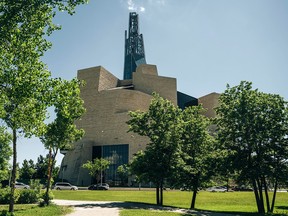
WINNIPEG — Rather than telling the story of the Arab refugee crisis as a tragic consequence of a complex war, the new “Palestine Uprooted: Nakba Past and Present” exhibit at the Canadian Museum for Human Rights presents it as an unprovoked expulsion, encouraging visitors to view Palestinian displacement as the product of Israeli intent alone.

THIS CONTENT IS RESERVED FOR SUBSCRIBERS
Enjoy the latest local, national and international news.
- Exclusive articles by Conrad Black, Barbara Kay and others. Plus, special edition NP Platformed and First Reading newsletters and virtual events.
- Unlimited online access to National Post.
- National Post ePaper, an electronic replica of the print edition to view on any device, share and comment on.
- Daily puzzles including the New York Times Crossword.
- Support local journalism.
SUBSCRIBE FOR MORE ARTICLES
Enjoy the latest local, national and international news.
- Exclusive articles by Conrad Black, Barbara Kay and others. Plus, special edition NP Platformed and First Reading newsletters and virtual events.
- Unlimited online access to National Post.
- National Post ePaper, an electronic replica of the print edition to view on any device, share and comment on.
- Daily puzzles including the New York Times Crossword.
- Support local journalism.
REGISTER / SIGN IN TO UNLOCK MORE ARTICLES
Create an account or sign in to continue with your reading experience.
- Access articles from across Canada with one account.
- Share your thoughts and join the conversation in the comments.
- Enjoy additional articles per month.
- Get email updates from your favourite authors.
THIS ARTICLE IS FREE TO READ REGISTER TO UNLOCK.
Create an account or sign in to continue with your reading experience.
- Access articles from across Canada with one account
- Share your thoughts and join the conversation in the comments
- Enjoy additional articles per month
- Get email updates from your favourite authors
Sign In or Create an Account
or
Article content
The term “Nakba,” meaning “catastrophe,” once referred to Israel’s victory over the five Arab nations that invaded it in 1948; now, at the Canadian Museum for Human Rights and beyond, it’s used to refer to the Arab Palestinian interpretation of 1948 war history, which focuses almost exclusively on what the Jews did to Arabs.
Article content
Article content
Article content
The museum’s omission-ridden narrative paints an incomplete picture, leading visitors to make faulty assumptions about both the 1948 and the current Israel-Hamas war — assumptions that have alarmingly led to a rise in support for targeted violence.
Article content
By signing up you consent to receive the above newsletter from Postmedia Network Inc.
Article content
The first assumption encouraged by the museum is that there was never an off-ramp in the lead-up to the 1948 conflict. One of the exhibit’s panels reads, “In 1948, militias followed by Israeli forces expelled civilians, destroying or emptying hundreds of villages amid regional war and lasting instability.” By emphasizing a linear progression from seemingly unprompted Zionist aggression to Palestinian displacement while overlooking rejected alternatives or internal Palestinian political divisions, the exhibit suggests that war was inevitable.
Article content
Yet Palestinian Arab society during the British Mandate was anything but politically uniform. It contained competing visions of leadership, strategy, and coexistence that were far more complex than the distortionary colonizer-versus-colonized framing of the Nakba exhibit.
Article content
Article content
Those visions unfolded against rapidly changing events on the ground. From the 1890s to the 1920s and 1930s, Jewish immigration and economic transformation brought change to Mandatory Palestine, a protectorate that the international community entrusted to Britain to establish a Jewish homeland after the fall of the previous Turkish imperial authority in the First World War. At the same time, waves of anti-Jewish violence devastated the territory.
Article content
This culminated in the Arab Revolt of 1936 to 1939, where thousands of Arabs refused to work, implemented a boycott of all Jewish products, and attacked Jewish communities and British soldiers. The British ultimately appeased the Arab street by severely limiting Jewish immigration during the Holocaust. Under the leadership of the supreme Arab religious and political leader in Jerusalem, Grand Mufti Amin al-Husseini, a movement against Jewish national aspirations dominated Palestinian Arab politics, marginalizing and assassinating rivals who favoured more pragmatic approaches to coexistence. Husseini literally became a Nazi collaborator and war criminal. His influence did not end with the Second World War. He eventually became a mentor to the young Yasser Arafat — another pivotal leader in the Palestinian National movement entirely absent from the exhibit — who later described Husseini as “our hero,” said he took “immense pride” in being his student, and declared that the Palestine Liberation Organization (now the government in the West Bank) was “continuing the path” Husseini had established.

























 Bengali (BD) ·
  English (US) ·