.png)
 56 minutes ago
7
56 minutes ago
7
Article content
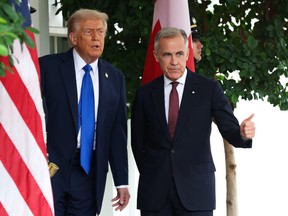
WASHINGTON, D.C. — Over the weekend, Prime Minister Mark Carney positioned Canadian oil and diesel exports as a reliable alternative to U.S. President Donald Trump’s new diesel arrangement with Russia, noting that Canada would “continue to maximise our exports” to the United States.

THIS CONTENT IS RESERVED FOR SUBSCRIBERS
Enjoy the latest local, national and international news.
- Exclusive articles by Conrad Black, Barbara Kay and others. Plus, special edition NP Platformed and First Reading newsletters and virtual events.
- Unlimited online access to National Post.
- National Post ePaper, an electronic replica of the print edition to view on any device, share and comment on.
- Daily puzzles including the New York Times Crossword.
- Support local journalism.
SUBSCRIBE FOR MORE ARTICLES
Enjoy the latest local, national and international news.
- Exclusive articles by Conrad Black, Barbara Kay and others. Plus, special edition NP Platformed and First Reading newsletters and virtual events.
- Unlimited online access to National Post.
- National Post ePaper, an electronic replica of the print edition to view on any device, share and comment on.
- Daily puzzles including the New York Times Crossword.
- Support local journalism.
REGISTER / SIGN IN TO UNLOCK MORE ARTICLES
Create an account or sign in to continue with your reading experience.
- Access articles from across Canada with one account.
- Share your thoughts and join the conversation in the comments.
- Enjoy additional articles per month.
- Get email updates from your favourite authors.
THIS ARTICLE IS FREE TO READ REGISTER TO UNLOCK.
Create an account or sign in to continue with your reading experience.
- Access articles from across Canada with one account
- Share your thoughts and join the conversation in the comments
- Enjoy additional articles per month
- Get email updates from your favourite authors
Sign In or Create an Account
or
Article content
In response, U.S. Ambassador Pete Hoekstra took to Instagram on Tuesday to reject the suggestion that Ottawa’s energy gives it leverage, noting that “we are not going to sit here and be dependent on Canada making a decision.”
Article content
Article content
Advertisement 1
Article content
This mischaracterized the situation — Ottawa is not withholding diesel exports from the U.S. — but it underscored that the White House is showing no urgency to return to the negotiating table. Since trade talks between Canada and the U.S. collapsed in August, there have been mentions of informal contact between negotiators and conversations between Carney and Trump, but no formal talks have been held — and Canada-U.S. Trade Minister Dominic LeBlanc has no plans to visit Washington.
Article content
By signing up you consent to receive the above newsletter from Postmedia Network Inc.
Article content
Since Canada has an economy one-twelfth the size of America’s, it has more to lose and less leverage, making this a risky waiting game. Some trade watchers say the two sides need to return talks, and some think the looming threat of higher tariffs on January 1, 2027 — and possibly a U.S.-Mexico preliminary deal — could push Ottawa back to the table.
Article content
So should Carney be doing everything in his power to get talks back on track as soon as possible?
Article content
“The longer it takes, the more harm we’re doing to ourselves,” said Goldy Hyder, president and CEO of the Business Council of Canada.
Article content
“What I hear from business leaders is, ‘sooner rather than later.’ There’s a belief that reality will impose itself and some kind of an agreement that works for all sides can be reached sooner rather than later.”
Article content
Advertisement 2
Article content
But when will there be enough pressure to push the two sides back to the trade talks?
Article content
“I don’t rule out the possibility of something happening between now and even the midterms,” said Hyder, acknowledging that the timing might be tight.
Article content
But some trade analysts say pressure may build to push the sides back into talks shortly after the U.S. elections.
Article content
Christopher Hernandez-Roy, acting director and senior fellow at the Americas Program of CSIS in Washington, thinks there’s potential that the midterms could be pivotal. If the vote results in a Democratic House while Republicans retain control of the Senate, he says there will be more pressure on Canada to negotiate than if the Democrats won a sweep.
Article content
A Democratic House could try initiating legislation to alleviate the trade war, but with a Republican majority in the Senate, any bills of this sort are unlikely to become law.
Article content
“For Canada, the picture is obviously much better if the Democrats control both houses rather than just the one,” he said.
Article content
Hernandez-Roy acknowledged that Trump will likely still be difficult and tariff-prone, but even if Congress doesn’t get a veto-proof majority, it “has the power of the purse,” he said, referring to legislators’ ability to withhold appropriations to rein in the president.




























 Bengali (BD) ·
  English (US) ·