.png)
 6 hours ago
9
6 hours ago
9
Kelly Adams-Smith dedicated her life to the U.S. Foreign Service, serving her country for almost three decades as a diplomat.
Subscribe to read this story ad-free
Get unlimited access to ad-free articles and exclusive content.

“I came in with my husband. We were a tandem couple. We met in graduate school, took the exams together, entered together and served together for 28 years,” Adams-Smith said. “We also left the Foreign Service on the same day.”
She was nominated as ambassador to Moldova in 2024 — a milestone in her career — where she expected to draw on the diplomatic experience she had gained across Europe, along with her training in economics and fluency in multiple languages, including Russian.
But in February 2025, Adams-Smith was one of dozens of senior career foreign service officers whose nominations were pulled down by the Trump administration. Offered little to no other prospective jobs to fit her skills, she is part of a wave of high-level retirements from the State Department in recent months as experienced foreign service officers struggle to find available positions in a system that — like the military — you must move up or be forced out.
“My job, and the people who left with me, they had more runway. They had expected to serve in those mentoring and leadership roles, and so it was devastating,” Adams Smith said. “But I also felt that there was not a place for me in the department anymore, and that I really didn’t have a choice.”
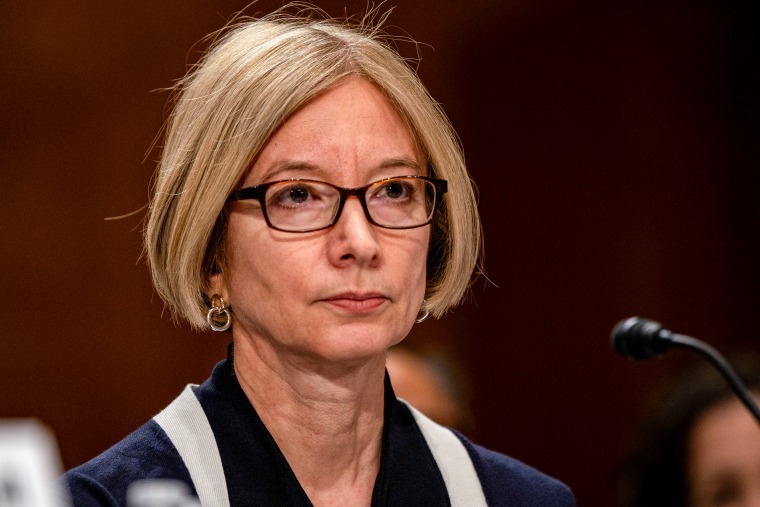 Kelly Adams-Smith at the U.S. Capitol in 2024.Kent Nishimura / Getty Images file
The State Department declined to provide exact numbers. According to the American Foreign Service Association, around 2,000 U.S. diplomats have left the Foreign Service over the last year, either through layoffs or forced retirements, taking with them decades of institutional knowledge, experience in crisis response and highly specialized language skills paid for by the U.S. government.
Their departure from a workforce that was estimated to be more than 13,000 in 2024 leaves the U.S. at a critical disadvantage, current and former State Department officials say, at a time when the nation is facing an escalating number of foreign policy crises.
Elizabeth Horst, who served her country across Republican and Democratic administrations in Tajikistan, Afghanistan, Pakistan and countries in Europe, said that when good leaders and experts leave, America is diminished.
“So when there’s a crisis, we just don’t have the infrastructure we used to have to make sure that Americans overseas stay safe, and that frankly, our business interests are protected,” Horst said. “It’s that day-to-day commerce that lots of American jobs rely on, and people don’t feel that immediately, but it is going to have a long-term impact.”
The leadership vacuum is large. The ambassadorship in Moldova is still vacant, along with more than half of ambassadorships around the globe, including in the Democratic Republic of the Congo where a worsening Ebola outbreak began. There is no ambassador to Ukraine, and seasoned diplomat Julie Davis, who has been leading the embassy in Kyiv while simultaneously serving as ambassador to Cyprus, is stepping down next month to join others in retirement.
And the administration is increasingly overlooking its own expertise; senior-level foreign service officers have been largely absent from high-level negotiations in Russia and the Middle East, as Trump aides struggle with allies and adversaries.
NBC News spoke with more than a dozen current and former senior career foreign service officers who detailed the decline from the inside. The officers who spoke on condition of anonymity did so over fear of reprisal.
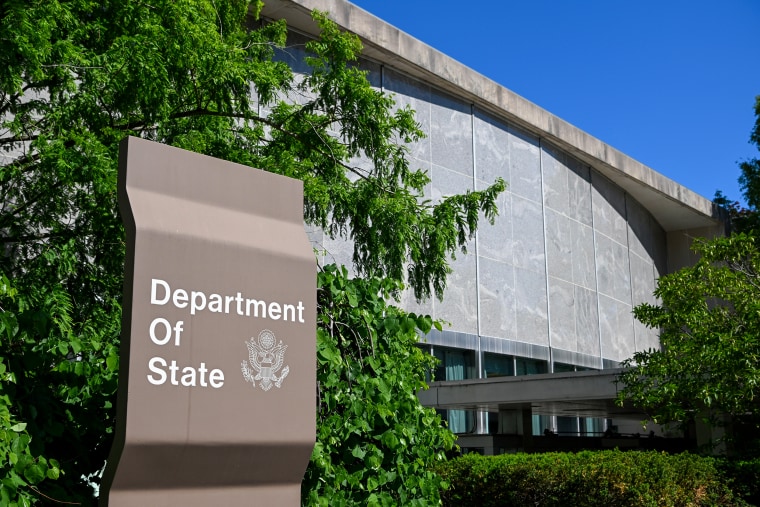 The U.S. Department of State building in Washington, D.C., on May 15.Li Rui / Xinhua News Agency via Getty Images file
State Department spokesman Tommy Pigott said the department “relies on professionalism, experience, and service of both Foreign Service Officers and Civil Service employees to advance American interests around the world.”
“Career personnel serve administrations of both parties and implement the foreign policy of the elected government. The department remains confident in the strength, capability, and professionalism of its workforce to carry out its mission at home and abroad,” he said.
Forced out
The Trump administration began withdrawing dozens of ambassadorial nominations for career senior foreign service members in the first months in office, but by December, it was recalling nearly 30 career ambassadors already in their posts.
U.S. diplomats who had worked across administrations were told they were welcome to apply for other jobs but the options available to them were limited. Returning ambassadors have 90 days to find another assignment or they are forced to retire under the Foreign Service Act of 1980.
Several current and former senior State Department officials described political vetting that went broader and deeper than it had ever been with scrutiny of social media and political donations extending beyond the applying officer to their family members.
“The message to those people was very clear. There’s no place for you,” one former career senior State Department official said.
The State Department acknowledged the increase in retirements but said the figures were affected by the inclusion of officers from the U.S. Agency for International Development, which had worked hand in glove on many international issues but was shuttered last year. The American Foreign Service Association said the tally didn’t include the laid off USAID officers which alone were over 2,000.
In a dramatic decline from even Trump’s first term, when senior foreign service officers made up more than half of ambassadorial nominations, less than 8% of the administration’s nominees for ambassador-level positions have been career diplomats.
“The administration was very clear when they came in that they viewed the foreign service as a barrier, not a tool,” the former official said. “They saw a very entrenched hierarchical institution and said this group of people is not going to fulfill our needs going forward.”
Pigott said the president had the right to determine who represents American interests globally. “The transition away from Biden-era ambassadors is not news nor should it be surprising.”
Absence of U.S. leadership abroad
The decision to keep senior foreign service officers out of top leadership positions has led to nearly a hundred embassies, more than half the worldwide total, operating without Senate-confirmed ambassadors, according to American Foreign Service Association data. The previous administration had roughly half as many open slots.
While it’s not uncommon for a president to name political allies with little to no diplomatic experience to more appealing ambassador positions in Paris or Tokyo, most U.S. missions have historically been led by career senior foreign service officers with decades of experience. It’s not uncommon for the process to take time, but for most vacant positions there is no nominee, career or political, awaiting confirmation.
In the meantime, many U.S. missions abroad continue to be led by a career foreign service officer acting as “chargé d’affaires” but the absence of a formal blessing by the president or Congress often leaves the diplomat with less influence, less power and less access to the top levels of a foreign government.
“We expect to work for political appointees throughout our career. It’s just inevitable, whanever an administration comes in,” a second former official said. “When the administration doesn’t put even its own people into these embassies, who it trusts, those embassies are just out of the loop.”
Pigott said the State Department had “confidence in our ability to communicate with our counterparts around the world and advance the national interest.”
In the Middle East where the U.S. continues to navigate a war with Iran and the fallout with regional allies, half of the U.S. missions including four Persian Gulf countries are without formal U.S. ambassadors. Pakistan and Qatar, where officials have taken on critical mediating roles in negotiations between the U.S. and Iran, are without ambassadors.
The absences contributed to the frantic effort to evacuate thousands of Americans who became stranded, and withdraw personnel when Iran began retaliating across the region in March, current and former diplomats say.
“The State Department’s good at task forces and evacuations. We do this all the time,” a third former official said. “There’s no reason it should have been that screwed up, but it was because you didn’t have the right people empowered to do the things that would get Americans to safety.”
Pigott said the department moved quickly to help Americans abroad.
“Department personnel swiftly worked to safeguard American citizens in the Middle East and used a range of options, including charter flights, ground transportation, and coordination with commercial airlines, to ensure the safety of tens of thousands of our fellow Americans,” he said.
In Africa, where the World Health Organization has declared an Ebola outbreak to be a “public health emergency of international concern,” more than 75% of countries are without an ambassador. The U.S. is also without a formal ambassador to the African Union, as well as the State Department’s regional bureau of African Affairs.
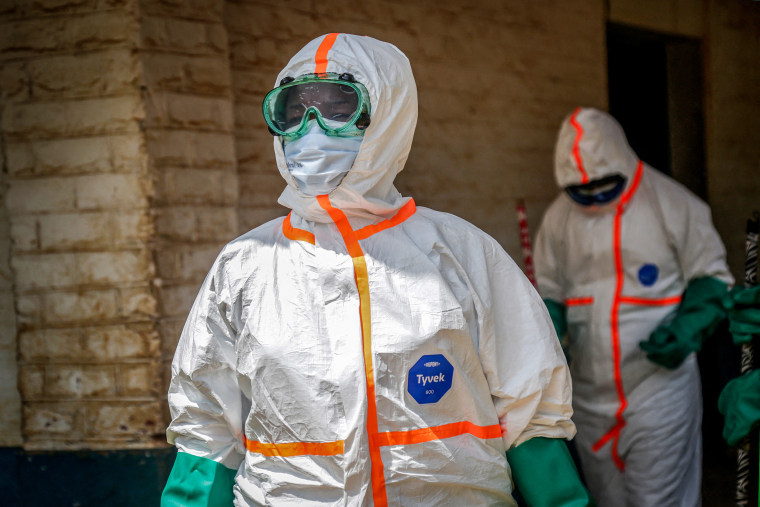 Health workers wearing protective equipment gather to disinfect the isolation area for Ebola patients at the General Referral Hospital of Mongbwalu in Democratic Republic of the Congo on May 23.Seron Muyisa / AFP via Getty Images
Pigott said the department mobilized a wide-ranging Ebola response within 24 hours of word of the outbreak. “Our highest priority remains protecting the health and security of the American people by working to prevent this outbreak from reaching our shores.”
Rewriting the rules
Current and former officials also say the State Department has rewritten the fundamental rules and policies around evaluations and promotions in a manner that will further sideline career diplomats.
A new bell curve designed to limit the number of U.S. diplomats receiving top ranking on their annual reviews could also limit chances for promotion and could spell the end of careers.
Both current and former officials acknowledged the evaluation system needed reform but said the changes only created a different set of problems. A fourth former diplomat said the new system had left many foreign service officers despondent.
Deputy Secretary of State Christopher Landau said the reformed system “is consistent with the Trump administration’s emphasis on accountability in government.
“Having been involved in supervising and evaluating personnel for many years in different contexts, I believe this change will restore accountability and ensure that evaluations reflect actual performance rather than inflated ratings designed to evade difficult conversations,” he told The Daily Wire.
Foreign service officers are also subject to new criteria for performance evaluations with a list that places “fidelity” at the top of desired skills and traits.
Former diplomat Mark Lambert, who retired last January after decades in Asia policy, said beyond ensuring bad advice to leadership from employees too scared to speak their minds, tying U.S. diplomats’ success to loyalty puts alliances at risk because a partisan Foreign Service results in inconsistent foreign policy.
“The Foreign Service is like the military, you take an oath to the Constitution,” Lambert said. “You have people who’ve served loyally to presidents and to secretaries of state, irrespective of political party, because that loyalty is to the Constitution. And you’re hired for your judgment, to provide analysis, to provide input to your boss, no matter what political party.”
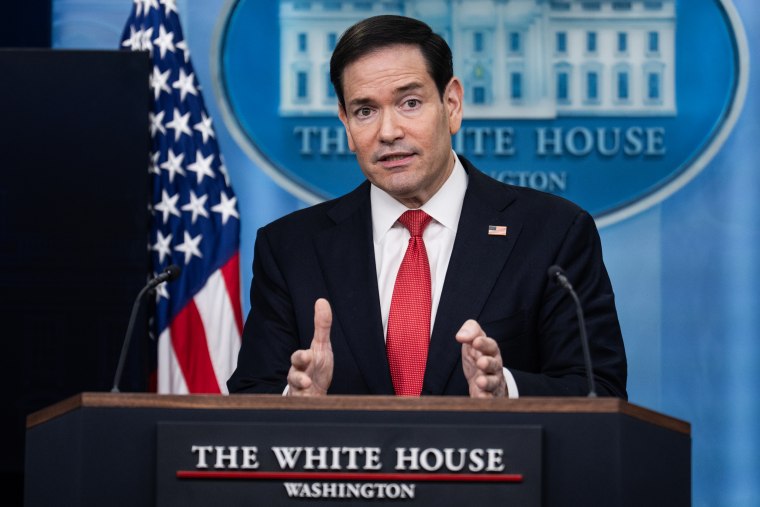 Secretary of State Marco Rubio. Tom Williams / CQ-Roll Call, Inc via Getty Images
Pigott, the State Department spokesman, said Secretary of State Marco Rubio “values candid insights from patriotic Americans who have chosen to serve their country.”
“In fact, this administration reorganized the entire State Department to ensure those on the front lines — the regional bureaus and the embassies — are in a position to impact policies,” Pigott said. “What we will not tolerate is people using their positions to actively undermine the duly elected president’s objectives.”
Experts without a seat at the negotiating table
Unlike past administrations of both parties, senior career foreign service officers have been largely absent from high level negotiations in the Trump administration, former and current State Department officials said.
Diplomatic discussions on the Ukraine and Iran wars have instead been led by the president’s son-in-law Jared Kushner or Trump’s longtime friend Steve Witkoff, a businessman with no diplomatic experience. Trump has praised them, saying they do great work on critical international negotiations.
“When the president went to Beijing, and if you look at who was manifested on his flight, there wasn’t a China expert among them,” Lambert said. “It’s not a surprise that if you have a problem with Russia or with China, and you’re using a real estate lawyer, or people who’ve never negotiated successfully with the Chinese, you’re going to have suboptimal outcomes.”
Three former senior career diplomats told NBC News they believed the Trump administration sidelines career experts because it did not want its decisions to be questioned.
Former Ambassador John Bass, who served in Turkey, Georgia and Afghanistan, said there was little doubt of the Trump administration’s intentions.
“Clearly, there is an organized effort to strip the career, professional workforce of experienced leaders who have a degree of expertise and who have been taught to take initiative, to solve problems, to fill the space and to speak on behalf of the nation,” Bass told NBC News.
“It’s pretty clear that this administration does not value any of those things, and in fact sees anyone taking initiative as disloyal or somehow part of a ‘deep state,’ even if they’re taking that initiative in a way that is fully consistent with the objectives that have been laid out by the president and the secretary.”
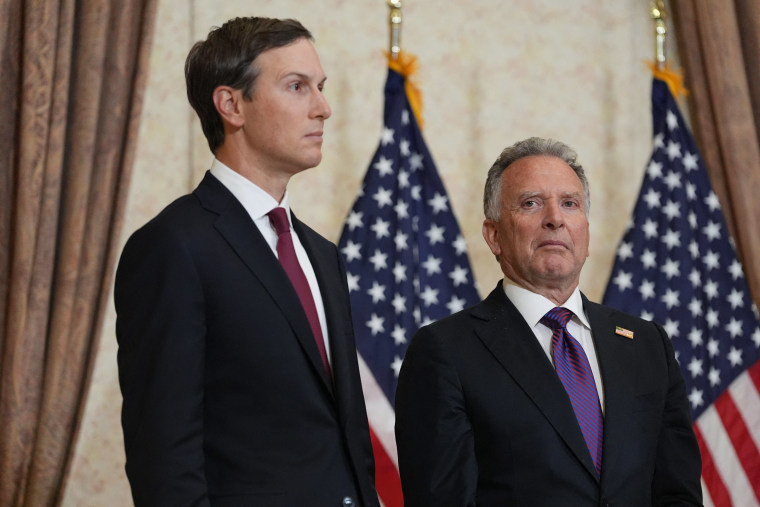 U.S. Special Envoy to the Middle East Steve Witkoff and President Donald Trump's son-in-law Jared Kushner in Islamabad on April 12, 2026.Jacquelyn Martin / AFP - Getty Images
Pigott rejected the premise that key decisions were made without meaningful input from experienced professionals.
“Career and political officials across the department, along with our embassies and interagency partners, are working side by side to respond to this operation,” he said.
As part of a reorganization last summer, nearly 250 foreign service officers were forced out of their jobs. Diplomats take on new assignments around the globe every few years, but the cuts only targeted foreign service officers who happened to be assigned to Washington at the time of the decision.
“The State Department arbitrarily fired 247 Foreign Service Officers based on where their name landed on a spreadsheet on May 29 of last year,” now-former U.S. diplomat Maryum Saifee said in a public post following the announcement. “Many of us had moved to onward assignments, and in some cases overseas postings. A good number were promoted after being fired.”
Their termination letters said it was performance based and there was “no work available,” she wrote, but “new classes of diplomats, expensive to train, have replaced us.”
After fighting the action in court for nearly a year, the layoffs were formalized this month, just as the agency ramped up a campaign for new recruits.
Changes to the foreign service entrance exam including the removal of questions deemed to be focused on a “diversity, equity and inclusion agenda,” alongside a State Department’s recruitment video featuring black and white historical footage of almost entirely white men only added to concerns.
“The messaging on who they’re trying to recruit is pretty obvious. You know, they’re using archival footage of a foreign service that hasn’t existed for 30 years,” according to the first former official. “Across administrations, Republican, Democratic, the whole purpose of the foreign service was to make it look like America. That means, the kid who went to community college in Montana, as well as a veteran who did grad work in Atlanta, as well as your usual sort of DC folks. That’s not what they’re recruiting with that message.”

Pigott dismissed the concerns.
“The same folks claiming to be concerned about supposed ‘politization’ should be thanking this administration for reversing the destructive DEI policies forced on the State Department under Biden,” he said. “We have one fundamental goal: to implement President Trump’s America first foreign policy to make our nation safer, stronger, and more prosperous.”
Putting America First
Horst had not planned on leaving the Foreign Service.
She had been nominated in February of 2024 to be the U.S. ambassador to Sri Lanka. Like Adams Smith, her nomination was also held up.
When realized her nomination — like dozens of others — was not going to be resubmitted by the Trump administration, she took it in stride and found herself an available position within the department. “It is the prerogative of every White House to decide who they want to nominate,” she said.
So she applied to be part of the Lewis Local Diplomats, an initiative which sends State Department employees to cities such as Knoxville, San Antonio, Riversideand Kansas City to help local governments connect with foreign businesses and attract foreign investment. “You don’t get more America first than this,” she said.
She was supposed to arrive at her next post in August but by the end of June she was told the program had been canceled. She spent the next month applying for a series of jobs but the only place to move was down.
“I decided if there’s a ceiling, I’m going to get out and work on the things that matter to me,” Horst said. She now works in sustainable agriculture in her home state of Minnesota.
Many of the current and former diplomats said the impact of the mass departure will be felt for many administrations to come.
“The long-term damage is not just to America’s reputation, but the things Americans care about,” Horst said. “Will I be OK overseas if I travel and have an emergency? Can I get a passport? Can my business export the way it used to? Are my supply chains okay?”
For Kelly Adams-Smith, who now teaches foreign policy at American University, the departure of senior foreign service officers is only more reason to encourage the next generation to take the foreign service exam and join the U.S. diplomatic corps.
“We need a pipeline of well-trained, educated, nonpartisan professionals coming into the foreign service, we always need that,” Adams-Smith said. “I would hate for young people who dream of a career in public service, to not do that at this moment, because we need them. Desperately.”





















/https%3A%2F%2Fsportsmole-media-prod.s3.gra.io.cloud.ovh.net%2Fuploads%2F2026%2F05%2Fimago1077546153-2-6a0b8bbf76f8f531157643.jpg)
 Bengali (BD) ·
  English (US) ·