.png)
 7 hours ago
13
7 hours ago
13
Israeli forces have crossed the Litani River and captured a strategic site in Lebanon, its defense minister said Sunday, marking Israel’s deepest incursion into the country in 26 years.
Subscribe to read this story ad-free
Get unlimited access to ad-free articles and exclusive content.

The capture of Beaufort Ridge, the site of a medieval castle, comes after days of intense fighting in southern Lebanon, and after Prime Minister Benjamin Netanyahu said he was “intensifying operations” in the country despite a nominal ceasefire that came into place in April.
And the advance comes despite hopes of a U.S.-brokered plan to forge peace between the two countries, as Israeli and Lebanese officials met in Washington Friday to discuss implementation of the ceasefire, which Israel and the Iran-backed militant group Hezbollah accuse each other of breaching.
“The Israeli flag is once again flying over the peaks overlooking the communities of the Galilee,” Defense Minister Israel Katz said in a speech Sunday. He added that soldiers who captured the Beaufort “will remain there as part of the security zone in Lebanon.”
“The campaign is not yet over,” he added on X, saying that Israel was determined to “crush” Hezbollah, which has historically operated in southern Lebanon close to the border with northern Israel.
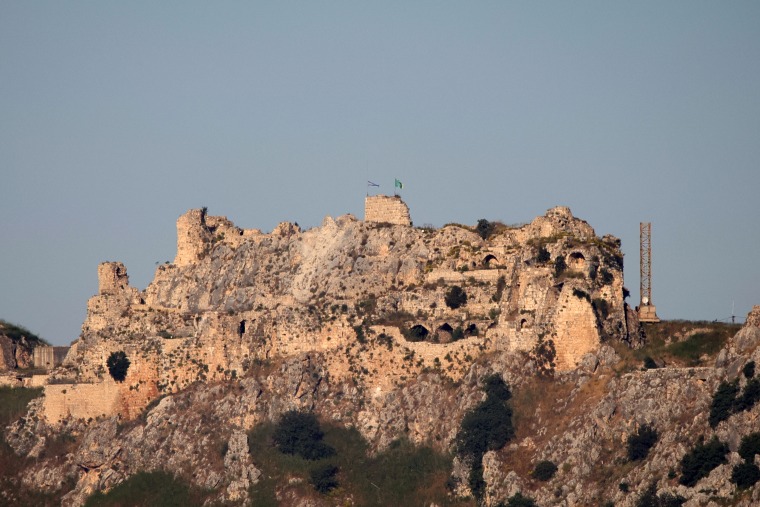 An Israeli flag flies over the medieval Beaufort Castle, known locally as Qalaat al-Shaqif or Shaqif Arnoun, as seen from the Marjayoun area of southern Lebanon on May 31.AFP via Getty Images
The Israeli army’s Arabic spokesperson Avichay Adraee posted a photograph on X showing Israeli troops walking outside the castle on Beaufort Ridge, which Israeli troops previously captured in 1982 during Israel’s second invasion of Lebanon. The site was held by Israel until its withdrawal from Lebanon in 2000.
UNESCO, the U.N. cultural agency, had said Friday ahead of the capture of the site that it was “deeply alarmed” by Israeli strikes near Beaufort Castle, which has a provisional protected status. Such sites should receive the “highest level of legal protection against attack and use for military purposes,” the body said.
The crossing of the Litani River and capture of Beaufort Ridge mark a major escalation in the current conflict.
The river has become a de facto boundary in Lebanon since Israel’s invasion, with large areas to the south under Israeli military control and residents ordered to leave. Israeli forces had already begun striking and destroying bridges over the Litani that connect the south to the rest of the country. Israel’s military says they were being used by Hezbollah to smuggle weapons and move fighters.
Fears of a long-term occupation have also grown amid outright calls from some for Israel to take permanent control of the area south of the Litani River, citing the security advantages it would offer Israel. An editorial in the Jerusalem Post in March cited David Ben-Gurion, Israel’s first prime minister, identifying the river as a natural northern border for the Jewish state.
Those calls were renewed among ultranationalists on Sunday, with Israel’s far-right Finance Minister Bezalel Smotrich posting on X that the seizure of Beaufort Ridge was “correcting old national sins” as he called for a permanent occupation.
Israel could occupy a “massive swathe” of Lebanese territory, Fawaz Gerges, a professor of international relations at the London School of Economics, told NBC News, but risks involving Israel in a “forever war” in Lebanon.

Trump's new demand muddles Iran deal
Israel will “never have either stability or security, regardless of how large its self-declared security zone is,” he said. “Hezbollah will continue to harass and to attack not only the Israeli forces inside Lebanon, but also Israeli settlements, in order to show Israel that even though it has the military capability, it won’t have the security that the government has promised.”
Netanyahu visited Israel’s northern border on Friday where he spoke to members of the military. “I must tell you that there are very impressive results here. Our forces have crossed the Litani; they have advanced to controlling positions,” he said.
“We are operating in Beirut, in the Bekaa, across the entire width of the front, and we are dealing Hezbollah a crushing blow,” Netanyahu said, referring to Lebanon’s eastern Bekaa Valley and the southern suburbs of Lebanon’s capital, a Hezbollah stronghold that Israel’s air force struck on Thursday.
Israel’s National Security Minister Itamar Ben Gvir on Saturday pressed Netanyahu to go further and “flatten” parts of Beirut.
The Israeli conflict in Lebanon has been the most deadly spillover of the Iran war, with more than 1.2 million Lebanese displaced by Israeli strikes and evacuation orders since March 2, when Hezbollah fired at Israel in support of ally Tehran.
Israeli strikes on Lebanon have since killed more than 3,350 people, according to Lebanon’s health ministry. Israel says 25 of its soldiers two civilians have been killed in or near southern Lebanon over the same period. Two civilians have also been killed in northern Israel.
The prime minister of Lebanon said Friday that “nothing can justify” Israel’s attacks on the country after the IDF pounded Tyre, Lebanon’s fourth-largest city, in a wave of strikes across southern Lebanon that killed at least 14 people.
Prime Minister Nawaf Salam said continued strikes, threats and evacuation orders across southern Lebanon “amount to collective punishment, condemned by all international norms and laws.”
The violence in Lebanon came as U.S. and Iranian negotiators seek to reach an agreement to extend the ceasefire in the ongoing war between the two nations. Iran has said any ceasefire with the U.S. has to include an end to the war in Lebanon.
A senior Arab official directly involved in mediating peace talks between Washington and Tehran told NBC News on Thursday that American and Iranian negotiators agreed to the terms of a truce deal days ago but that both sides have delayed finalizing and announcing it.
“It was already closed in Doha three days ago; now everyone is playing a game of chicken and egg,” the official said, describing the delays as “frustrating.”
Defense Secretary Pete Hegseth said Saturday that Trump was “patient” and wanted to make a “great deal” that ensures Iran doesn’t get a nuclear weapon.
But Gerges said Israel’s wider offensive in Lebanon threatens to “undermine and torpedo and kind of deal between the U.S. and Iran.”
“Unless President Trump intervenes and exerts pressure on Netanyahu, I doubt it very much whether the Iranian side will sign into any kind of a deal with the United States,” he said.





















/https%3A%2F%2Fsportsmole-media-prod.s3.gra.io.cloud.ovh.net%2Fuploads%2F2026%2F05%2Fimago1077546153-2-6a0b8bbf76f8f531157643.jpg)
 Bengali (BD) ·
  English (US) ·