.png)
 2 hours ago
11
2 hours ago
11
Vice-President JD Vance in Switzerland for high-stakes talks
Author of the article:

Washington Post
Mary Ilyushina, The Washington Post
Published Jun 21, 2026 • Last updated 8 minutes ago • 2 minute read
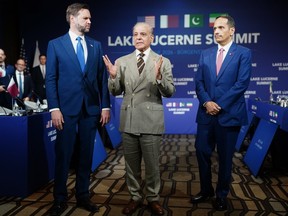
U.S. Vice-President JD Vance arrived in Switzerland on Sunday for high-stakes talks with Iran on its nuclear program, hoping to bring a 60-day sprint from loosely defined agreement to full peace deal back on track.
Advertisement 2

THIS CONTENT IS RESERVED FOR SUBSCRIBERS ONLY
Subscribe now to read the latest news in your city and across Canada.
- Unlimited online access to articles from across Canada with one account.
- Get exclusive access to the Toronto Sun ePaper, an electronic replica of the print edition that you can share, download and comment on.
- Enjoy insights and behind-the-scenes analysis from our award-winning journalists.
- Support local journalists and the next generation of journalists.
- Daily puzzles including the New York Times Crossword.
SUBSCRIBE TO UNLOCK MORE ARTICLES
Subscribe now to read the latest news in your city and across Canada.
- Unlimited online access to articles from across Canada with one account.
- Get exclusive access to the Toronto Sun ePaper, an electronic replica of the print edition that you can share, download and comment on.
- Enjoy insights and behind-the-scenes analysis from our award-winning journalists.
- Support local journalists and the next generation of journalists.
- Daily puzzles including the New York Times Crossword.
REGISTER / SIGN IN TO UNLOCK MORE ARTICLES
Create an account or sign in to continue with your reading experience.
- Access articles from across Canada with one account.
- Share your thoughts and join the conversation in the comments.
- Enjoy additional articles per month.
- Get email updates from your favourite authors.
THIS ARTICLE IS FREE TO READ REGISTER TO UNLOCK.
Create an account or sign in to continue with your reading experience.
- Access articles from across Canada with one account
- Share your thoughts and join the conversation in the comments
- Enjoy additional articles per month
- Get email updates from your favourite authors
Article content
The day before, Iran’s military said it was closing the Strait of Hormuz in response to Israeli strikes on Lebanon, a move that tested the strength of recent U.S. diplomatic efforts and underscored how uncertain the war’s endgame remains.
Article content
Article content
Vance said his priorities are establishing the structure of the talks, making progress on the nuclear issues and ensuring a ceasefire in Lebanon, where Israel continues to exchange fire with Hezbollah, the Iranian-backed militant group, threatening the tentative deal.
“We’re going to have a principal level of political leadership at the top, and then obviously the technical team is going to stay on the ground,” Vance told journalists at Joint Base Andrews before departing for Switzerland.
The U.S. negotiating team includes White House envoys Steve Witkoff and Jared Kushner, who arrived in Switzerland on Saturday. The Iranian delegation, led by parliamentary Speaker Mohammad Bagher Ghalibaf and Foreign Minister Abbas Araghchi, arrived later that day. Pakistani and Qatari officials are mediating the talks.
By signing up you consent to receive the above newsletter from Postmedia Network Inc.
Article content
Advertisement 3
Article content
A memorandum of understanding — which President Donald Trump signed at the Palace of Versailles in France last week — puts the onus on the U.S. to deliver early, including by lifting sanctions, freeing billions in frozen assets and dismantling a naval blockade of Iran’s ports. The two sides established a two-month timeline to flesh out the details and settle issues that have plagued negotiators for years.
Iran promised to let shipping flow freely through the strait, a vital waterway for transporting fuel whose closure has spiked oil and gas prices. The deal also outlined an end to military operations in Lebanon, which is a core issue for Iran and requires the Trump administration to pressure Israel to halt attacks on Hezbollah there — even though Israel is not a signatory to the agreement and has denounced it.
U.S. intelligence agencies have warned the administration that Israeli Prime Minister Benjamin Netanyahu is likely to remain intent on continuing attacks in Lebanon, which could undermine Trump’s effort to reach a lasting peace with Iran.
Advertisement 4
Article content
In remarks before travelling to Switzerland, Vance downplayed the hostilities, saying that “despite the headlines, things are actually getting better there” and the U.S. is “actively managing” the situation.
“It’s going to just be something we’re going to have to continuously manage to ensure that Israel and Lebanon are both safe and secure,” he added.
Stranded vessels had cautiously begun to transit the Strait of Hormuz after the preliminary agreement was signed and the countries agreed to lift all restrictions on movement through it.
The U.S. military said commercial vessels continued operating in the waterway even after Iran’s Saturday announcement that it would be shut, stating that 55 merchant ships and 17 million barrels of oil passed through and denying that the strait is closed.
Ship-tracking sites show that several crude oil tankers have passed through the strait in the past 24 hours, keeping close to the coast of Oman rather than the Iranian side.
Read More
-

Diplomats hold U.S.-Iran preparatory discussions at Swiss retreat
-

KINSELLA: Doctor held hostage by Hamas says Iran's vision is 'global Islamic state'


Article content
























/https%3A%2F%2Fsportsmole-media-prod.s3.gra.io.cloud.ovh.net%2Fuploads%2F2026%2F06%2Frio-ngumoha-email-sportmole-6a27b73e9a471352625861.png)
 Bengali (BD) ·
  English (US) ·