.png)
 7 hours ago
12
7 hours ago
12
Article content
He said temporary is the fiscally prudent way to go.
Article content
“You don’t need to turn the clock back very far to look at Olympic Games where there were many new stadiums built for a major sporting event to come to town, and that then sits there unused or partially used for decades afterwards,” he said. “People are challenging that rationale of building so-called white elephants that don’t have the use afterwards.”
Article content
Brazil learned that lesson the hard way, investing heavily in permanent structures for the 2014 World Cup and the 2016 Summer Olympics, only to see one stadium converted into a parking lot and another rented out for birthdays and weddings.
Article content
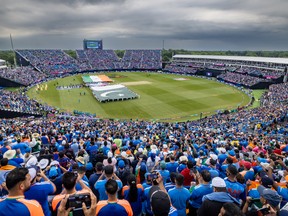
Arena Group, in contrast, once built a complete 34,000-seat stadium in Long Island, New York, for the 2024 Cricket World Cup. It came together in a little over three months, hosted eight matches over 10 days, and then was taken down.
Article content
Article content
That makes sense to Richard Peddie. The president and CEO of Maple Leaf Sports and Entertainment from 1998 to 2011, he oversaw the acquisition and operations of Toronto FC, as well as the construction and operation of BMO Field in its early years.
Article content
Article content
“I really wanted to bring a soccer team to Toronto,” he recalled. “And so I talked the board into saying, ‘Let’s buy a team.’ And it was $10 million; that’s all. Today it’s worth $750 million, all U.S. dollars. And you need a stadium to play in.”
Article content
BMO Field might have been a bit on the small side, he said, but it fit the team and the times.
Article content
“Twenty years ago, it fit the times, and it fit the financials,” he said. “You don’t build a billion-dollar stadium for a $10-million team. So it was the right stadium and the right size in the right place.”
Article content
Peddie said he’s no fan of events like the World Cup or the Olympics — too many ways for costs to spiral out of control. “If I’d been mayor, I would have tried to talk us out of it.”
Article content
That said, “I think it’s good that it’s temporary, because scarcity is a great sales tool. If all of a sudden you had a permanent 50,000-seat stadium, it would look really empty a lot. When you’ve got something that’s more like 22, 23,000 and you’ve got a team that still attracts fans, you know … get it done (and then) take it back to the original intention.”
Article content

Article content
Doug Perovic, a professional engineer and a professor at the University of Toronto, said early images of the network of trusses used at BMO Field “may look a bit unnerving to people that don’t understand structural integrity,” but they actually are safe, designed and built according to the Ontario Building Code and other relevant standards.
Article content
Article content
As to whether they feel safe, “there’s a different conversation.”
Article content
“Engineered structures do sway,” he said. “We don’t like to make things completely rigid, because that can actually lead to problems. If you look at an aircraft … the wings are actually designed to flop up and down quite a bit. And the CN Tower … the top of it moves several feet from side to side in heavy winds.”
Article content
He added: “That means it’s fine in terms of safety, but does it feel good? I can understand for many people it’s like: ‘Oh, wow, this is making me feel queasy.'”
Article content
It’s a notion as old as Aesop’s fable about the flexible reed, and as new as singer Ani DiFranco, whose 1994 song Buildings and Bridges begins: “Buildings and bridges / Are made to bend in the wind / To withstand the world /That’s what it takes … What doesn’t bend breaks.”
Article content

Article content
Of course, sometimes both things can happen. On June 16, 2012, the roof of a temporary stage collapsed during the setup for a concert by the band Radiohead in Toronto’s Downsview Park. A drum technician, Scott Johnson, was killed, and three other personnel were injured.
Article content
“Imagine if that happened just a couple of hours later during the show,” said Perovic. “Don’t even want to think about that.”
























 Bengali (BD) ·
  English (US) ·