.png)
 2 hours ago
8
2 hours ago
8
Article content
“(T)hese actions were intended to reinforce the parties’ respective sovereignty claims, but they didn’t really contribute to solving the legal dispute.”
Article content
The booze battle flowed for years. The only shots fired in the dispute were shots of alcohol.
Article content
Whisky, Canada’s weapon of choice in the fracas, was deliberately chosen.
“It (whisky) really does have a lot more cultural significance and symbolic meaning than just, oh, we’re just giving someone a means to get drunk. It’s, we’re giving someone something that recognizes sociability and recognizes our shared kind of community,” said Dr. Dan Malleck, a professor in Health Sciences at Brock University.
Article content
Schnapps is equally significant for the Danes.
Article content
“When we have schnapps. It’s normally at festive meals such as our very traditional Christmas lunches … it’s a thing for the Danes during December,” said Harris.
Article content
In 2001, Dewing and another researcher with the Geological Survey of Canada, Chris Harrison, surveyed and visited Hans Island after they had done some mapping on Ellesmere Island.
Article content
Article content
“The thing that was weird to us is that if you’re on Ellesmere where we were mapping, the rocks are all tilted, like they’ve been heavily faulted and it looks like the Rocky Mountains, but when you go to Hans Island, [it] is flat lying,” said Dewing.
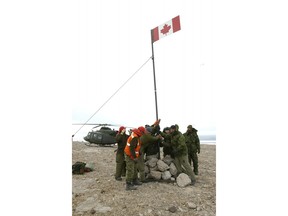
Dewing didn’t see any bottles or flags during the 15 minutes or so that he was on the disputed island.
Article content
Article content
The “war” ratcheted up some years later. In a National Post article in 2022, Rob Huebert, an associate professor of political science at the University of Calgary, wrote: “In 2002, the exchange of booze and flags that had characterized the dispute was completely upended when the Danes used an ice-capable frigate, HDMS Vaedderen, to land troops on the island. Despite Canadian pleas not to repeat these escalatory actions, they did it again in 2003 with her sister ship, the Triton.”
Article content
As a result, in 2005, then-Canadian defence minister Bill Graham arrived on Hans Island to officially claim it as Canadian territory after the Danish incursions. This was actually difficult to do, Huebert writes, since Canada had no real “ice-capable vessels” at the time.
Article content
Eventually, the two NATO allies issued a joint statement that acknowledged their differences and pledged a peaceful resolution.
Article content
Still, diplomacy can proceed — pardon the pun — at a glacial pace.
Article content
In 2018, “a joint Canadian Danish Greenland task force was formed,” Harris noted.
The Whisky War finally concluded on June 14, 2022, with Hans Island divided 60-40 between Denmark, which got the larger portion, and Canada.
Article content
Article content
Consequently, Canada now has a land border with Europe.
Article content
“[I]t was signed at the headquarters of the Royal Canadian Geographical Society in Ottawa, by the two foreign ministers, from Canada and Denmark and the premier of Greenland … And during the ceremony … they also exchanged a bottle of whisky and a bottle of schnapps,” said Harris.
Article content
As minor as the decades-long dispute seems, its peaceful conclusion showed the effectiveness of diplomacy in border disputes.
Article content
“The efforts deployed to reach this outcome demonstrate their leadership in the region and commitment to resolve disputes peacefully and in accordance with international law,” said Global Affairs Canada spokesperson Charlotte MacLeod.
Article content
As well, “We all took it as a clear reference to Russia’s sort of full-scale and illegal invasion of Ukraine earlier the same year,” said Harris.
Article content
Both Canada and Denmark now fight together against threats in the Arctic and elsewhere.
Article content
For example, “Canada and Denmark both are present with troops, in the multinational brigade in Latvia to defend NATO’s eastern flank … Also, we signed (a) defence agreement this year and we are in the process now of implementation,” said Harris.




















/https%3A%2F%2Fsportsmole-media-prod.s3.gra.io.cloud.ovh.net%2Fuploads%2F2026%2F01%2Fdanny-welbeck-5-6956bfa3ea945973722124.jpg)
 Bengali (BD) ·
  English (US) ·