.png)
 2 hours ago
5
2 hours ago
5
Mohammad Amin Biglari disappeared as anti-government protests rocked Iran in early January. His father desperately searched morgues in Tehran, the Iranian capital, for a month, fearing his son was among the thousands killed in the crackdown by authorities.
Subscribe to read this story ad-free
Get unlimited access to ad-free articles and exclusive content.

Instead, a lawyer from the revolutionary court contacted the family and said Biglari had been arrested.
Biglari’s father was not allowed to visit him at the Ghezel Hesar prison, some 30 miles west of Tehran, a relative outside of Iran who is in contact with the family told NBC News. The relative is not being identified for security reasons.
While in prison, Biglari, a 19-year-old who worked at a hair salon and the internet department of a chain store, was only allowed to have one-minute calls with his father, according to the family member. On the fourth call, the family member said, Biglari told his father while sobbing that he had received his sentence: death.
The news site of the Iranian judiciary reported April 5 that Biglari was hanged.
While the Iranian regime has been battling its external enemies, Israel and the United States, it has also been ramping up a deadly crackdown on those seen as the enemy within.
Since mid-March, there have been at least 28 executions in Iran, including 13 people arrested in connection with the January protests, according to the Norway-based group Iran Human Rights. The group also reported Biglari’s death in early April.
“The Iranian authorities have used the context of armed conflict as a pretext to further intensify repression,” Raha Bahreini, Iran researcher for Amnesty International, said in an interview.
She added, “Authorities have escalated their use of the death penalty as a tool of political repression. It’s really unfathomable that as people were being bombed, they were also waking up almost daily to news of hangings of protesters and dissidents and others targeted for politically motivated reasons.”
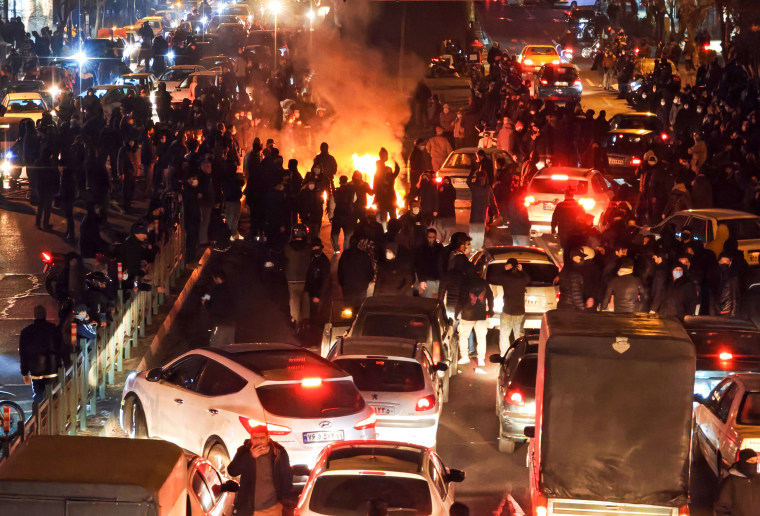 Protests in Tehran on Jan. 8, 2026.Getty Images
The government has also arrested at least 4,000 people on charges related to national security since the U.S. and Israel attacked Iran on Feb. 28, the United Nations said in a report two weeks ago. In many cases, the detainees were “forcibly disappeared, tortured, or subjected to other forms of cruel, inhuman and degrading treatment, including coerced — and sometimes televised — confessions and mock executions,” the U.N. said in the report.
“I am appalled that — on top of the already severe impacts of the conflict — the rights of the Iranian people continue to be stripped from them by the authorities, in harsh and brutal ways,” U.N. Human Rights Chief Volker Türk said in the report.
Among those in detention is Nobel Peace Prize laureate and prominent human rights activist Narges Mohammadi, who was being held in a prison in Zanjan in northwest Iran on national security charges.
Mohammadi, 54, had a heart attack in prison in late March and Amnesty International said in a report two weeks ago that her life was at risk because authorities were “subjecting her to torture or other ill-treatment through the deliberate denial of timely and adequate specialized healthcare.”
She has now been transferred to a hospital in Tehran for treatment, her lawyer Mostafa Nili posted on X on Sunday, after days of pleading by her family and others.
The Iranian regime has also started meting out financial punishment as part of the crackdown.
The properties of 40 people identified as “traitors to the country and those who have taken action against the security and stability of the country” were confiscated, according to a report published last week by Mizan, the news site of the Iranian judiciary.
The country’s top officials drew a hard line against any possible domestic unrest early in the war. National police chief Ahmad Reza Radan said in an interview with state TV in mid-March that any protesters would be treated as the “enemy.”
Security forces showed their deadly intent even before that warning: a handful of people were killed on the first day of the war for celebrating the death of Supreme Leader Ayatollah Ali Khamenei in public, according to Bahreini from Amnesty International.
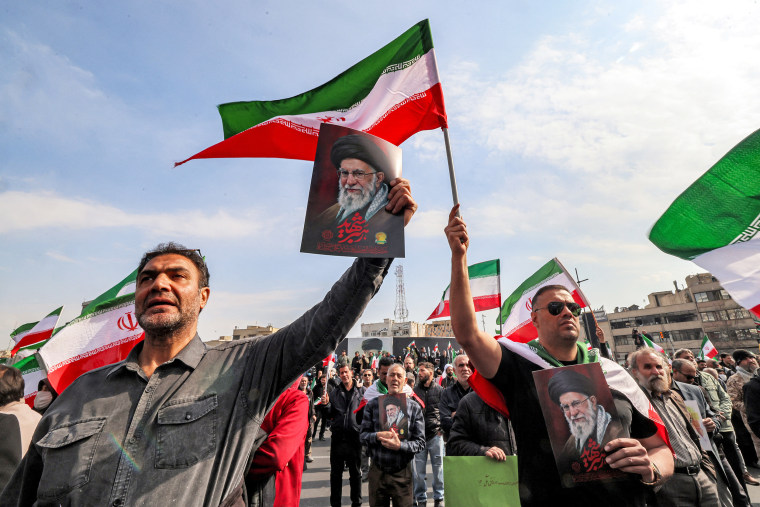 Iranians rally in support of the new supreme leader in central Tehran on March 9.Atta Kenare / AFP via Getty Images
Khamenei was killed along with a number of other top officials in the initial salvo of the war on Feb. 28.
There haven’t been any significant protests since the war started as ordinary Iranians have scrambled to stay safe and make ends meet.
Biglari, the 19-year-old executed in early April, had been taking music classes and saving money to buy a computer. On the night of his arrest in early January, Biglari was walking home from work and was arrested in an area where protests were taking place and a building had been set on fire, according to the relative.
Members of the Basij paramilitary force had pushed Biglari and a handful of others into their base and confronted them there, the family member said.
At the time, thousands of anti-government protesters were hitting the streets in cities across the country and security forces were out in large numbers. Biglari was accused of breaking into a military facility and setting the building on fire, according to the Mizan news site. Biglari did not play a role in setting the building on fire, the family member said. Biglari’s lawyer, Hassan Aghakhani, told the Emtedad news site in February that he was not allowed to review the case or present a defense.
After the execution, Iranian authorities refused to give Biglari’s body back to the family or tell them where he may be buried, according to the family member.
Iran’s judiciary did not respond to a request for comment from NBC News.
President Donald Trump has repeatedly said that the current leadership in Iran appears more reasonable than officials the U.S. was dealing with prior to the war. But human rights groups say that an even more hard-line group is now leading the country, who will likely crack down even harder on domestic unrest when the war ends.
“We have not seen any sign of reasonableness or flexibility or any attempt at reconciliation on the national level from the current leadership,” said Hadi Ghaemi, executive director of the Center for Human Rights in Iran, a New York-based advocacy group, and added, “I think the future, especially once the war is settled, could be very bloody.”
























/https%3A%2F%2Fsportsmole-media-prod.s3.gra.io.cloud.ovh.net%2Fuploads%2F2026%2F05%2Fchamp-69fa166311171530187348.jpg)

 Bengali (BD) ·
  English (US) ·