.png)
 1 hour ago
9
1 hour ago
9
In May, U.S. Citizenship and Immigration Services (USCIS) announced that, except under “extraordinary circumstances,” non-immigrant visa holders must return to their home countries to apply for green cards—a process that could effectively eliminate most traditional pathways to permanent residency or citizenship for many visa holders residing in the United States.
This is just one part in the Trump Administration’s brutal immigration crackdown, which has focused on mass deportation, broadened policing and enforcement, expanded detention, expedited removals, and travel bans, among other measures. As the announcement makes crystal clear, the Trump Administration is interested in targeting not only undocumented immigrants they consider “criminal” but also those who are here legally and seeking more permanent status.
At the same time, President Donald Trump has quietly expanded the guest-worker program, nearly doubling the number of seasonal guest workers for 2026. It has also made it easier and cheaper for farmers to hire H-2A workers and suspended enforcement of a Biden-era farmworker protection rule.
At first glance, mass deportation and heightened immigration restrictions may seem at odds with the expansion of guest-worker programs. But in fact, they are mutually reinforcing. The Trump Administration is increasing access to temporary migrant labor while making undocumented migrants more vulnerable and stable legal status harder to secure for many others.
I would argue that Trump is not simply cracking down on immigrants while separately adjusting labor policy; he is reorganizing migration in a way that makes workers more temporary, more dependent, and easier to expel. In doing so, the White House threatens to make long-term belonging more difficult for immigrants.
But Trump is not doing anything new. The same logic structured the Bracero Program that began in 1942. Then and now, the United States has tried to separate labor from belonging: to welcome migrants’ work while denying them stability, rights, and permanence. Although the Bracero Program officially ended in 1964, its logic remains whenever the United States treats migrant labor as essential but migrant belonging as unacceptable.
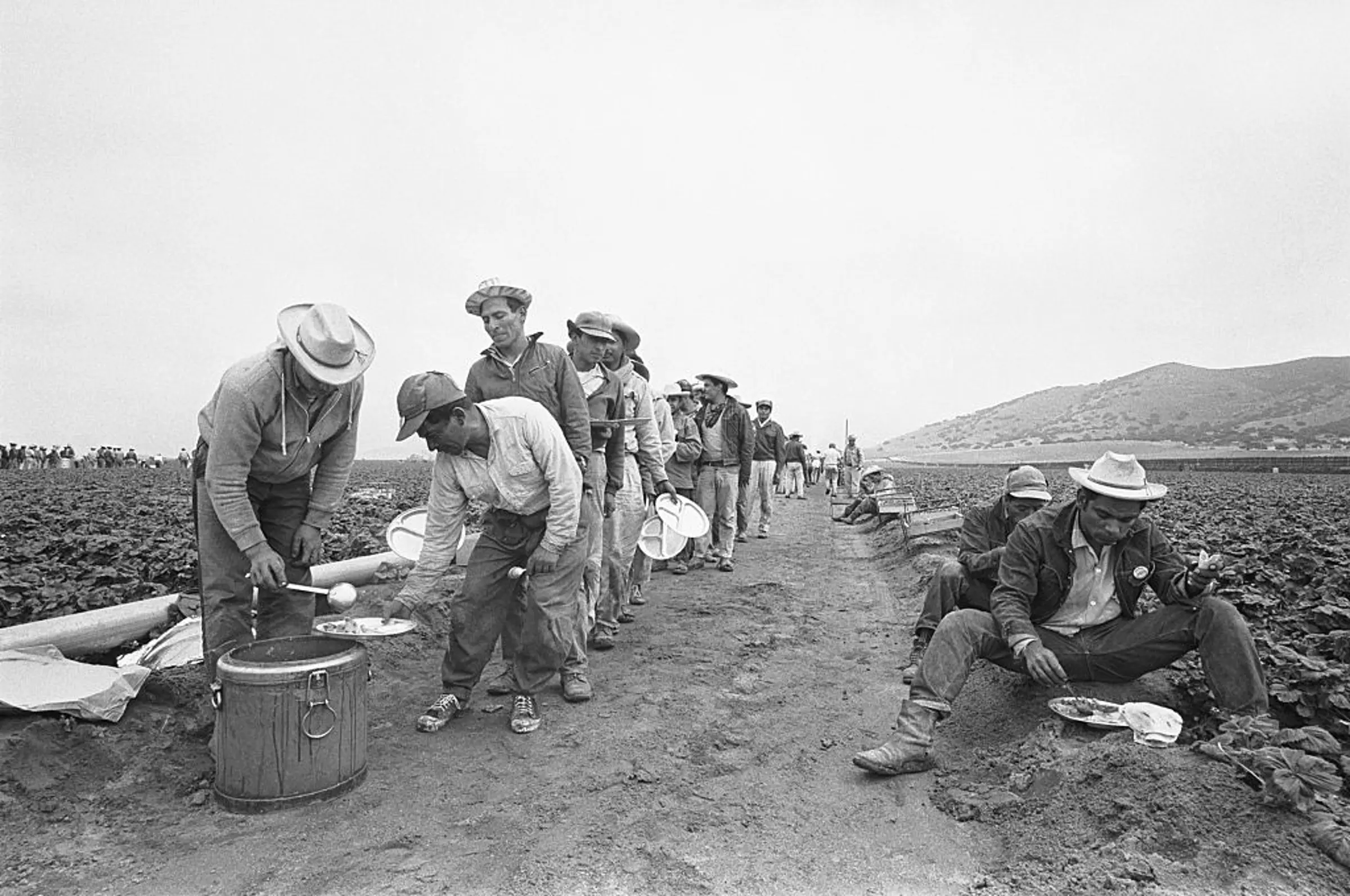
Bracero Program workers in 1963. Bettmann—Getty Images
Started in 1942 as a supposed remedy for labor shortages during World War II, the Bracero Program invited Mexican laborers, exclusively men, into the U.S. on short-term work contracts. It lasted over two decades, during which time approximately 4.5 million contracts were issued to Mexican guest workers, who worked primarily in the agricultural industry.
While the U.S. expanded the number of legally contracted braceros, it simultaneously cracked down on undocumented immigrants. In 1954, in the middle of the Bracero Program, as many as 1.3 million people, almost entirely Mexicans, were rounded up in what would become the largest mass deportation in American history, derogatorily named “Operation Wetback.”
Though some historians now argue that number is an overcount, the operation’s significance lies less in the precise totals than in its tactics and messaging. The operation used military tactics, racial stereotyping, and brutal treatment of Mexicans.
Historian Mae Ngai describes how Lieutenant General Joseph M. Swing, Commissioner of Immigration and Naturalization (INS) from 1954 to 1962—a retired army general and West Point graduate—conceived of and executed the immigration sweep as a military operation, fully mobilizing all resources at his disposal, including planes, jeeps, cars, buses, and other equipment. Swing described the move as a “direct attack . . . upon the hordes of aliens facing us at the border.” During the operation, Mexicans were inhumanely crammed into buses, trains, planes, and cargo ships for deportation back to Mexico.
They were not simply dropped over the border, but frequently transported to the interior of Mexico, to make immediate return more difficult. Some were left in remote or dangerous conditions, such as deserts, with little access to food and water, or ability to contact family members.
Ngai’s research indicates that in one instance, 88 people died of heatstroke after they were abandoned in the extreme heat of Mexicali. Swing also proposed the construction of a chain-link fence along sections of the border in order to deter the illegal migration of supposedly “disease-ridden” women and children.
Operation Wetback thus drew on a longer racial script that cast Mexican migrants as dirty, sick, and criminal. Earlier border inspection practices had treated Mexican bodies as potentially diseased and contaminating, while mid-century immigration discourse increasingly represented unauthorized Mexican workers as criminals invading U.S. labor markets and communities. This logic is evident in the operation’s very name: a racial slur that reduced Mexican migrants to the act of crossing the Rio Grande and helped make Mexican identity appear synonymous with unlawful entry.
Both the Mexican and U.S. governments saw the Bracero Program as a means for reducing unauthorized migration. It was also touted by both governments as an economic opportunity for Mexican workers, a way to protect workers from the abuses and exploitations often encountered if they were undocumented, and a chance to “modernize” Mexican workers—who would supposedly gain new skills and knowledge of new agricultural technologies working on American farms.
The program largely failed to achieve these goals. Abuse was rampant. Living conditions were often deplorable. Far from engaging with modern agricultural equipment, employers typically relegated braceros to back-breaking stoop labor. Many came back to Mexico poorer than they left or with relatively little to show for their months of hard labor.
And it did little to curb unauthorized migration. In fact, it increased during the bracero years, especially in states like Texas, where growers continued to depend on low-wage, undocumented Mexican labor. By the early 1950s, INS apprehensions had surged. Historian Kelly Lytle Hernández notes, for example, that the “number of apprehensions made by the U. S. Border Patrol in the Mexican border region rose from 279,379 in 1949 to 459,289 in 1950 and 501,713 in 1951.” While some of this increase was certainly due to the apprehension of “repeat crossers” and to innovations in Border Patrol policing practices, the substantial increases in the raw numbers in these years still underscore a central fact: the Bracero Program did not curtail but actually stimulated the unauthorized migration of Mexicans.
The Bracero Program ended in 1964 after mounting criticism from labor unions, civil rights advocates, and farmworker organizers who argued that the program institutionalized the exploitation of Mexican workers while depressing wages and working conditions for U.S.-based farmworkers. And yet its legacy continued by cementing in place a seemingly endless cycle of departure and return that expanded over decades and in generations upon generations of Mexicans.
As in the era of the Bracero Program, today’s crackdown on undocumented immigrants has not diminished the demand for migrant labor. If anything, that demand has remained high—without stronger protections for workers and with serious questions about whether the government is willing, or even able, to prevent abuse or monitor poor living conditions and unsafe labor practices at such a scale.
The logic of the Bracero Program was never simply to admit workers. It was to recruit labor, restrict permanence, and manage workers through contracts, oversight, and dependency. It produced widespread abuse and helped create what historian Cristina Salinas calls a “non-constitutional space” along the border: a zone of exception where Mexican migrants could be intensely monitored, processed, and disciplined while denied the full protections supposedly guaranteed by law.
That non-constitutional space has since expanded. Since the dismantling of the INS and the creation of the Department of Homeland Security in 2003, immigration enforcement has become broader, more diffuse, and more deeply embedded in everyday life. Agencies like CBP and ICE, together with programs such as 287(g) and Secure Communities, have extended the reach of immigration enforcement far beyond the border itself. Researchers have also shown how immigration authorities increasingly rely on digital databases and ordinary records—such as driver's license information, utility bills, and other routine data—to identify, monitor, and track migrants deep inside the United States. Immigration enforcement today is no longer confined to the physical border. It has become a vast interior regime of surveillance, policing, detention, and deportation.
If the history of the Bracero Program teaches us anything, it is that temporary labor programs do not solve the “immigration problem.” They manage it by keeping a labor force precarious—useful to employers, but limited in its ability to make claims on the nation itself.
The recent expansion of guest-worker admissions is not in contradiction with current immigration restrictions. It is one of the ways that restriction works.
What this reveals is simple: the United States still wants migrant labor. What it resists is migrant belonging.

























 Bengali (BD) ·
  English (US) ·