.png)
 1 hour ago
6
1 hour ago
6
As a young boy, Tim Weah was generally aware his father had played professional soccer. There were clues all around the house: photos from his career, the jersey on the wall. Then when Tim was 10 years old, his father brought him to the World Cup in South Africa.
Limited time: Save 25% on NBC News subscription
Get exclusive reporting, live Q&As and ad-free reading.

George Weah was going for work as a TV commentator. But he also wasn’t going to miss the first World Cup being hosted by an African nation. George is from Liberia and is considered one of the greatest players the continent has ever produced. In his prime, he played for European powers Paris Saint-Germain and AC Milan and in 1995 won the Ballon d’Or, which was given at the time to Europe’s best player. He’s still the only African-born player to ever receive the honor.
In South Africa, George took his son to games and young Tim saw how strangers reacted to seeing his father, crowding around him, asking for photos.
“You kind of realize, OK, yeah, he’s an important person,” Tim said. “That’s when I really found out, like, wow.”
Tim was in his childhood home in Queens, New York, recalling this memory for an NBC News camera crew. Over his shoulder was a photo of him. He’s seen lifting a trophy as a member of Juventus, the famous Italian soccer club. Tim became a professional soccer player, too, following in his father’s footsteps. He’s carved out a career in Europe and is playing in his second World Cup, as a key reserve for the U.S. men’s national team.
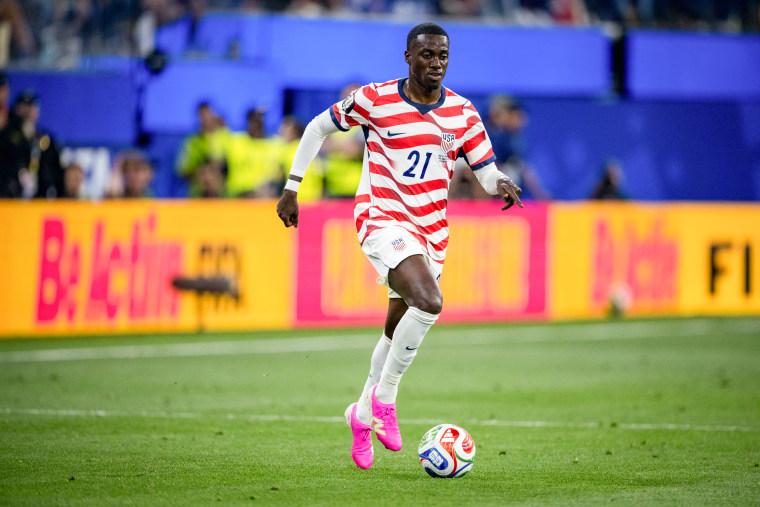 Weah during the U.S. World Cup Group D match against Paraguay in Inglewood, Calif., on June 12.Sebastian Frej / Getty Images
Tim sat for this interview in May, for a profile to run during the tournament. His parents were rummaging around upstairs somewhere. They’d both sit with the reporter when Tim was finished. Every one of these stories seemed to come with the same tagline, though. “I always hear them say, ‘Timothy Weah, son of George Weah,’” Clar Weah, Tim’s mother, said. “I’ve heard it so many times: ‘Son of George Weah.’”
Maybe that’s because George has had an outsize impact on his son’s career. Tim certainly inherited his soccer talent from his father. According to family lore, Tim started kicking a ball when he was barely 1 year old. Not just any ball, either — a soccer ball designed for 12-year-olds. “I said, ‘Oh, this could be interesting,’” George said.
As a preteen, Tim started playing with an elite New York-area club team. George saw enough potential that, when the boy was 13, he helped connect Tim with Chelsea of the English Premier League, one of his former teams, about possible entry into its youth academy. Chelsea turned them down. But George had more connections. He set Tim up with Paris Saint-Germain, another of his former clubs, which took in his son.
“He proved himself,” George said, unprompted. “He did not just earn it because one of his parents played. He worked so hard. He fought very hard.”
Tim spent the next several years in France, training at PSG’s academy. There, he had the chance to work with world-class coaches and trainers, honing his game around the clock. “I learned so much,” Tim said. “They built me into the player that I am to this day.”
PSG’s senior team featured some of the best players in the world — Neymar, Ángel Di María, Kylian Mbappé. But Tim only played a handful of games with the senior club. He was still a teenager and wasn’t a wunderkind like those others, or like his father once upon a time. Naturally, Tim had to deal with being constantly compared with his father, too.
“When you have a dad who’s successful, if you’re having a bad game, they often say, ‘His dad is better,’” Clar said.
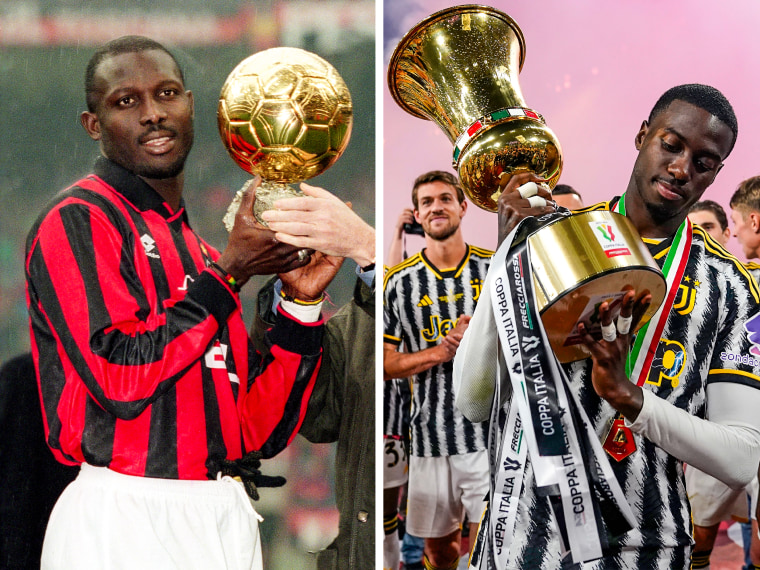 George Weah holding the Ballon d'Or in 1995; Tim Weah holding the Coppa Italia in 2024.Grazia Neri / Getty Images
The Weahs took the opposite approach at home. “We didn’t judge him; we encouraged him,” George said. “I always say to Timothy, ‘Play well, train well, be respectful, be disciplined — that’s it.’ When you have the talent, it’s just a matter of time.”
After leaving PSG, Tim found more opportunity playing for Lille, a smaller club in a town of about 240,000 people in northern France. He also spent a few years playing for Juventus, the powerhouse Italian club, before returning to France to play for Marseille, another of his father’s teams, where he’s blossomed into a regular starter.
After games, George might offer his son advice. But it’s more of a two-way conversation than a list of demands. “I’m not going to be charging at my son: ‘You didn’t do this!’ No. I’ll wait for him,” George said. “‘How are you? How was the game? You know what? You did well, but you can do better. You can move faster. You can get in that area. Kick! Kick when you’re in front of the goal.’ That’s my advice. But it’s up to him to take that advice.”
George knows how fickle soccer can be. “I put myself in his shoes,” he said. “I don’t want to criticize someone that’s making effort. He’s my son. Are you making effort? I understand the game, so if I sit there and harass him because he didn’t do well, then I missed it.”
George and Tim are different players, too. George was a powerful athlete, a striker who hunted goals. Tim is about the same height but 20 pounds lighter. He’s played winger, striker, defensive roles, all over, really — and he projects as a role player more than leading man. “He’s a good player,” George said. “The most important thing is, he can fit in. He can fit into any team he goes to because he’s a quality player who plays everywhere.”
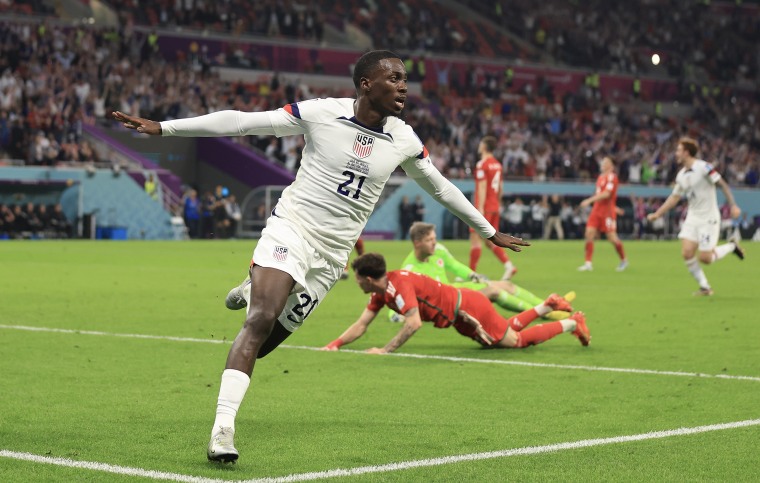 Weah celebrating after scoring against Wales at the 2022 World Cup in Doha, Qatar.Marc Atkins / Getty Images file
That versatility helped Tim make the U.S. World Cup roster in 2022, and then again in 2026. That’s one thing he has on his dad. For all his accolades, George Weah never played in a World Cup. He says he could have, if he had taken the opportunity as a young man to leave for Brazil or Cameroon. But he wanted to stay loyal to his home country, Liberia.
Throughout most of George’s career, Liberia was engulfed in civil war, from 1989 until 2003 with a few-year break in between. He served as a peace ambassador and tried to use his celebrity to curb the fighting. “We thought that, through sports, we could bring back stability to our country,” George said. “Whenever my status was needed to calm the nation, I was there.”
After George retired from soccer, he became more formally involved in politics. He led a new political party that came to be called the Congress for Democratic Change, or the CDC. In fall 2017, the people elected him president of Liberia after he promised to make sweeping changes. But he was voted out in the 2023 election and left office to mixed reviews. Some media pointed to his inability to curb corruption there.
He did keep one major promise: There is no more war in Liberia. “What I wanted to do was promote peace and stability and true democracy,” George said. “Democratic [processes] have to be the hallmark of the day. That’s it. So we can be peaceful.”
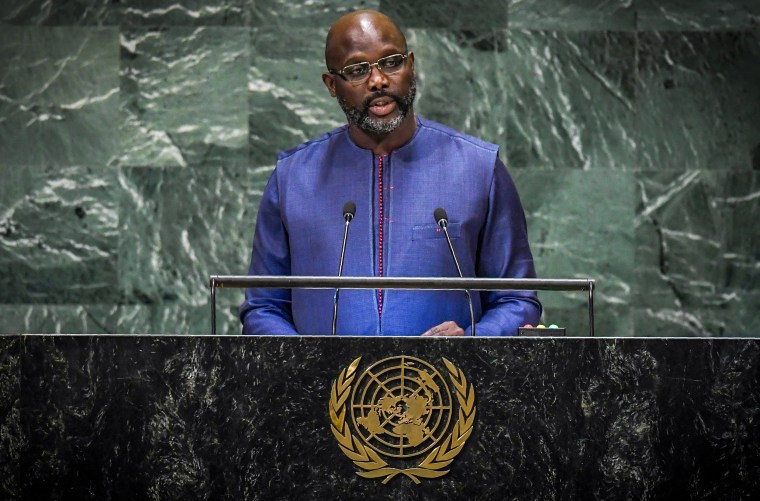 Liberian President George Weah addresses the U.N. General Assembly in 2018.Timothy A. Clary / AFP via Getty Images file
During his presidency, he found time to watch his son play in the 2022 World Cup in Qatar. In the U.S. national team’s opening game, against Wales, Tim was a starter on the wing. In the 36th minute, Christian Pulisic was dribbling upfield when Tim made a heady cut into open space. Pulisic made the pass, and Tim flicked the ball into the net, past the sliding goalkeeper.
Up in the stands, the Weahs lost their minds, cheering and hugging everyone in sight, the famous George Weah included. “He was basically like a kid again, living that dream through me,” Tim said. “It was fun to see that joy and that love for the game in his eyes again.”
After that, Clar noticed, things started to shift for her son. Before, he had always been referred to as Tim Weah, son of George Weah. That still happens. “But now people are knowing Timothy for himself,” Clar said, “playing for the U.S. national team.”























/https%3A%2F%2Fsportsmole-media-prod.s3.gra.io.cloud.ovh.net%2Fuploads%2F2026%2F05%2Fscheffler-6a034d9fca412032057779.jpg)
/https%3A%2F%2Fsportsmole-media-prod.s3.gra.io.cloud.ovh.net%2Fuploads%2F2026%2F06%2Ficonsport-111147-0089-1-6a27d006a81d1227497324.jpg)
/https%3A%2F%2Fsportsmole-media-prod.s3.gra.io.cloud.ovh.net%2Fuploads%2F2026%2F06%2Fimago-xinhua-nestory-irankunda-celebrates-scoring-for-australia-in-the-world-cup-on-june-14-2026-6a2f348854d1b663111439.jpg)
 Bengali (BD) ·
  English (US) ·