.png)
 1 week ago
13
Provincial ministers say 'these punitive and unjustified measures are raising construction costs' on both sides of the border
Published Oct 15, 2026 • Last updated 1 hour ago • 3 minute read
See more Toronto Sun on Google — save as a Preferred Source
Advertisement 2

THIS CONTENT IS RESERVED FOR SUBSCRIBERS ONLY
Subscribe now to read the latest news in your city and across Canada.
- Unlimited online access to articles from across Canada with one account.
- Get exclusive access to the Toronto Sun ePaper, an electronic replica of the print edition that you can share, download and comment on.
- Enjoy insights and behind-the-scenes analysis from our award-winning journalists.
- Support local journalists and the next generation of journalists.
- Daily puzzles including the New York Times Crossword.
SUBSCRIBE TO UNLOCK MORE ARTICLES
Subscribe now to read the latest news in your city and across Canada.
- Unlimited online access to articles from across Canada with one account.
- Get exclusive access to the Toronto Sun ePaper, an electronic replica of the print edition that you can share, download and comment on.
- Enjoy insights and behind-the-scenes analysis from our award-winning journalists.
- Support local journalists and the next generation of journalists.
- Daily puzzles including the New York Times Crossword.
REGISTER / SIGN IN TO UNLOCK MORE ARTICLES
Create an account or sign in to continue with your reading experience.
- Access articles from across Canada with one account.
- Share your thoughts and join the conversation in the comments.
- Enjoy additional articles per month.
- Get email updates from your favourite authors.
THIS ARTICLE IS FREE TO READ REGISTER TO UNLOCK.
Create an account or sign in to continue with your reading experience.
- Access articles from across Canada with one account
- Share your thoughts and join the conversation in the comments
- Enjoy additional articles per month
- Get email updates from your favourite authors
Article content
OTTAWA — Industry groups and provincial leaders are united in calling for negotiated settlements after the U.S. Department of Commerce increased import taxes on Canadian softwood lumber to nearly 35%.
Article content
Article content
While that number is lower than the 45% announced by U.S. officials last August, the news comes as the U.S. Department of Commerce sets its latest combined anti-dumping and countervailing duty rate at 24.75%.
Paired with existing 10% Section 232 tariffs, Canadian softwood lumber will now face a total tax burden of 34.75% when entering the U.S. market.
“Commerce determined that softwood lumber from Canada was being unfairly subsidized at rates ranging from 12.12% to 16.82%,” read a Commerce Department statement issued last week.
“These final rates are, on average, larger than the final subsidy rates determined in the previous administrative review but in line with Commerce’s preliminary results from April 2025. Notably, the final rate for non-selected companies, which applies to most Canadian companies, increased to 14.63%, up from 6.74% determined in the previous administrative review.”
By signing up you consent to receive the above newsletter from Postmedia Network Inc.
Article content
Advertisement 3
Article content
In July, the U.S. Commerce Department issued a decision on anti-dumping duties, finding that Canadian wood was being dumped into the U.S. at rates ranging between 9.95% and 35.53%.
Read More
-

'KEEP YOUR NOSE OUT': U.S. Ambassador Pete Hoekstra warns Canada as midterms loom
-

Cleveland-Cliffs boss ready to battle Ottawa over Stelco cuts


Duties hurting Canada and US, Queen’s Park says
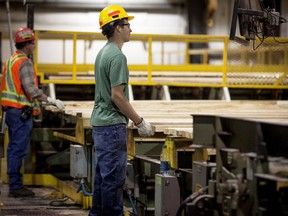
The United States relies heavily on Canadian softwood lumber, as domestic supply cannot keep up with demand.
About a quarter of all softwood lumber used in the U.S. comes from Canada, while 75% to 80% of the wood imported by American firms comes from Canadian mills.
Trade organizations, including the National Association of Home Builders (NAHB), have frequently warned that tariffs on Canadian lumber are driving up American homebuilding costs.
In a joint statement, Ontario’s Associate Forestry Minister Kevin Holland, Natural Resources Minister Mike Harris and Economic Development Minister Vic Fedeli said the duties are unjustified and hurting workers, businesses and communities in both Canada and the United States.
Advertisement 4
Article content
“These punitive and unjustified measures are raising construction costs and making life more expensive for American families,” the statement read.
“While the decision to decrease the duty rate to 24.75% may suggest some relief to softwood lumber producers, Ontario remains firm in our position that these duties are unwarranted, not supported by evidence and making life more expensive for American families and businesses.”
The three ministers are calling on U.S. officials to eliminate all softwood lumber duties and tariffs and work toward a fair agreement that provides long-term certainty on both sides of the border.
Canadian wood vital to U.S. construction: lumber council
In a statement, the BC Lumber Trade Council (BCLTC) expressed disappointment with the decision.
“The combined weight of duties and tariffs continues to place a significant burden on Canadian lumber producers,” said Council Interim President Kim Haakstad.
“For nearly a decade, this dispute has put jobs, mills and forestry communities across B.C. under pressure.”
Advertisement 5
Article content
The council says the U.S. cannot meet its own demand for spruce-pine-fir (SPF) lumber and relies heavily on imports to fill the gap.
SPF and Southern Yellow Pine (SYP,) the council maintains, are not interchangeable.
While both types of wood are widely used in home construction, SPF is preferred for floor joists, wall studs and roof trusses because it is easier to work with and holds its shape better. SYP, meanwhile, is the industry standard for outdoor uses such as decks, fences and structures exposed to the ground.
Echoing the concerns raised by Queen’s Park, the council says a fair, negotiated agreement is the best solution for both Canada and the U.S.
“Lumber crosses our shared border because builders on both sides need it,” Haakstad said.
“Our producers compete fairly in a market-driven system, and these duties are unjustified. It’s time to end this dispute.”
Article content



























 Bengali (BD) ·
 English (US) ·