.png)
 1 hour ago
7
Story
by
Oct 29, 2026 11:00 AM UTC
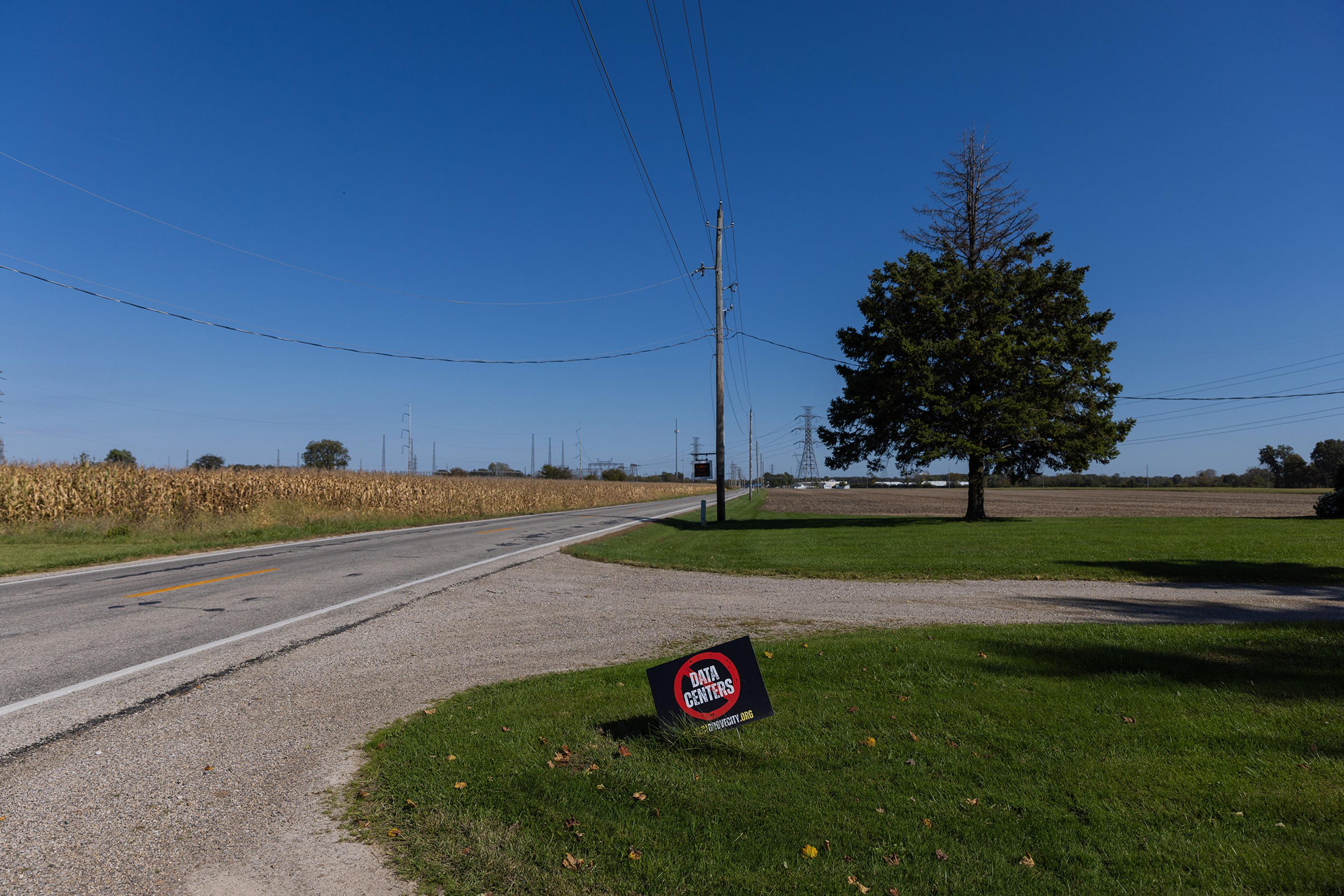
Patty Spillman’s farm in Grove City, Ohio, abuts the site of a proposed 310-acre data center Maddie McGarvey for TIME
Patty Spillman and Jen Belt drive through the outskirts of Grove City, Ohio, mapping the battle lines of a war they’ve waged for months. Pointing out the window of Belt’s blue Chrysler mini-van, Spillman notes the precise borders of a proposed 310-acre data-center campus. She singles out the electrical substation and towering power lines, and recounts the personal histories of neighbors who got offers to sell their land to Headwaters Site Development, the Texas-based company proposing to construct a cloud-computing storage facility on this patch of rural farmland about 10 miles outside Columbus. In between fields of drying corn-stalks and short rows of soybeans, some farmers have planted “no data center” signs on their lawns.
Spillman’s 165-year-old farm sits across the street from the proposed complex. A soft-spoken retired bus driver, Spillman, 63, is a Republican who voted for President Donald Trump three times. Belt, a 51-year-old artist and marketing contractor, is a Democrat. For months, they’ve co-led a group called Protect Grove City, which mobilized a community effort to thwart the proposed data center. The residents’ concerns are legion: water usage, noise and environmental concerns, energy costs, the cloak of secrecy hanging over the project. “This is our community. What if we don’t want you here?” says Spillman, whose mother-in-law turned down an above-market offer from Headwaters of around $1.5 million for 30 acres of land.
Community pushback prompted the Grove City council to pass a yearlong moratorium on data-center construction. In November, Grove City residents will vote on a proposal to go even further, making all large developments subject to voter approval. The issue has upended the intimate politics of this conservative community of 45,180. Community Facebook groups are filled with bickering, angry residents have filled council meetings, and activists filed freedom-of-information requests seeking answers about city officials’ communications about the referendum. Grove City’s longtime mayor, Richard “Ike” Stage, and other local leaders have fought against their efforts, saying the ballot initiative to restrict development would hurt economic growth.

TIME illustration (Source image: Wong Yu Liang–Getty Images)
The fervor against data centers is spreading across the state. Ohio has some 200 data centers, making it one of the biggest hubs in the country. In a former swing state that went red in the Trump era, Republicans admit the groundswell of political opposition to data centers has created a political opening for Ohio Democrats in the upcoming midterm elections.
“I’m as Republican as they get, but it’s going to be a tough year for Republicans in the state of Ohio,” says Nick Owens, a former county GOP chair and Trump delegate at the 2024 Republican National Convention. Owens is now working with the anti-data-center group Conserve Ohio. “I can get on my phone right now and text or call 10 or 12 people from 10 different corners of the state, from all different political backgrounds, from all different socio-economic backgrounds,” Owens says, “because we’re all united about this.”
A national Gallup poll published in May found that more than 70% of voters oppose building an AI data center in their area. In Ohio, where the average household’s electric bill climbed some 15% in the past year and more than 66% over the past decade, the sentiment is even more negative. A September survey by Bowling Green State University found that nearly 80% of Ohioans support a moratorium on data centers. More than 100 local governments in Ohio have reportedly enacted data-center moratoriums; in November, at least 10 will vote on adding a data-center ban to their charters, while two others will decide whether to recall mayors who cut data-center deals. In the eyes of opponents, the facilities—and the powerful AI industry that backs them—have come to represent an attack on their safety, jobs, pocketbooks, and quality of life.
It’s not clear just how potent the issue will be at the polls in November. By themselves, data centers don’t rank as a top-tier national campaign issue, according to voters—in a recent Pew Research Center survey, the economy, the future of democracy, health care, education, and immigration made up the top five. But Democratic candidates have sought to connect data centers to many of those themes. They’re promising to ease affordability concerns by cracking down on high electricity bills through data-center restrictions, pledging to strengthen democracy by fighting Silicon Valley’s opaque deals to get facilities built, casting AI companies as puppet masters in an unequal economy, and painting their political rivals as corrupt leaders seeking to curry favor from powerful companies. This election cycle, $137.6 million has been spent on broadcast ads about data centers, with Democrats making up 77% of that estimated spending, according to the analytics firm AdImpact.
Some Democrats believe data centers could be a decisive issue in tight races, especially in red states like Texas, Iowa, and Ohio. In those states and others, voters have told pollsters they trust Democrats more on the issue. President Donald Trump has positioned himself as one of the industry’s biggest champions, deriding opponents of data centers as “backwards and poor.” The wave of populist anger has “become the one thing that unites Americans right now,” says Megan Mullin, a UCLA political-science professor. “They connect to bigger themes that are becoming really important in American politics—around affordability, around energy affordability, around suspicion and discomfort about AI, about populist resistance to the accumulation of wealth and tech titans.”
In early October, Don Leonard, the Democratic candidate in Ohio’s 15th Congressional District, arrives at the Schmidlapp Free School Library in Piqua. The space is decorated for fall with artificial flowers, and filled with activists and community leaders ready to detail the latest data-center controversy.
Meta, which has been rapidly building out its data-center infrastructure to fuel its AI push, made plans to erect a $1 billion campus in the area. The company hashed out the deal in secret last year, according to city documents and news reports, using a private LLC and nondisclosure agreements with local officials. After Meta was outed as the company behind the data center, the social media giant and Piqua government officials said the project would bring economic investment to the region. In a statement, Meta told TIME the company is reviewing its use of nondisclosure agreements.
Leonard heard from Alisha Lange, 42, who worried about contamination of her well water. Lange, a registered Republican, was among those angered by the secrecy surrounding the project and revelations that several city officials had been awarded $3,000 bonuses by the city after winning Meta’s business. In response, outraged residents successfully petitioned to add a measure to the November ballot designed to recall Piqua’s mayor and other elected officials.
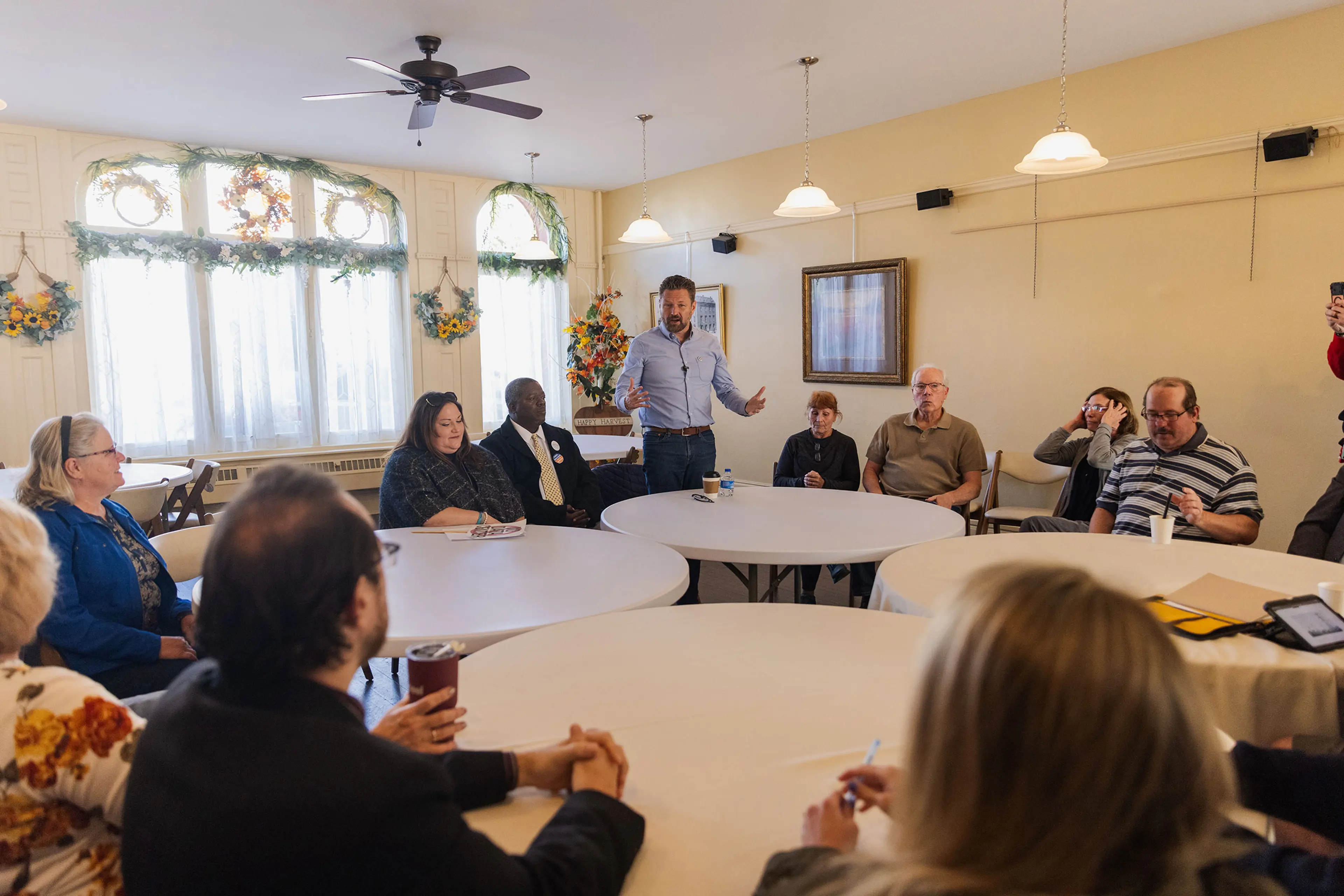
A former city and regional planning professor at The Ohio State University, Leonard, 48, sports a stubbly beard and speaks with a deliberate unpretentiousness. Normally, a progressive candidate wouldn’t stand much of a shot in a congressional district that’s been represented by Republicans for the past 15 years. The incumbent, former coal-industry lobbyist Mike Carey, won by 13 points two years ago. But by the time Leonard won the primary in May, residents in the district, which includes Grove City, were aflame over data centers. Leonard pushed his team to add a data-center question to their polling. They found more than 70% of likely voters in the 15th District wanted greater say over where data centers are located and how they operate. “If we were going to message on it, we had to confirm quantitatively what we knew from listening to the constituents,” Leonard explains in an interview at a modern co-working space in Columbus. “Which is that data centers are one of the most bipartisan issues in Central Ohio right now.”
Leonard sees data centers as “the mascot for predatory capitalism,” forcing communities to absorb increased electricity costs and environmental threats as their local landscapes are remade by huge companies based far away. He says the developments have exacerbated the anxieties of residents who watched neighbors lose solid factory jobs to outsourcing and suspect they’ll once again be the losers in an AI-driven economy. “There’s a feeling like we didn’t even govern the last revolution—globalization—and now they’re hoisting another one on us,” Leonard says. “They’re doing it in our backyard. They’re attacking our way of life.”
It’s not clear whether the backlash will be enough to catapult Leonard into contention in a solidly Republican district. There has been no non-partisan polling in the race, nor any public debates, and Carey holds a clear fundraising advantage, raking in $4 million to Leonard’s $1.2 million, according to campaign filings, though a recent influx of spending against Leonard is a sign Republicans may be a little nervous.
But in other races in Ohio, Democrats spy a clear opportunity.
On a crisp fall day, Sherrod Brown takes the microphone during a small rally outside a Franklin County strip mall. He begins with talking points about economic inequality that he could have fed this crowd of Democratic organizers and voters at any point during his 18 years representing the state in the Senate. But then Brown pivots to an attack line that might have landed with a thud even a year ago. “These data centers are in Ohio now thanks to Jon Husted,” Brown says of his Republican opponent. “They come into communities. They gulp up the land. They swallow the water. Then they get these huge tax breaks.”
After three terms in Washington, Brown was defeated in 2024, when Trump won Ohio for the third straight time. The cornerstone of his comeback bid this year has been the data-center issue. In stump speeches, social media posts, and advertisements blaring across television, Brown blames Husted for the role he played as lieutenant governor in fostering data-center growth in the state, which gave data centers an estimated $2.5 billion in incentives, including breaks on sales and property taxes, from 2017 to 2024, according to a report by the Ohio Chamber of Commerce. (The report also estimates that the centers brought in twice as much in revenue to the state’s coffers.)

Back then, Husted, like other political leaders in both parties, often celebrated tech companies like Google and Amazon, which built the sprawling campuses, as a boost to Ohio’s economy. Husted campaign spokesperson Amy Natoce called Brown’s critiques hypocritical, noting that in 2015 the former Senator himself praised an Amazon Web Services data-center project in Ohio, calling it “great news.”
Now Husted is playing defense on the issue, sponsoring a Senate bill designed to get data centers to pay for electrical-system upgrades that was ultimately blocked by Democrats. Data centers should be a local decision, he says. Polls show the race as a toss-up. But a recent New York Times/Siena poll found that Ohio was one of five right-leaning states—Alaska, Iowa, Kansas, and Texas are the others—where Democrats are outperforming expectations in Senate races, in part because voters said they thought the Democratic candidate would do a better job on data centers.
The party is eager to press that advantage. Dr. Amy Acton, the Democratic candidate for Ohio governor, has called for a conditional moratorium on data centers until they meet certain requirements, such as covering the cost of their own electricity, meeting environmental standards, and participating in community-benefit agreements. Vivek Ramaswamy, the Republican nominee, wants to force hyperscale data centers to cover electricity costs and abide by air- and water-quality standards. Acton has assailed Ramaswamy for not committing to selling off his investments in tech and AI stocks, calling these holdings a conflict of interest.
A similar pattern is playing out in other states. In Texas, both Democratic Senate nominee James Talarico and his Republican opponent Ken Paxton have proposed tighter restrictions on data centers and accused each other of being supported by tech-aligned donors. The state’s Republican governor Greg Abbott, who is locked in a surprisingly tight race of his own, has imposed a temporary moratorium on new data centers until an audit is complete. In Iowa, data centers have been a flash point in the race between Democratic Senate nominee Josh Turek and Republican nominee Ashley Hinson, with Turek proposing restrictions and Hinson emphasizing the need for local control.
Ike Stage first became the mayor of Grove City in 1988. A retired banker who helped set up the local chamber of commerce, he credits cheapish land, a convenient location, and a business-friendly climate for the steady stream of calls he’s fielded from developers over the years. Companies like medical manufacturer American Nitrile have moved in, along with three hospitals and two scientific-research facilities. “Not many cities can say that,” Stage says in an interview at city hall, where brightly colored maps of the area adorn the walls.
Stage has aspirations for Grove City to grow further. In 2018, it adopted a vision that included better transportation options, more parks, and mixed-use developments. Officials also eyed more than 9,000 acres of agricultural and vacant land they thought could be turned into “light industrial-style development.”
Seven years later, Headwaters Site Development, founded by former Google data-center infrastructure leader Michael Lebow, had a similar thought. It contacted property owners in a rural area just south of Grove City’s limits. One of the homesteads belonged to Patty Spillman’s family, which rejected the deal. “Most of us turned them down,” Spillman says. But not all. By this spring, Headwaters had found enough homeowners willing to sell to cobble together the necessary land.

During two information sessions at a local food bank in April, Headwaters representatives pitched locals on what they called Project Maple. Headwaters says it plans to sell the $6.9 billion project to an unidentified tech company, and pledged to support community-friendly zoning requirements that would be assumed by the buyer, such as a 100-ft. height limit, concealing landscaping, and noise levels that aren’t louder than a dishwasher. Headwaters says the project would bring 250 permanent jobs, pay for its own energy costs, and take precautions to keep water usage low. But according to advocates, Head-waters’ refusal to say which tech company would ultimately buy the facility was unnerving. “They just skirted around giving us straight answers about anything,” Jen Belt recalls. “A lot of people left mad.”
The anger emboldened the activists. Belt circulated a petition calling for the city council to reject any upcoming data-center applications. The group posted negative information about the facilities on their personal social media pages, as well as in popular Facebook groups, and put up no data centers signs near the proposed site.
The following month, Grove City councilman Mohamed Omar, 26, announced he was working on legislation to impose a 12-month moratorium on local data centers. Headwaters responded by sending a letter to city council members, arguing that such a moratorium could violate its due process rights. (Lebow says the company has no plans to sue.)
Yet the implied legal threat intensified the community pushback against the project on the eve of the moratorium vote. In June, the moratorium passed 6-1. Emboldened, the anti-data-center advocates with Protect Grove City decided the one-year moratorium wasn’t enough, and wrote a proposed amendment to the city’s charter, which functions like a governing constitution. It would prohibit the city from approving zoning applications for developments that occupy at least 50 acres, use more than 20 megawatts of power at peak capacity, or consume more than 500,000 gallons of water per day unless a majority of voters have backed the project in a public referendum. To drum up support, they canvassed local farmers’ markets, parks, and sporting events to ask people to sign a petition to put the measure on the ballot in November. Within a few weeks, they secured enough signatures.

Councilman Mohamed Omar, who opposes data center development, in Grove City Maddie McGarvey for TIME
City officials nervously tracked news coverage of the data-center backlash across Ohio and beyond, according to emails obtained by TIME. The charter amendment wouldn’t just inhibit the Headwaters project, they warned. It would fundamentally change how any future development deals are approved, and perhaps inhibit existing organizations, including churches, a hospital, and schools, from expanding by imposing overly burdensome processes. Critics contend residents already have opportunities to weigh in on upcoming developments through the normal city approval process. “It’s going to affect business. It’s going to affect our schools. It’s going to affect our taxes,” says Steve Funk, 70, who runs a car dealership in Grove City.
The city has been sending mailers to residents explaining the amendment’s potential effects. Residents have gotten into bitter personal disputes over the amendment in Facebook groups. “It’s bad,” says Omar. “It almost feels like the city is torn.”
To Stage, tech companies have done a poor job trumpeting the benefits the facilities bring to local communities, allowing residents’ anxieties about the industry to flourish. He likens the backlash to the fears Americans had about railroad expansion during the 19th century, when rural farmers worried about the effect the technology might have on their livestock. Americans eventually got used to trains. But Stage also recognizes that he’s on the short side of public opinion. Stage is up for re-election next year. “I’ve won most elections pretty handily, and I’ve been through 11 of them,” he says. “But you never, never make that assumption.” —With reporting by Leslie Dickstein




























 Bengali (BD) ·
 English (US) ·