.png)
 9 hours ago
12
9 hours ago
12
Article content
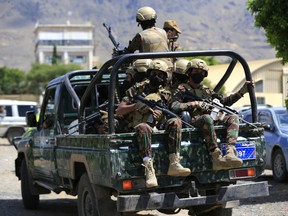
The war in Yemen is no longer simply a domestic conflict. It has become a dangerous proxy war between Iran-backed Houthi rebels and Saudi-backed government forces — and another front in Tehran’s decades-long effort to project its Islamic revolutionary ideology and expand its regional reach, at a devastating human cost.

THIS CONTENT IS RESERVED FOR SUBSCRIBERS
Enjoy the latest local, national and international news.
- Exclusive articles by Conrad Black, Barbara Kay and others. Plus, special edition NP Platformed and First Reading newsletters and virtual events.
- Unlimited online access to National Post.
- National Post ePaper, an electronic replica of the print edition to view on any device, share and comment on.
- Daily puzzles including the New York Times Crossword.
- Support local journalism.
SUBSCRIBE FOR MORE ARTICLES
Enjoy the latest local, national and international news.
- Exclusive articles by Conrad Black, Barbara Kay and others. Plus, special edition NP Platformed and First Reading newsletters and virtual events.
- Unlimited online access to National Post.
- National Post ePaper, an electronic replica of the print edition to view on any device, share and comment on.
- Daily puzzles including the New York Times Crossword.
- Support local journalism.
REGISTER / SIGN IN TO UNLOCK MORE ARTICLES
Create an account or sign in to continue with your reading experience.
- Access articles from across Canada with one account.
- Share your thoughts and join the conversation in the comments.
- Enjoy additional articles per month.
- Get email updates from your favourite authors.
THIS ARTICLE IS FREE TO READ REGISTER TO UNLOCK.
Create an account or sign in to continue with your reading experience.
- Access articles from across Canada with one account
- Share your thoughts and join the conversation in the comments
- Enjoy additional articles per month
- Get email updates from your favourite authors
Sign In or Create an Account
or
Article content
During the months I spent covering the Iran war from Kuwait, the United Arab Emirates, Saudi Arabia and Lebanon, one question kept coming up in my interviews and conversations with people on the street: is the Gulf’s golden age beginning to slip away as escalating wars increasingly intrude on everyday life?
Article content
Article content
Advertisement 1
Article content
And another question loomed: what happens if Iran fully mobilizes its Houthi allies in Yemen? If Tehran can disrupt traffic through the Strait of Hormuz — which carried roughly 20 per cent of the world’s oil before the war — could the Houthis also threaten the Bab al-Mandab Strait, a vital artery for about 12 per cent of global maritime trade?
Article content
By signing up you consent to receive the above newsletter from Postmedia Network Inc.
Article content
The Iran-backed Houthis have waged an insurgency against Yemen’s internationally recognized government since the early 2000s. The conflict escalated dramatically in 2014 after the Houthis seized Sanaa, prompting a Saudi-led coalition to intervene in 2015.
Article content
The Houthis are part of an Iran-led military and ideological network often described as the “Axis of Resistance,” which includes Hezbollah in Lebanon, Hamas in Gaza and militias in Iraq. Canada designated Ansarallah, the Houthi movement, as a terrorist entity in 2024. The United Nations maintains a sanctions regime targeting Houthi leaders and activities.
Article content
The latest escalation, which began in July, shattered the period of relative calm that followed the UN-brokered truce of 2022. The immediate trigger came on July 13, when a U.S.-sanctioned Mahan Air flight reportedly carried Islamic Revolutionary Guard Corps (IRGC) personnel and military equipment to Yemen.
Article content
Advertisement 2
Article content
While the flight was originally bound for Sanaa, its airport was attacked by government forces, forcing the plane to divert to Hodeidah International Airport in western Yemen. The Houthis regarded the airport strike as an act of war and retaliated with strikes on major Saudi targets, reigniting the conflict.
Article content
Article content
From there, the cycle of violence intensified, with the Houthis launching missiles and drones toward Saudi Arabia and targeting energy infrastructure and military sites. The most serious escalation came on Sept. 8, when Houthi attacks injured at least 73 people, according to Saudi authorities.
Article content
The battle for the Bab el-Mandeb Strait — which connects the Red Sea to the Gulf of Aden and links Asia, the Middle East and Europe via the Suez Canal — was among the war’s most dramatic episodes. An eyewitness I spoke with remotely described it as almost “apocalyptic.”
Article content
In early September, Houthi fighters launched a week-long offensive, seizing the port city of Mokha and advancing along the coast. They captured strategic positions including Perim Island, at the entrance to the strait, forcing Saudi-backed government forces to withdraw from parts of the coast.



























/https%3A%2F%2Fsportsmole-media-prod.s3.gra.io.cloud.ovh.net%2Fuploads%2F2026%2F09%2Fmikel-arteta-21-6ab9a6087b35f019707296.jpg)
 Bengali (BD) ·
  English (US) ·