.png)
 2 hours ago
7
2 hours ago
7
Article content
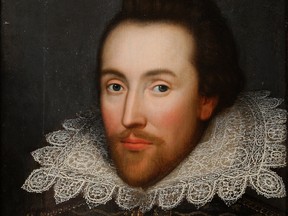
The Shakespeare Birthplace Trust, custodian of buildings and archival materials linked to the playwright, has decided that Shakespeare was too white for their liking. So white, in fact, that the Trust commissioned an investigation into how the playwright’s work advanced “white supremacy.”

THIS CONTENT IS RESERVED FOR SUBSCRIBERS
Enjoy the latest local, national and international news.
- Exclusive articles by Conrad Black, Barbara Kay and others. Plus, special edition NP Platformed and First Reading newsletters and virtual events.
- Unlimited online access to National Post.
- National Post ePaper, an electronic replica of the print edition to view on any device, share and comment on.
- Daily puzzles including the New York Times Crossword.
- Support local journalism.
SUBSCRIBE FOR MORE ARTICLES
Enjoy the latest local, national and international news.
- Exclusive articles by Conrad Black, Barbara Kay and others. Plus, special edition NP Platformed and First Reading newsletters and virtual events.
- Unlimited online access to National Post.
- National Post ePaper, an electronic replica of the print edition to view on any device, share and comment on.
- Daily puzzles including the New York Times Crossword.
- Support local journalism.
REGISTER / SIGN IN TO UNLOCK MORE ARTICLES
Create an account or sign in to continue with your reading experience.
- Access articles from across Canada with one account.
- Share your thoughts and join the conversation in the comments.
- Enjoy additional articles per month.
- Get email updates from your favourite authors.
THIS ARTICLE IS FREE TO READ REGISTER TO UNLOCK.
Create an account or sign in to continue with your reading experience.
- Access articles from across Canada with one account
- Share your thoughts and join the conversation in the comments
- Enjoy additional articles per month
- Get email updates from your favourite authors
Sign In or Create an Account
or
Article content
Shakespeare’s plays stand accused of being a pillar of “British cultural superiority” and “Anglo-cultural supremacy,” compliments with which I shan’t quibble. The Trust was magnanimous enough, no doubt to the delight of continental esthetes who would like to claim him, to also implicate the Bard in “white European supremacy.” One wonders if the English can, in turn, be awarded some kudos for Dante — but I digress.
Article content
Article content
Article content
Dr. Helen Hopkins, of Birmingham City University, conducted the research underpinning the project and has proffered some recommendations about how best to move forward. First, a mea culpa on the playwright’s behalf: the Trust should acknowledge that “the narrative of Shakespeare’s greatness has caused harm — through the epistemic violence.” Second, some humble pie: Shakespeare should be presented not as the “greatest” playwright, but instead as “part of a community of equal and different writers and artists from around the world.” Finally, Shakespeare must be “decolonized” forthwith. His work and legacy should be subjected to a full autopsy for any links to colonialism and Empire, as well as any “language or depictions that are racist, sexist, homophobic, or otherwise harmful.”
Article content
By signing up you consent to receive the above newsletter from Postmedia Network Inc.
Article content
There is a handy rule of thumb to understand envy: it almost never announces itself. Fantastic yarns are spun to disguise that emotion more than any other. This project and its recommendations are one such yarn. Each charge is dressed up as probing cultural criticism, yet perspires with envy and resentment. The resulting odour borders on being intentional.
Article content
Article content
Hopkins, preoccupied in the manner of a small child with a new toy with the word “supremacism,” appears oblivious to the supreme confidence with which she has appointed herself judge of what the rest of us may admire. I suppose one woman’s “narrative” of greatness is another’s global literary consensus, in a crowded field, over half a millennium. As for “epistemic violence,” one might highlight to Hopkins that living is a dangerous business, and, for most of history, humanity has been no stranger to casual blood-shedding that has mercifully become less commonplace. Steven Pinker, in The Better Angels of our Nature, his impressive study on the subject, attributes the global decline in violence in part to the growth in reading, which allowed people around the world to place themselves in the shoes of another for hours at a time. This is what James Baldwin was getting at when he wrote: “You read something which you thought only happened to you, and you discover that it happened 100 years ago to Dostoyevsky. This is a very great liberation for the suffering, struggling person, who always thinks that he is alone. This is why art is important.” Baldwin was not so bereft of imagination as to find “Russian supremacy” in Dostoyevsky. Queen Victoria resisted similarly pedestrian interpretations when she read Uncle Tom’s Cabin, Harriet Beecher Stowe’s 1852 novel chronicling the life of a slave in the American south. She merely wept.

























/https%3A%2F%2Fsportsmole-media-prod.s3.gra.io.cloud.ovh.net%2Fuploads%2F2026%2F04%2Ficonsport-362425-0006-1-69cd324521f82764565288.jpg)
 Bengali (BD) ·
  English (US) ·