.png)
 2 hours ago
6
2 hours ago
6
Article content
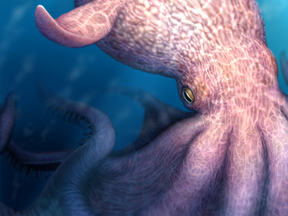
A giant octopus may have ruled the ancient seas as a top marine predator in the age of the dinosaurs, according to new research.

THIS CONTENT IS RESERVED FOR SUBSCRIBERS
Enjoy the latest local, national and international news.
- Exclusive articles by Conrad Black, Barbara Kay and others. Plus, special edition NP Platformed and First Reading newsletters and virtual events.
- Unlimited online access to National Post.
- National Post ePaper, an electronic replica of the print edition to view on any device, share and comment on.
- Daily puzzles including the New York Times Crossword.
- Support local journalism.
SUBSCRIBE FOR MORE ARTICLES
Enjoy the latest local, national and international news.
- Exclusive articles by Conrad Black, Barbara Kay and others. Plus, special edition NP Platformed and First Reading newsletters and virtual events.
- Unlimited online access to National Post.
- National Post ePaper, an electronic replica of the print edition to view on any device, share and comment on.
- Daily puzzles including the New York Times Crossword.
- Support local journalism.
REGISTER / SIGN IN TO UNLOCK MORE ARTICLES
Create an account or sign in to continue with your reading experience.
- Access articles from across Canada with one account.
- Share your thoughts and join the conversation in the comments.
- Enjoy additional articles per month.
- Get email updates from your favourite authors.
THIS ARTICLE IS FREE TO READ REGISTER TO UNLOCK.
Create an account or sign in to continue with your reading experience.
- Access articles from across Canada with one account
- Share your thoughts and join the conversation in the comments
- Enjoy additional articles per month
- Get email updates from your favourite authors
Sign In or Create an Account
or
Article content
Japanese scientists from Hokkaido University studied 15 jaw fossils of large octobrachia, which were previously found on Vancouver Island and in Japan, and another 12 jaws of finned octopuses, which were unearthed in Japan using a “digital fossil-mining method.” All the specimens were from the Late Cretaceous period, about 100 to 72 million years ago, when dinosaurs still roamed he earth.
Article content
Article content
Article content
Article content
By signing up you consent to receive the above newsletter from Postmedia Network Inc.
Article content
The scientists produced visual data sets through artificial intelligence to study the specimen’s jaw grinding habits.
Article content
“In well-grown specimens, up to 10 per cent of the jaw tip relative to the total jaw length had been worn away,” said Professor Yasuhiro Iba, one of the study authors, in a press release. “This indicates repeated, forceful interactions with their prey, revealing an unexpectedly aggressive feeding strategy.”
Article content
The scientists studied chips, cracks, and indents visible in the fossils from Cirrata, a group of extinct finned octopuses, as well as measurements of the species’ palette to determine its approximate size and eating habits.
Article content
“Based on exceptionally well-preserved fossil jaws, we show that these animals reached total lengths of up to nearly 20 metres, which may have surpassed the size of large marine reptiles of the same age,” Iba said. “Our findings suggest that the earliest octopuses were gigantic predators that occupied the top of the marine food chain in the Cretaceous.”
Article content
Article content
Scientists have long understood vertebrates to be “top predators in marine ecosystems,” the study, published in the journal Science, states. These are ocean species with strong backbones and skeletal systems. Invertebrates do not develop this stability and would have served as small prey during the Mesozoic Era, the age of the dinosaurs, from 252 to 66 million years ago.
Article content
Article content
“This study provides the first direct evidence that invertebrates could evolve into giant, intelligent apex predators in ecosystems that have been dominated by vertebrates for about 400 million years,” said Iba. “Our findings show that powerful jaws and the loss of superficial skeletons, common characteristics of octopuses and marine vertebrates, were essential to becoming huge, intelligent marine predators.”
Article content
Several gigantic octopus fossils over two metres in length are documented from the Mesozoic era, however, this monster of the underwater world is estimated to have ranged from seven to 19 metres in length.
Article content
Its jaw resembled a beak and was strong enough to break through shell and bone. The species likely had powerful arms that enabled it to catch prey. Scientists revealed that “kraken-like” octopuses were the North Pacific ocean’s most prolific predator during the Cretaceous period.
Article content
Article content
Our website is the place for the latest breaking news, exclusive scoops, longreads and provocative commentary. Please bookmark nationalpost.com and sign up for our daily newsletter, Posted, here.
Article content




























/https%3A%2F%2Fsportsmole-media-prod.s3.gra.io.cloud.ovh.net%2Fuploads%2F2025%2F11%2Fimago1068606686-1-69071bd01fb89577912048.jpg)
 Bengali (BD) ·
  English (US) ·