.png)
 1 hour ago
3
1 hour ago
3
Article content
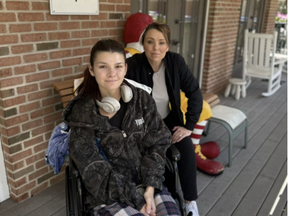
Imagine your child is diagnosed with idiopathic scoliosis, a curved spine, just days after her thirteenth birthday. Over the next several months, she wears a brace religiously to see if it will correct the curve, but the bend just keeps getting worse. You watch helplessly as your daughter gives up on sports and becomes increasingly self-conscious about her appearance. You get on the waitlist for surgery, and you wait. And wait. And wait.

THIS CONTENT IS RESERVED FOR SUBSCRIBERS
Enjoy the latest local, national and international news.
- Exclusive articles by Conrad Black, Barbara Kay and others. Plus, special edition NP Platformed and First Reading newsletters and virtual events.
- Unlimited online access to National Post.
- National Post ePaper, an electronic replica of the print edition to view on any device, share and comment on.
- Daily puzzles including the New York Times Crossword.
- Support local journalism.
SUBSCRIBE FOR MORE ARTICLES
Enjoy the latest local, national and international news.
- Exclusive articles by Conrad Black, Barbara Kay and others. Plus, special edition NP Platformed and First Reading newsletters and virtual events.
- Unlimited online access to National Post.
- National Post ePaper, an electronic replica of the print edition to view on any device, share and comment on.
- Daily puzzles including the New York Times Crossword.
- Support local journalism.
REGISTER / SIGN IN TO UNLOCK MORE ARTICLES
Create an account or sign in to continue with your reading experience.
- Access articles from across Canada with one account.
- Share your thoughts and join the conversation in the comments.
- Enjoy additional articles per month.
- Get email updates from your favourite authors.
THIS ARTICLE IS FREE TO READ REGISTER TO UNLOCK.
Create an account or sign in to continue with your reading experience.
- Access articles from across Canada with one account
- Share your thoughts and join the conversation in the comments
- Enjoy additional articles per month
- Get email updates from your favourite authors
Sign In or Create an Account
or
Article content
Article content
After two years, you can’t wait any longer. The curve is now so bad that it’s painful, causing lost sleep and threatening organs. Desperate for relief, you take your daughter to the United States to get the surgery. It’s available there right away. Within weeks, your daughter is cured. She’s back to normal just in time for her last year of high school. But you’re left with a life-altering $200,000 bill. Should the province pick up the tab?
Article content
Article content
By signing up, you consent to receive the above newsletter from Postmedia Network Inc.
Article content
We think so. That’s why we’re supporting Vienna Pedetella’s lawsuit against the province that failed to provide the surgery and denied funding to get the surgery abroad.
Article content
Canada controls the supply of health care like no other country in the western world, effectively banning private care while rationing the number of doctors, nurses and operating rooms. The stated purpose of this monopoly, outlined in the Canada Health Act, is to “provide reasonable access to health services without financial or other barriers.”
Article content
The results are less than ideal. While few of us end up with medical bills that could bankrupt us, we rank far behind the U.S. on access to care, and seventh out of 10 wealthy countries in overall performance. This is behind Australia, France, Netherlands, New Zealand, Sweden and the United Kingdom.
Article content
Article content
Timely access to pediatric scoliosis surgery is an example of how the system is failing us. The Conference Board of Canada reported in 2023 that four in 10 pediatric spinal surgeries were performed after the recommended clinical timeframe of six months. When waitlists get this long, they may violate Charter rights.
Article content
Section 7 of the Charter guarantees that “everyone has the right to life, liberty and security of the person and the right not to be deprived thereof except in accordance with the principles of fundamental justice.” Liberty has been recognized as protecting fundamental life choices including making medical decisions, but patients often don’t have meaningful access to those decisions in Canada. Life is protected from state-imposed increased risks in death. Security of the person, meanwhile, protects Canadians from physical or serious psychological suffering.
Article content
The Supreme Court recognized in the 2005 decision Chaoulli v. Quebec that when governments block patients from accessing care in a timely fashion, that can violate section 7. In that decision, even those judges who found that patients’ rights were not violated by Quebec’s laws agreed their rights would have been infringed upon had there not been a Quebec policy of sending patients abroad when Canada cannot provide care in time.





























 Bengali (BD) ·
  English (US) ·