.png)
 2 hours ago
9
2 hours ago
9
Article content
As the Liberals prepare to table their economic update next week, Prime Minister Mark Carney’s banker buddies are stepping in to defend his government’s high-spending ways.

THIS CONTENT IS RESERVED FOR SUBSCRIBERS
Enjoy the latest local, national and international news.
- Exclusive articles by Conrad Black, Barbara Kay and others. Plus, special edition NP Platformed and First Reading newsletters and virtual events.
- Unlimited online access to National Post.
- National Post ePaper, an electronic replica of the print edition to view on any device, share and comment on.
- Daily puzzles including the New York Times Crossword.
- Support local journalism.
SUBSCRIBE FOR MORE ARTICLES
Enjoy the latest local, national and international news.
- Exclusive articles by Conrad Black, Barbara Kay and others. Plus, special edition NP Platformed and First Reading newsletters and virtual events.
- Unlimited online access to National Post.
- National Post ePaper, an electronic replica of the print edition to view on any device, share and comment on.
- Daily puzzles including the New York Times Crossword.
- Support local journalism.
REGISTER / SIGN IN TO UNLOCK MORE ARTICLES
Create an account or sign in to continue with your reading experience.
- Access articles from across Canada with one account.
- Share your thoughts and join the conversation in the comments.
- Enjoy additional articles per month.
- Get email updates from your favourite authors.
THIS ARTICLE IS FREE TO READ REGISTER TO UNLOCK.
Create an account or sign in to continue with your reading experience.
- Access articles from across Canada with one account
- Share your thoughts and join the conversation in the comments
- Enjoy additional articles per month
- Get email updates from your favourite authors
Sign In or Create an Account
or
Article content
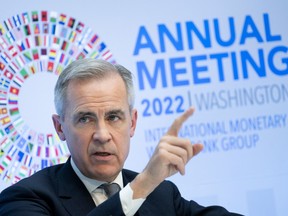
Speaking to Bloomberg News last week, Nigel Chalk, director of the International Monetary Fund’s Western Hemisphere department, said that among the G7 economies, “Canada’s probably in the strongest position fiscally,” and lauded the Carney government’s “very strong focus on the debt path.”
Article content
Article content
Article content
He further argued that because Canada’s net debt-to-GDP ratio is relatively low compared to its G7 peers, Ottawa has fiscal room to manoeuvre, and that, “In the current circumstances, if you have fiscal space, it’s the time to use it.”
Article content
By signing up you consent to receive the above newsletter from Postmedia Network Inc.
Article content
Which sounds a lot like former finance minister Chrystia Freeland’s 2021 statement, made after doubling the national debt during the pandemic, that due to the “low interest rate environment” at the time, “not only can we afford these investments in Canada’s future, it would be short-sighted of us not to make them.”
Article content
Since that time, not only have interest rates gone up, but the national debt keeps on climbing. Carney’s first budget, introduced last fall, projected a deficit of $78.3 billion. In nominal dollars, that’s the highest ever outside a pandemic year.
Article content
It’s true that when the government applies a little accounting magic — subtracting assets it doesn’t actually own, like the Canada Pension Plan, from the gross debt, and pretending as though Canada isn’t a federation with highly indebted sub-national governments — our net-debt-to-GDP ratio works out to around 43 per cent, which looks good compared to other G7 countries.
Article content
Article content
This is why the Liberals have long chosen to highlight Canada’s net debt as their preferred fiscal anchor, and previously promised that it would continue to fall, even as deficits spiked and the debt skyrocketed.
Article content
Article content
Yet they have quietly given up on that pledge. Last year, the parliamentary budget officer warned that the federal debt-to-GDP ratio is “no longer projected to be on a declining path over the medium term.”
Article content
The provincial governments have also been taking on debt at record pace, adding a near equal amount to the country’s gross government debt this year as Ottawa, according to economist Livio Di Matteo.
Article content
Take away all the smoke and mirrors, and Canada’s position relative to other countries starts to erode.
Article content
According to the IMF’s own data, Canada’s gross national debt was 113.5 per cent of GDP in 2025, which puts us in a stronger position than Japan (206.5 per cent), Italy (137 per cent), the United States (124 per cent) and France (116 per cent), but is far higher than the United Kingdom (102.3 per cent) and Germany (63 per cent).
Article content
Limiting the comparison to the high-spending economies in the G7 is also misleading, as Canada’s gross debt-to-GDP ratio is well above the world average (94 per cent), along with the average for advanced economies (108 per cent) and the European Union (82.5 per cent).



























 Bengali (BD) ·
  English (US) ·