.png)
 2 hours ago
6
2 hours ago
6
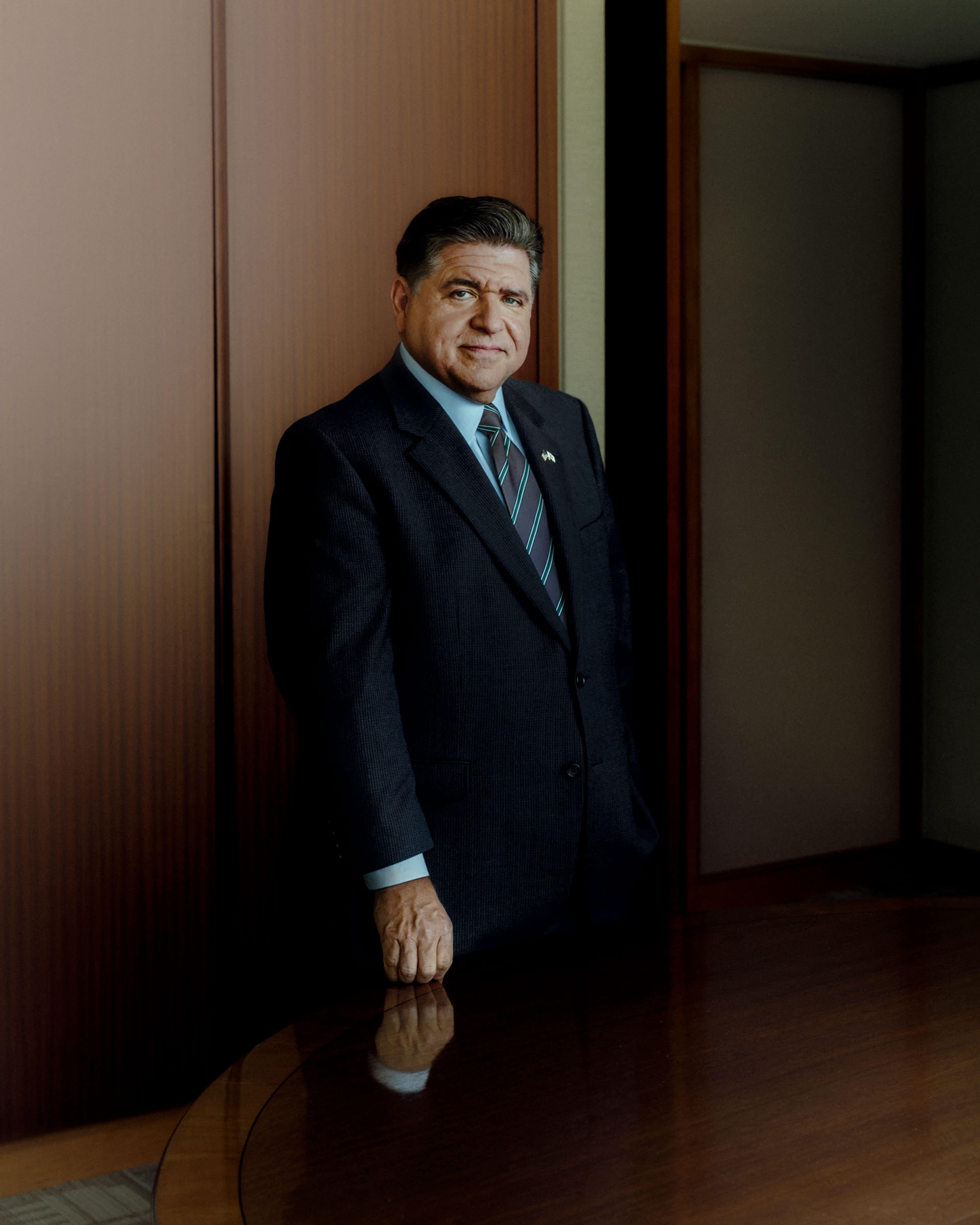
The Governor in his Chicago offices on April 8.

Apr 28, 2026 11:00 AM CUT
It’s St. Patrick’s Day in Chicago, and JB Pritzker is on a boat cruising down the city’s green-dyed river. An icy breeze whips beer cans across the deck as the Illinois governor takes a swig of Redbreast whiskey from a flask offered to him by a bagpiper. Weaving through the crowd, he mingles with the tipsy guests, talking housing policy with a visiting Irish diplomat, joking that they don’t make kilts in his size, and chatting up the members of the holiday parade court.
Even here on the party boat, the city awash in festive green, President Donald Trump is not far from minds. Colleen Kelch, a marketing professional and member of the queen’s court, grows serious as she details Pritzker’s battles with Trump and his defense of LGBTQ people in the state. “He fights for us,” Kelch says.
As he campaigns for a third term, Pritzker is riding his battles with the President to national prominence. His re-election campaign mentions the Commander in Chief more than it does his GOP challenger, and he blasts Trump ad nauseam on social media. Like other blue-state governors, he has sued and trolled the White House. But he has gone further than most of his peers: after Trump sent federal law-enforcement agents into Chicago, Pritzker created an accountability commission to create a public record, investigate, and recommend possible actions against officials he believes overstepped. He’s demanded Trump reimburse the state for about $8.6 billion in tariffs later ruled unconstitutional. “People ask me why I push back on Trump so much,” he tells TIME. “Every day you let an authoritarian go unchecked is another day that people are losing their rights and maybe even losing their lives.”
In a primary, Pritzker would face scrutiny of everything from his past support for AIPAC to his family’s offshore trusts. Some Democrats are skeptical that an heir to the Hyatt hotel fortune can win over a party that wants to shed its elitist image and win back working-class voters. “He casts himself as the benevolent billionaire,” says Victor Reyes, an Illinois Democratic political consultant, “but it’s gonna be hard for the Democratic Party to say we are against the whole billionaire class but we’re gonna nominate this billionaire.”
For the moment, Pritzker is riding high, leveling his attacks against Trump with a happy-warrior vibe, alternating grim warnings about the demise of democracy one moment and dad jokes the next. “That’s not really coffee, is it?” he chides a member of the plumbers’ union holding a paper cup. Then he smiles widely as the boat dumps more bright-green liquid into the city’s river.
At Lou Mitchell’s diner in the West Loop, a waitress moves to refill Pritzker’s (actual) coffee, and he reflexively shields his mint green tie. “This is my genius business idea for after I’m governor,” he says, describing a tie that unfolds into a bib. “You can get in on it.”
Dismissing Pritzker’s business ideas seems unwise. With a net worth of nearly $4 billion, he is among the richest elected officials in America. His family name is on museums, architecture awards, and law schools. He has poured money into Democratic candidates, groups, and causes. The ability to bankroll his own campaigns, Pritzker argues, makes him one of the few politicians no one can buy—which is, of course, an argument Trump once made too. “It’s not like every wealthy person is a terrible person or can’t understand other people, or every poor person can’t understand the importance of, let’s say, a business succeeding,” Pritzker says. “I don’t think it matters what your income level is. I think what matters is what your experiences are and what your values are.”
Pritzker is the great-grandson of Ukrainian Jews who fled pogroms in the 1880s. His great-grandfather Nicholas Pritzker emigrated from Kyiv to Chicago; a book he wrote about that journey has become a prized possession of the governor’s. JB and his two siblings were raised in Atherton, Calif., an upscale Bay Area suburb, as the family business grew into a major hotel chain from an initial motel near the Los Angeles airport, where Pritzker worked as a busboy.
A privileged upbringing was marred by personal tragedy. Pritzker’s father Donald died of a heart attack at 39, when JB was 7. His mother Sue struggled with alcoholism. Pritzker talks about her tenderly, describing a role model who marched for abortion rights and taught her kids alcoholism was a disease before that was common. The governor recalls the day she sat her children down and gave them a book about addiction. “I was probably 10,” he says. “I think about how hard that must have been, to lay yourself bare about your own challenges.” When Pritzker was 17, his mother was driving drunk when her Cadillac broke down. She was on the way to a garage in a tow truck when she inexplicably leaped from the truck and was killed.
Left parentless just before college, Pritzker started at Georgetown and later transferred to Duke. There he met Terry Sanford, the university president, who would change the trajectory of his life. Sanford was a former North Carolina governor who protected Freedom Riders in their push for desegregation in the 1960s and backed Vietnam War protesters while leading Duke. Pritzker became a mentee. When Sanford ran for Senate in 1986 and won, Pritzker joined the campaign and then his staff. It was Sanford, Pritzker says, who advised him that if he wanted to run for office someday, he should decide where he wanted to set up a life, meet the people, and go do it there. Pritzker took a job with Senator Alan Dixon, an Illinois Democrat, and studied law at Northwestern. He spent a million dollars of his own money to run for a Chicago House seat in 1998, when he was 33, but finished third to Jan Schakowsky, who has held it since. He has said the loss taught him that ideas go only so far in a campaign. “It’s like somebody building like a small business,” he told the Chicago Tribune. “You need to build the infrastructure to win a campaign.”
Pritzker, 61, is widely expected to run for Trump’s job in 2028. He has positioned himself as a contender by bringing stability to a historically dysfunctional state, ushering in a raft of progressive policies, and emerging as one of Trump’s most vocal antagonists among a crowded chorus of agitated Democrats. He’s managed to attract the curiosity and even admiration of the party’s left while cultivating the Democratic establishment, a balancing act that could be powerful in a primary if he can maintain it. Money wouldn’t be a problem: Pritzker is a billionaire who has self-funded each of his previous campaigns. Longtime Democratic strategist James Carville said recently that if he had to bet on a Democratic presidential nominee this far out, it’d be Pritzker. “He’s shown a lot of backbone,” says Democratic strategist Rebecca Katz. “He’s also done some quiet work on some big issues.”
For more than two decades, Pritzker worked in the private sector, running a venture-capital firm with his brother. He stayed active in civic life, founding the Pritzker Children’s Initiative, an offshoot of his family foundation, to support early childhood education. He was the chief fundraiser and a primary driver of the construction of a Holocaust museum in the Chicago suburb of Skokie, the site of a famous controversy over a planned neo-Nazi march in the 1970s.
In 2018, Pritzker ran for governor. The incumbent, Republican Brad Rauner, was unpopular: Illinois had gone two years without a budget, was suffering from a pension crisis, and had a backlog of unpaid bills. Pritzker ran on a platform of raising the minimum wage, banning assault weapons, and expanding pre-K. His slogan, “Think big,” gestured to both his plans and his weight, a topic he often jokes about even though he has slimmed down in the past year. (“If you’re seeing me in person for the first time, yes, I’m the guy who put the gov in Wegovy,” he quipped at the Gridiron dinner in Washington in March.)
Aides and allies describe Pritzker as down-to-earth and hard to ruffle. “He’s warm, he’s real, he’s human,” says Christian Mitchell, his deputy governor and running mate. “It’s always: What do you need? How can I help? And then it’s the call, six, seven days later, when you didn’t realize you needed it.” Pritzker says he sleeps about five hours a night; aides say they often wake up to early-morning texts about policies he’s read about in Europe and wants to bring to Illinois. To relax he watches TV—he loves Star Wars and Star Trek—and does puzzles.
“I tell people he’s the one billionaire I’m not eating when things go down,” says Minnesota Governor Tim Walz. Walz recalls once calling Pritzker in a panic when Elon Musk threatened to sue him; Pritzker talked him off the edge, telling Walz the tech billionaire was likely bluffing because he wouldn’t risk the legal disclosure a suit would require. Pritzker, in turn, came to Walz to better understand how to manage Trump’s threats to send federal agents to Illinois for the immigration-enforcement surge known as Operation Midway Blitz. The state’s successful lawsuit over the National Guard deployment—combined with Pritzker’s combative pushback—is often credited with shortening the length of the federal immigration operation in Chicago. “He knows what he doesn’t know and he has the confidence to say so,” Walz says. “I admire that in leadership.”
Pritzker inherited a state with a long history of corruption and mismanagement. Since he took office in 2019, Illinois has earned multiple credit-rating upgrades. He helped close a deal to bring a Hyundai plant to Joliet, pushed to build a quantum-technology sector on Chicago’s far South Side, and in October dragged legislators and labor leaders into three straight days of talks until they struck a deal to fund Chicago’s transit system. Some Republicans credit Pritzker’s fiscal record and approach, though they say he has grown less collaborative over time, and note the bar set by his predecessors is low. “I give him a C,” says former state representative Tom Demmer, a Republican who was his party’s chief budget negotiator. “He’s stayed out of prison, avoided scandals previous governors have had, and tried to bring some professionalism and consistency to the office.”

Kevin Serna for TIME
Soon after winning his first term, Pritzker sank $56.5 million of his personal money into an ad campaign for a graduated income tax that would hike rates on millionaires and billionaires like himself. The measure was defeated after Ken Griffin, a hedge-fund billionaire and prominent GOP donor, spent $54 million on ads attacking it. Lawmakers say that battle marked a turning point for Pritzker, who had already signed bills to legalize marijuana, ban right-to-work laws, raise the minimum wage from $9.25 to $15 an hour, and make the state an abortion sanctuary. With a Democratic supermajority behind him, Pritzker successfully pushed affordable-housing bills and a medical-debt forgiveness program as his anger hardened against Trump, who he believed had abandoned the state during the COVID-19 pandemic. “Progressives held their nose when they voted for him the first time,” Pritzker’s former economic strategist Cameron Mock says. “Then a lot of them came back and said, ‘I’m pleased to report I was so wrong.’”
To some Illinois liberals, Pritzker hasn’t gone far enough. The governor has pushed back on Democratic legislation he considers bad for business, including Chicago Mayor Brandon Johnson’s proposal to reinstate a corporate “head tax”—a monthly charge of $33 per employee for companies with more than 500 employees that would fund public safety. Pritzker called it a job killer. In an interview, Johnson said the two often agree; they’re currently advocating for a new version of a millionaire’s tax. But he argued the governor can get more credit than he deserves for being a progressive champion. “Wealthy white men have a lot of cover,” Johnson says. “The expectations of individuals of privilege are different than women and people of color, and I think that more politicians need to be challenged to push an agenda that’s responsive to the people who have been stuck in the margins.”
The same policies that have excited the left have frustrated many on the right. In Beverly, an upper-middle-class neighborhood on the far South Side of Chicago, several residents at the annual St. Patrick’s Day parade had sharp criticism for the governor. “It seems like he just wants to have a nonsense fight with Trump in everything he does,” says Kenny Green, a 41-year-old maintenance worker. Other paradegoers lamented the state’s high tax rate, crime concerns, and Pritzker’s refusal to work with federal immigration officials. “Almost every day he’s out there poking the bear,” says state representative Tony McCombie, the GOP minority leader in Springfield, of Pritzker’s attacks on Trump. “It makes me nervous for our rural health care, for our education funding, for our infrastructure funding.”
Pritzker has taken the most heat recently for standing by the state’s sanctuary immigration policies after an 18-year-old Loyola University student named Sheridan Gorman was shot and killed, allegedly by an undocumented immigrant, while walking on Chicago’s lakefront trail. Trump blamed the killing partly on Pritzker, whom he called “one of the worst governors in the history of our country.” (The suspect in the case has been charged with murder; Pritzker accused the Administration of politicizing the tragedy.)
A third term would focus on unfinished business. Pritzker introduced a package to the legislature to rework Chicago’s zoning laws to boost affordable and middle-income housing units in the city, a proposal that’s gotten some national attention. He also wants to add more free pre-K seats and streamline early education services in the state. “I’m going to get it done,” he says.
One lingering question is whether Pritzker can forge a deal to get the Chicago Bears to stay in Illinois rather than decamp for a new stadium in Indiana, which has dangled more lucrative tax incentives. The governor has been adamant that he doesn’t want to saddle taxpayers with the burden of a new stadium even as pressure mounts to keep the team in the city. “It’s not easy in a sports-manic culture to stand your ground,” says Illinois state representative Kam Buckner, a Democrat. “People lose their economic common sense when a team, a logo, and emotion gets involved. So for the governor to say Illinois is not gonna be held hostage, not gonna be bullied, we’re gonna apply scrutiny to this conversation, is admirable.”
As she prepared to march in the St. Patrick’s Day parade, MK Pritzker, the governor’s wife, considered what she thought of her husband’s running for a third term. Her shoulders sank. “‘Oh jeez.’ That was my response,” she says. “If the national landscape was a little bit different, maybe he wouldn’t have run, but he’s in a strong position to continue the fight.”
Those close to Pritzker say his decision on whether to run for President will hinge on conversations with his wife and two college-age children. The governor insists he is undecided. There’s “not some plan of what’s going to happen in the future,” he says. But few people in Illinois believe him, and Pritzker has done little to dampen the widespread suspicion that he has national aspirations. He is doing many of the things that candidates-in-waiting do: giving speeches in key early-voting states like Nevada and New Hampshire, expanding his political network by spending time with party leaders in states like Texas and Florida. He was the headliner at Washington’s white-tie Gridiron dinner, where he lobbed jokes at his fellow governors and potential 2028 rivals Gavin Newsom and Josh Shapiro.
If he runs for President, Pritzker would have to retool his pitch for a post-Trump era. Demmer, the former Republican lawmaker, questioned whether some of Pritzker’s pugnacious rhetoric will come back to haunt him, pointing to comments calling for Democrats to be “street fighters” to ensure Republicans “cannot know a moment of peace.” “It just begs an interesting question as the whole Democratic primary field shakes out,” Demmer says. “Trump is not on the ballot—how directly relevant is that aggression to what people want?”
In the meantime, there is the business of winning his current campaign. Pritzker ran unopposed in the March 17 primary, teeing up a November election against former state representative Darren Bailey, whom he beat in 2022. More notably, his endorsement, money, and political operation helped lift Juliana Stratton, his former lieutenant governor, to victory in the U.S. Senate primary. Pritzker’s involvement in the race drew criticism from the Congressional Black Caucus, which backed U.S. Representative Robin Kelly, another Black woman. Its chair warned Pritzker’s effort to “tip the scales ... won’t soon be forgotten.”
Two days after the primary, Pritzker and I spoke for a final time over Zoom. He’d just launched his first general-election ad. The spot never mentions Bailey; instead it goes after Trump for inflicting high grocery prices on Illinois residents. I asked the governor if Democrats risk focusing too much on Trump as they search for a path forward. Pritzker said no. He says he doesn’t think about how he’s received nationally when he takes on Trump; he thinks about children of immigrants worried their parents won’t be there to pick them up, or businesses hit by tariffs. “I’m doing what I’ve learned is best to do in the face of a threat to people’s lives,” he says. “I’m not picking up polling to tell me what to do.”
Pritzker framed the fight against Trump as a “necessary pre-cursor” to what comes next. First you defend democracy, he explained. Then you have to explain what it should get you. “If you can’t afford to pay your health insurance, if you can’t afford to pay your rent, if you can’t afford food, or a vacation now and then, what kind of a life are you having?” he says. “We need to be fighting for that. Whoever it is that’s running in 2028, it’s got to be about a better life for people.”
—With reporting by Leslie Dickstein




















 Bengali (BD) ·
  English (US) ·