.png)
 1 hour ago
10
The Israeli settlement of Neve Daniel sits south of Jerusalem, atop one of the highest ridges in the West Bank, nearly 1,000 meters above sea level. The view to the east stretches to the mountains of Jordan, and to the west across the Mediterranean coastal plain—where most Israelis live. But the tranquility of the landscape belies the political fervor animating the Oct. 27 election, a contest with stakes as great as any in the 78-year history of the world’s only Jewish state. When I ask three residents what will ultimately determine their votes, one responds with particular ferocity.
“Seven hundred trucks were delivered to Hamas today by Israel,” says Barak Moore, who has lived in Neve Daniel for 14 years. He’s referring to commercial goods and international aid entering the Gaza Strip. “We’re paying a terrorist organization that committed the greatest atrocity against the Jewish people since Auschwitz.”
While much of the world has come to define Israel by its military actions in Gaza since Oct. 7, 2023, Moore’s views reflect the passions coursing through a society still traumatized by that day. Israelis tend to be less preoccupied by the nearly 75,000 Palestinian fatalities in Gaza since the war began, than by the 1,200 people killed in Israel and 251 hostages taken by Hamas—the women subjected to sexual violence, the children shot at point-blank range, the families burned alive in their homes. In a country so small and intimately connected, scarcely anyone was untouched by events that shattered the assumptions of a people whose nation was founded to give Jews a safe haven in their ancestral homeland.
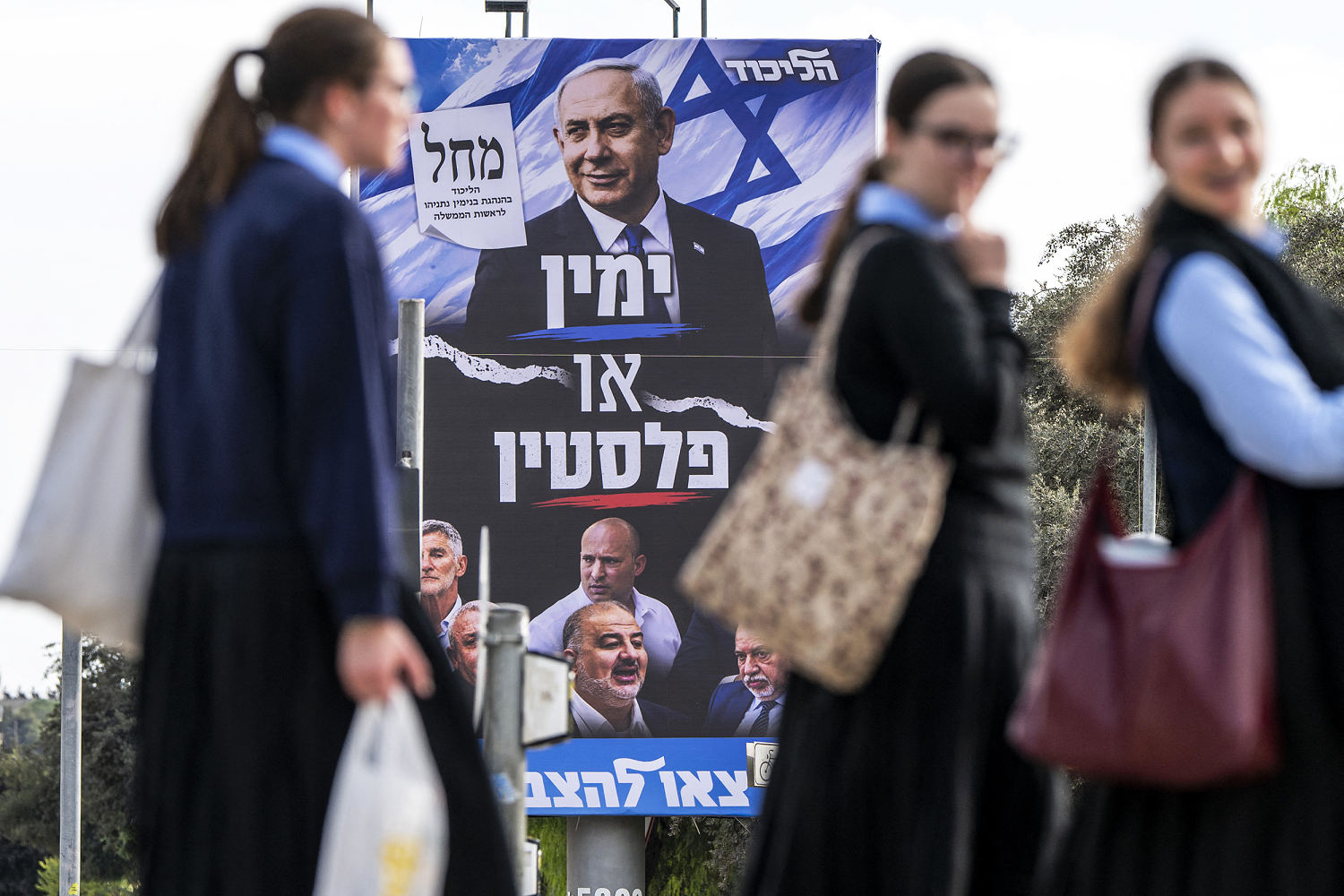
Both the Hamas massacre and the wars that followed loom over a vote shaping up not only as a referendum on Benjamin Netanyahu, but also the nature of the country that, as Israel’s longest serving prime minister, he has done so much to shape.
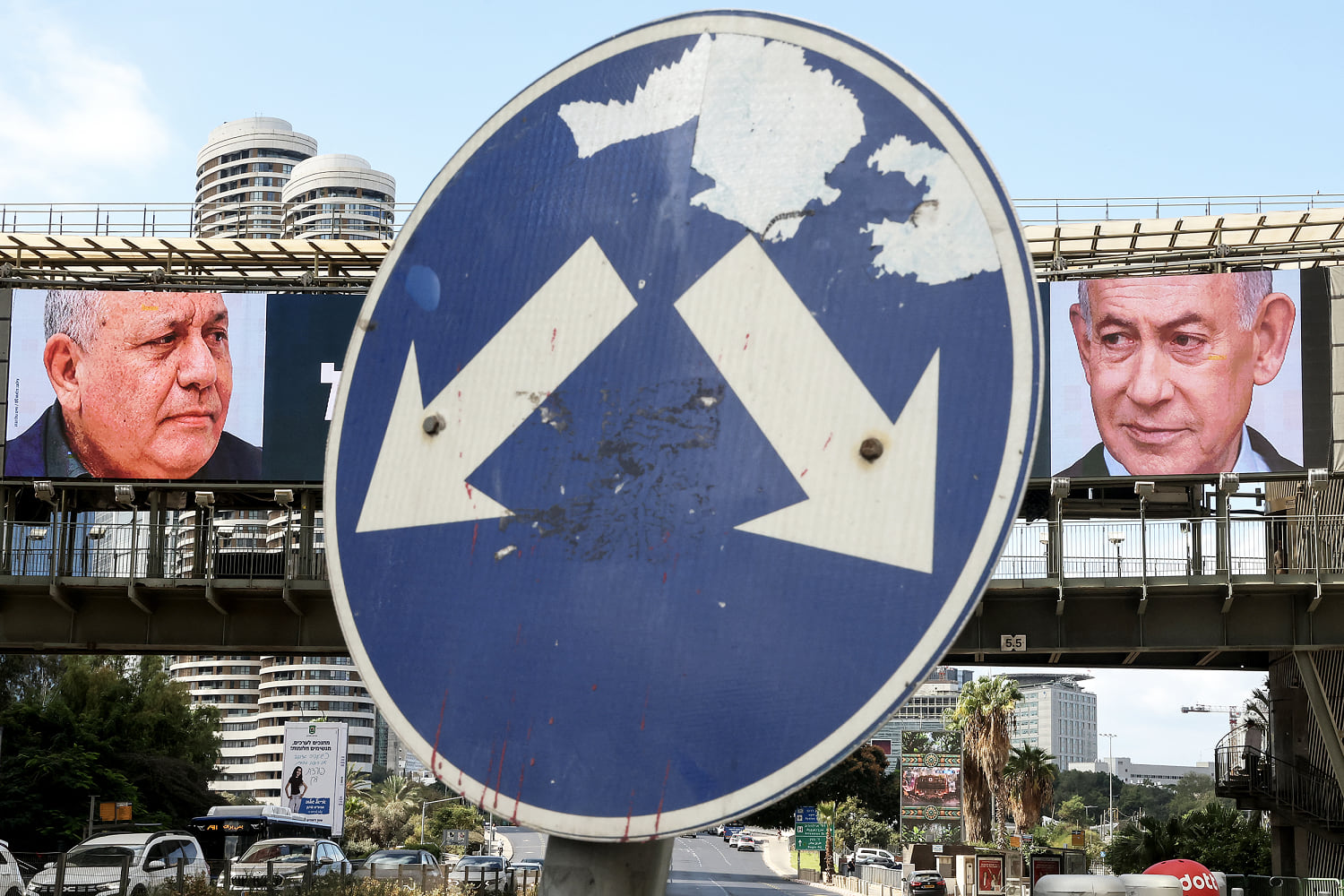
Arrayed against Netanyahu is a fractured field of challengers. There is Gadi Eisenkot, the former military chief whose reputation for honesty, sobriety, and competence contrasts with Netanyahu’s polarizing leadership; Naftali Bennett, the right-wing former prime minister seeking a comeback; Yair Lapid, the centrist former premier who has spent years trying to dislodge Netanyahu; and Avigdor Lieberman, the hawkish secular nationalist who has become one of Netanyahu’s fiercest adversaries.
Also on the ballot: Itamar Ben-Gvir and Bezalel Smotrich, far-right extremists whose parties made possible Netanyahu’s current coalition, and whose ambitions to annex the West Bank and resettle Gaza constrain his room to maneuver while damaging Israel’s standing abroad. The next government will either push Israel further down the path of religious nationalism, permanent conflict, and international isolation—or toward a new generation of leadership.
According to the polls, Netanyahu’s strongest challenger is Eisenkot, a soft-spoken, heavyset career soldier running as a centrist. His son, Gal, was killed fighting Hamas in Gaza, and one of his nephews also died in the war. Eisenkot is campaigning on a promise to restore public trust in government, rebuild Israel’s security, and heal the divisions that have fractured the country. “This election is about the identity of Israel,” Eisenkot told TIME in an interview on Oct. 20. “What will be Israel two weeks from now, 10 years from now, 20 years from now? This is the main question.”
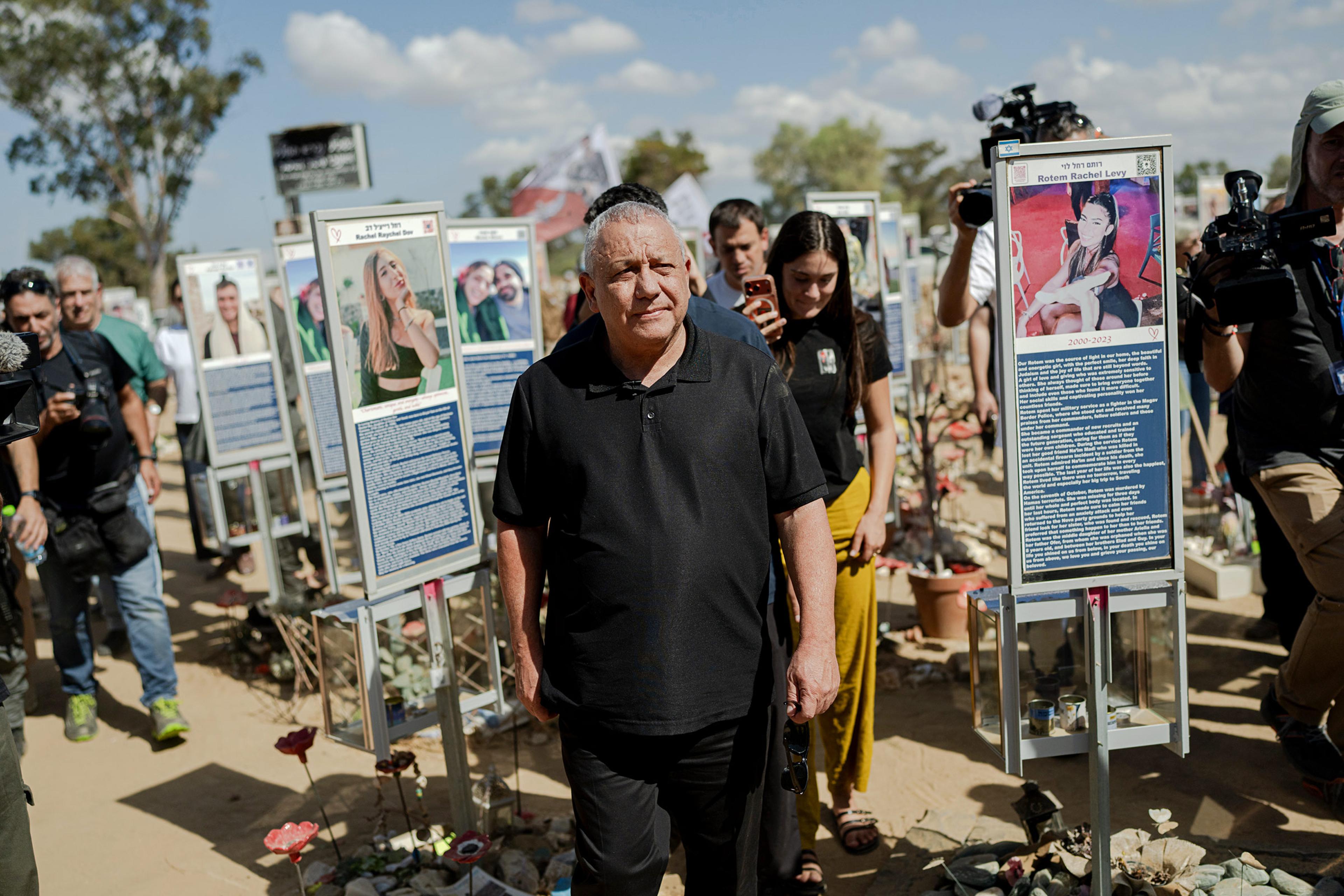
Gadi Eisenkot walks past memorial displays honoring victims at the Nova music festival site as Israel marks the third anniversary of the Oct. 7th 2023 attacks. Erik Marmor—Getty Images
Three years after Netanyahu’s political obituary was being written, pre-election polls show him running in a dead heat. On the eve of the vote, the nation is suffused with a sense of uncertainty; political analysts say almost anything can happen. Netanyahu and Eisenkot could form a unity government. Netanyahu could cobble together another right-wing coalition, dragging Israel further right. Eisenkot could join forces with Bennett, Lapid, and the Arab parties (20% of Israeli citizens are Palestinian) to oust Netanyahu, producing the closest thing Israel could muster to a center-left government. Or perhaps no bloc will manage to pull together the 61 Knesset seats needed for a majority, plunging Israel into another round of elections and a reprise of the paralysis that produced five contests between 2019 and 2022.
“The most probable scenarios currently are either there will be some sort of unity government, which again is very complicated politically because all of the opposition parties swear they don’t want it under Netanyahu, and I don’t see how Netanyahu is going to sit under them,” says Nimrod Nor, an expert on Israeli politics at Hebrew University. “The other is we’re going to have another election after this one.”
According to two sources familiar with Netanyahu’s thinking, he would prefer to form a unity government with Eisenkot. One reason is legacy. He believes such an alliance offers his best chance to transcend the worst security failure in the nation’s history, and to be remembered not only as the leader who emerged from the slaughter of Oct. 7 to decimate Hamas in Gaza and Hezbollah in Lebanon and persuade an American president to wage war against Iran, but also as the statesman who helped to reconcile a divided nation.
The other reason, the sources say, is personal. Netanyahu has little desire to form another right-wing coalition that would leave him beholden to the radical and uncompromising parties led by Ben-Gvir and Smotrich, both of which he brought into government four years ago to reclaim power. “He thought that he could control Ben-Gvir,” one Netanyahu aide says. “Now he knows that he can’t.”
That is precisely what the Israeli right fears he’s thinking, and what brought me to Neve Daniel. The settlement of capacious red-tiled homes is just across the Green Line that defined Israel’s borders before the Six-Day War of 1967. It was built on land that was a Jewish farm even before Israel was founded in the crucible of the 1948 war. Settler violence against Palestinians has risen sharply during Netanyahu’s tenure, but the militant settlers who make headlines by terrorizing their Palestinian neighbors tend to live on hilltops deeper into the West Bank than this.
But few, if any, of the 700,000 Israelis who live in settlements are leftist. Many regard Netanyahu as a cynical opportunist—a political chameleon who parrots their convictions but will do whatever it takes to survive. Among his many heresies, they say, is a long history of accommodating American presidents: signing the Wye River Memorandum under Bill Clinton to advance the Oslo peace process that aimed to create a Palestinian state; voting for the disengagement from Gaza under Ariel Sharon and George W. Bush; endorsing, at least rhetorically, a two-state solution and imposing a moratorium on settlement construction under Barack Obama; and, under Donald Trump, accepting a ceasefire and hostage-exchange agreement to end the war in Gaza.
Three people in Neve Daniel offer a revealing glimpse of the forces pulling Netanyahu rightward. Each plans to vote for a different party, but they all share an overriding objective: a right-wing government with Netanyahu at its center, constrained by allies who will keep him from drifting toward the middle.
Barak Moore is supporting Zehut, a libertarian nationalist party founded in 2015, whose eclectic platform combines tax cuts, the dismantling of monopolies, and cannabis legalization with an uncompromising vision of Israeli sovereignty and the removal of Palestinians from Gaza. It is something of a right-wing hipster party, blending free-market economics with religious nationalism.
Avi Abelow, 52, an activist who runs the website Pulse of Israel, is voting for Netanyahu’s Likud Party. His complaint is not that the prime minister has gone too far in Gaza, but rather that he has not gone far enough, hamstrung by a security establishment and governing coalition insufficiently committed to the nationalist cause. “We should have conquered all of Gaza and made sure it’s Jewish again,” he says.
The youngest of the three, Hershey Helner, is a 19-year-old Orthodox Jew who moved to Israel from New Jersey just months before Oct. 7. He is supporting Otzma Yehudit, the far-right party led by Ben-Gvir, whose confrontational politics and open contempt for established norms have made him a hero to some of Israel’s most fervent ideologues. Helner admires Ben-Gvir’s push to expand civilian gun ownership, permit Jewish prayer on the Temple Mount, and introduce the death penalty for terrorists.
To explain his thinking, Helner invokes one of the most consequential decisions in recent Israeli history: the 2011 deal that freed the Israeli soldier Gilad Shalit in exchange for more than 1,000 Palestinian prisoners. Among them was Yahya Sinwar, who would go on to mastermind the Oct. 7 massacre. Helner believes that sparing Sinwar’s life was a catastrophic mistake. “If you hanged him or put a bullet in the back of his head, not sure how the world would be now,” he says, “but it would definitely be better.”
For three years, Israel has been a nation at war, not only with its enemies but with itself. The extraordinary solidarity that followed Oct. 7 has given way to recriminations and ideological divisions, intensified by the trauma of war, the anguish of the hostage crisis, the pain of deepening antisemitism worldwide, and the unresolved question of who bears responsibility for such a stunning security lapse. Though Israel rejects the charge, critics accuse the country committing a genocide in Gaza, where the dead include both uncounted Hamas fighters and 20,000 children—and of countenancing a thuggish brand of ethnic cleansing in the West Bank. On Oct. 16, masked settlers were filmed attacking Palestinians and European diplomats in the West Bank, and injuring a Washington Post photojournalist.
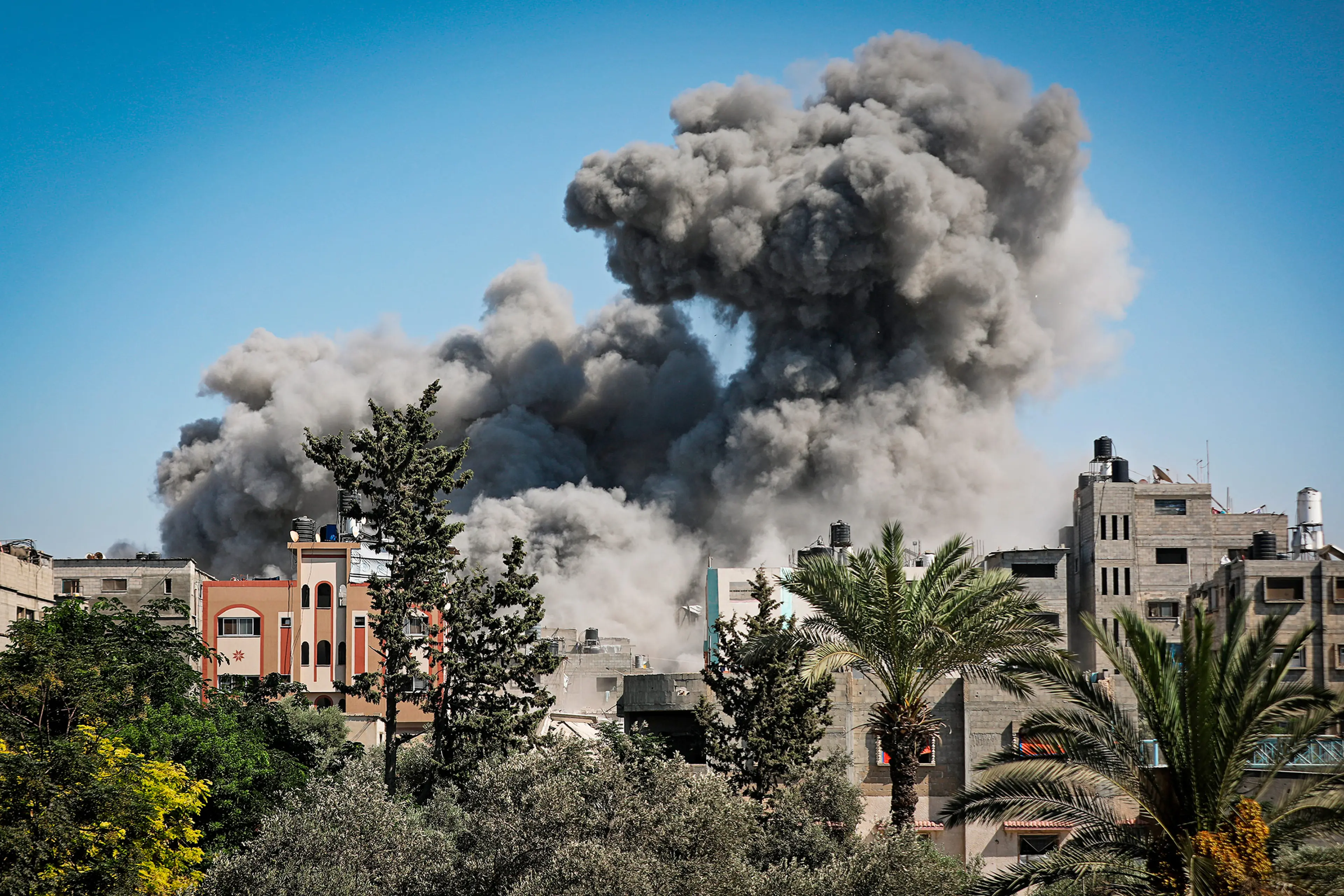
Smoke rises above Gaza after and Israeli air strike on Sept. 8, 2026. Moiz Salhi—Anadolu/Getty Images
The fault lines run through nearly every aspect of Israeli life. Secular and religious. Liberals and nationalists. Those obliged to serve in the military and the ultra-Orthodox who are not. Those who believe Israel must reach an accommodation with the Palestinians and those who want permanent Israeli control over the West Bank and Gaza. And, not least, those who regard Netanyahu as the indispensable guarantor of Jewish security and those who see him as the principal threat to the country’s democratic character and reputation abroad.
The fear increasingly voiced across Israel’s political and cultural establishment is that another Netanyahu victory could push those divisions toward a societal rupture. After Netanyahu’s coalition moved in early 2023 to restrict the power of the Supreme Court, the prospect of another government dependent on religious and ultra-nationalist parties has raised the specter of an exodus of young Israelis, who see the country’s liberal and democratic traditions slipping away. In a recent survey by the Agam Institute, an Israeli research firm, and the Hebrew University of Jerusalem, 59% of Israelis said they believe internal threats are greater than external ones, while 64% said they were considering leaving Israel, citing insecurity, living costs, and political instability. In a nation of roughly 10 million, even the departure of tens of thousands of highly educated citizens could have consequences far beyond their numbers, draining the country of the talent and investment on which its economic and military strength depends.
There is a deeper irony. Israel was founded as a refuge, a place where a people long subjected to persecution and exile could finally determine their own destiny. Some Israelis now contemplate leaving, not because they have lost faith in the necessity of a Jewish state, but because they fear the political direction of the state created to provide one.
For those contemplating a future abroad, there is an unsettling question: Where, exactly, would they go? Antisemitism has surged across much of the world, with 2025 marking the deadliest year for Jews in the diaspora in more than three decades, according to Tel Aviv University. Israel has become increasingly isolated, condemned in international forums, denounced in the streets of European capitals, and regarded by many critics as a pariah state. The result is a profound paradox: Israelis who fear for their country’s future wonder whether they would be any safer, or more welcome, anywhere else.
It is this siege mentality, the sense of a small nation standing alone against a hostile world, that Netanyahu is counting on to sustain his political survival. He has spent much of his career presenting himself as a leader hardened by history, experienced in diplomacy, and ruthless in the exercise of power. His message: Whatever Israelis think of him personally, whatever blame they assign him for Oct. 7, the world is too dangerous to entrust their security to anyone else.
The chasm between how Israelis see themselves and how much of the outside world sees them has rarely seemed wider. In the new documentary NAZA, Israeli filmmakers draw on the anonymous testimony of 24 soldiers and intelligence officers to expose what they describe as the military’s systematic use of artificial intelligence to identify Hamas targets in Gaza, even when commanders knew that bombing them would kill women and children. Inside Israel, meanwhile, the fifth season of Fauda, the country’s enormously popular television thriller, recreates the atrocities of Oct. 7 in harrowing detail, immersing viewers once again in the terror, grief, and vulnerability of that day.
One production focuses on the suffering Israel inflicted, the other on the suffering Israelis endured. Together, they illuminate the competing narratives of a war that has left Israel increasingly estranged from the world, and many Israelis feeling more besieged than ever. Indications from polls and analysts are that even after voters have their say, no one bloc will have mustered a legislative majority. At that point the leading vote-getter will have weeks to try to gather a coalition, a test of the kind of political leadership at which Netanyahu has long excelled.
For nearly three decades, Netanyahu has been the dominant figure in Israeli public life, his political fortunes rising and falling with the country’s anxieties and ambitions. He has survived scandals, indictments, electoral defeats, and repeated attempts to engineer his ouster. The question is whether a political system he has spent so long mastering can produce a future that no longer revolves around him.
In a country not yet 80 years old, many are ready to chart a new era. “I think that Eisenkot is the one,” says Livna Savir, 72, at a rally for the challenger on a basketball court in Kibbutz Netzer Sereni, outside of Tel Aviv. “It’s a change of direction.” With her children living in the U.S., she laments the impacts of the last three years on a once unified group: “What happened now in our country—it’s not good for the family.”




















 Bengali (BD) ·
 English (US) ·