.png)
 1 hour ago
5
1 hour ago
5
Students at universities across Russia are being promised high salaries, no front-line duty and a return to their studies within a year with free tuition if they join Russia’s newly formed drone force, meant to give Moscow an edge amid Ukraine’s significant leaps in drone warfare.
Subscribe to read this story ad-free
Get unlimited access to ad-free articles and exclusive content.

But rights activists told NBC News the offer could be a trap that would see students in the thick of the fighting in Ukraine, risking being drafted into front-line infantry units with no way out until the war ends.
The intense recruitment drive has accelerated since January, reflecting the increasingly crucial role of drone warfare in the conflict, now into its fifth year. Russia is sustaining heavy casualties, and the U.S.-led peace talks have stalled amid the focus on the Middle East.
Andrey, a student from the Krasnoyarsk region in Siberia, told NBC News he attended an event at his university in February where a man from the military enlistment office as well as a veteran of what Russia calls its “special military operation” told students, all young men, about the new drone force and its personnel needs.
They were told about all sorts of benefits of joining, said Andrey, who did not want his last name, age or the name of his university published out of fear of potential repercussions for speaking about a sensitive security topic during the war.
“It was irritating because it felt forced,” he said in a Zoom interview last month, adding that no one told them about potential drawbacks of signing a contract.
“No one wants to join,” Andrey said. “No one is interested. Everyone understands that it’s not as they say it is.”
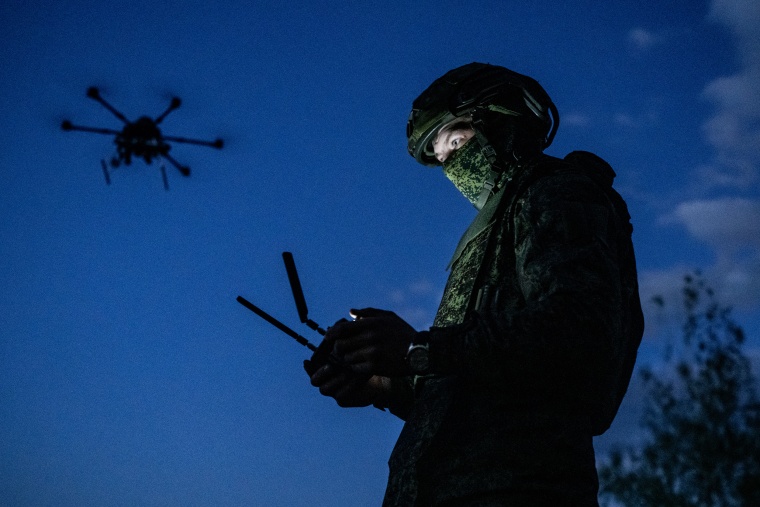 A Russian soldier operates a drone on the battlefield in Lyman, eastern Ukraine on April 28.Sergey Bobylev / Sputnik via AP
In January, Russia’s Defense Ministry announced that it was recruiting into the drone forces, which were formed in November 2025 as a new branch of the Russian army, saying it was looking for people with experience in flying drones, aircraft modeling, tech, electronics and radio engineering. Good “analytical, vestibular and fine motor skills, and computer proficiency” were a plus, the ministry said.
A recruitment video that the Defense Ministry posted to Telegram last week centered on an “honest account” of a former student who is “now mastering drone operations as a contract pilot.” The video features video game-style shots of a drone being piloted remotely, while rock music plays in the background. “I thought our motherland needs young, nimble specialists,” the man said in the video.
Ukraine and Russia are in a fierce competition for drone dominance in the ever-shifting battlefield. Ukraine has focused on cutting-edge drone technology and battle testing to give it the upper hand and help hold back Moscow’s bigger military. With drones increasingly used to kill on the battlefield, their pilots have become key targets for both sides — a reality that’s absent from the recruitment material.
Danila, a student from Moscow, told NBC News in a Zoom interview last month that he was strongly encouraged by the dean’s office at his university to attend an event with a “potential employer,” which turned out to be the Defense Ministry.
Danila, who like Andrey did not want to reveal his last name, age or the name of his university out of concerns for his safety, said he declined to attend. “I study humanities, so it was weird for me to hear this offer,” he said.
Both Danila and Andrey said posters around campus and their universities’ websites promoted the drone force recruitment drive.
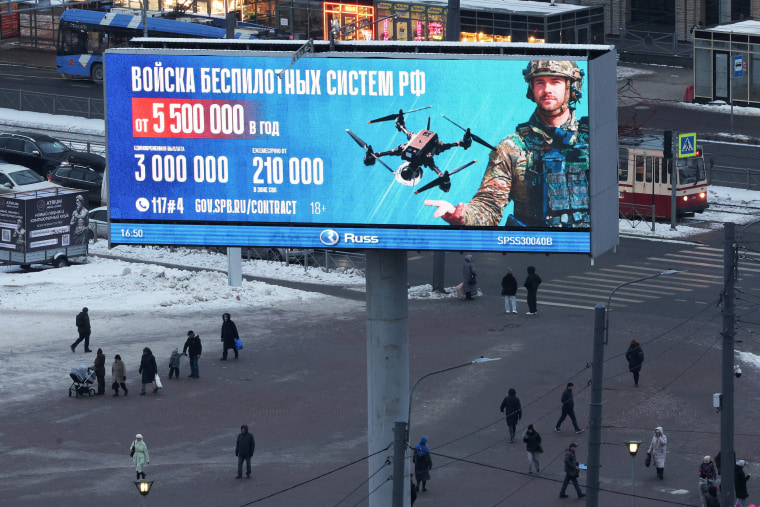 People in St. Petersburg walk under a billboard advertisement promoting contract military service in the Russian army’s unmanned systems forces on Jan. 26.Anton Vaganov / Reuters
Russian President Vladimir Putin ordered a partial mobilization of reservists in late 2022, a hugely unpopular measure that led to a mass exodus of men who feared being drafted into the war. Since then, the Kremlin has stayed clear of announcing any new mobilization efforts.
But what’s been happening to Russian students in recent months amounts to “quiet mobilization” by the government, according to Grigory Sverdlin with the Idite Lesom organization that helps Russians avoid military duty in Ukraine. In a post on X last month, Sverdlin said his group has been approached by students from universities and colleges across the country.
The Kremlin has sought to dispel what it says are “myths and rumors” about the recruitment drive, with Deputy Defense Minister Viktor Goremykin saying last month: “We have no intention and ability to force students to participate in the special military operation.”
The Defense Ministry issued that public statement after NBC News reached out for comment on the nature of the contracts for students but did not hear back.
Kremlin spokesman Dmitry Peskov said last month that an “offer” for those who have the relevant competencies to join the drone force applies equally to everyone, including students.
Student news portal Groza estimated last month that at least 269 Russian universities and colleges had promoted service in the drone forces among their students, including those in occupied parts of Ukraine. There is no official data on how many students have been recruited so far.
Timur Tukhvatullin with Molnia, a human rights project helping Russian students defend their right to education, told NBC News they have had their lawyers get involved in cases of school administrators pressuring students into signing a contract, but the amount of pressure students encounter can vary greatly. “Some might be more ideologically charged and, maybe, they might start believing themselves that they don’t mind sending their students to war,” he added.
NBC News reviewed postings on websites and social media accounts of more than a dozen Russian universities and colleges, most of which had a virtually identical message: Sign up to serve in the drone forces for money and other benefits, but more importantly, to be your country’s hero.
The Far Eastern Federal University in Vladivostok promised its students an extendable academic leave and tuition-free education upon return from the war in a message on its website, which claimed students could make as much as 5.5 million rubles (about $74,500) in the first year of service alone, a substantial sum for young people in the region. It also promised a financial bonus from the university itself. An average annual salary in Russia hovers around 1.25 million rubles or around $17,000.
Like many others, the Moscow State University of Civil Engineering emphasized in its online memo that its students would be signing a “special contract” with the Defense Ministry, while St. Petersburg’s Russian State Hydrometeorological University promised students who sign up would “carry out combat missions at a distance” while receiving bonus payments from the local government.
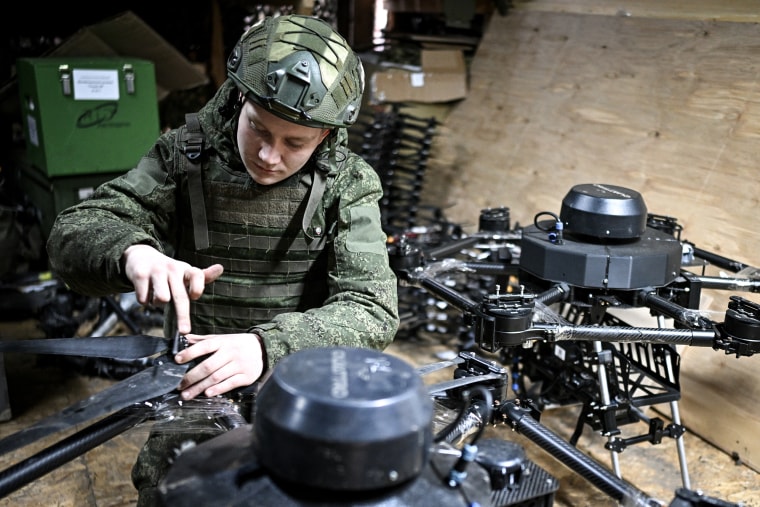 A young Russian soldier works on a Vampire drone in Lyman, eastern Ukraine on April 28.Sergey Bobylev / Sputnik via AP
Meanwhile, a recruitment banner on the Ural College of Applied Arts and Design website featured an image of a drone pilot with glowing eyes.
Artyom Klyga, a human rights lawyer with the Movement of Conscientious Objectors, which helps those refusing military service, told NBC News the promises being made to students are not grounded in Russian law.
There is no guarantee that students who sign up will serve for only one year, he said, and the Defense Ministry also can’t guarantee students will actually serve in the drone forces rather than be made to join the infantry or any other force.
The Defense Ministry said last month that “coercion” into signing a contract won’t be tolerated and that those who sign up for drone forces would not be transferred into any other military unit against their will.
Klyga said his group is advising students to avoid signing a military contract at all costs because once that happens, “they literally become the subject of the Defense Ministry.”
“This pressure will only get worse,” he said. “We will be dealing with this all year and probably into 2027 if the war doesn’t end.”




















 Bengali (BD) ·
  English (US) ·