.png)
 1 hour ago
5
1 hour ago
5
VIENNA — New voting rules. A boycott. But still a camp cavalcade of pop music.
Subscribe to read this story ad-free
Get unlimited access to ad-free articles and exclusive content.

The annual contest that captivates Europe is back, but this year’s Eurovision Song Contest finds itself facing a geopolitical firestorm that threatens to eclipse the onstage pyrotechnics.
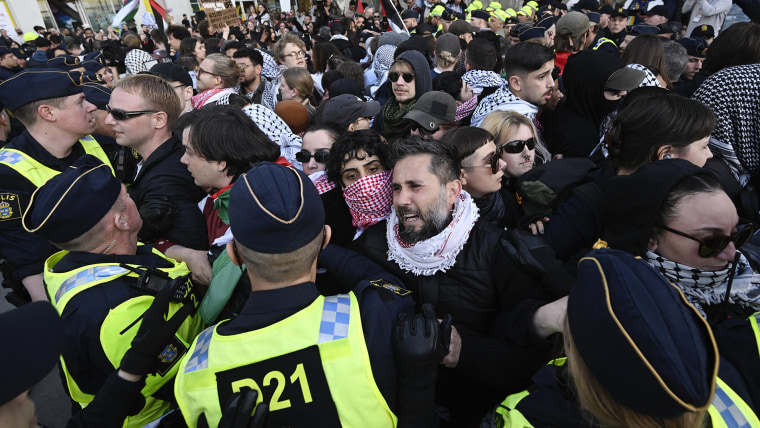
Security is high in the Austrian capital, Vienna, where this year’s contest is taking place this week. Police say they expect both authorized pro-Palestinian protests as well as unauthorized attempts to try to disrupt the event.
Eurovision can be a befuddling spectacle — a viewer tuning in to Tuesday’s semifinal will see a heady mix that includes a Moldovan rapper extolling the virtues of his country, a silver-painted Lithuanian singer dancing robotically, and ‘80s new wave star Boy George, seemingly inexplicably, competing for San Marino.
That chaos is part of the appeal, contest director Martin Green told NBC News in an interview.
“Some people love it as a piece of spectacle. Some people love the songs. Some people love when it’s a bit silly and camp. Some people love when it’s emotional. But what it always is annually is an excuse for friends and family to gather together to argue about which song is best and just enjoy the whole spectacle,” he said.
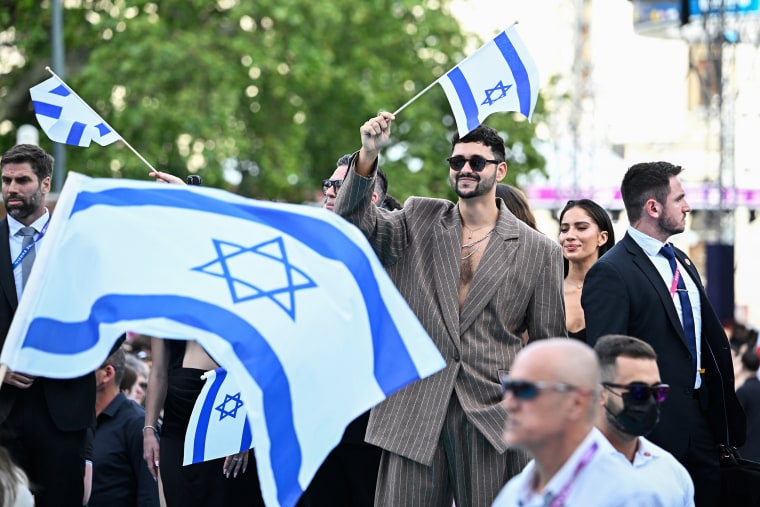 Israeli singer Noam Bettan at the opening ceremony of the Eurovision Song Contest in Vienna on Sunday.Tobias Schwarz / AFP via Getty Images
As the contest celebrates its 70th edition this year, though, the spectacle garnering the most discussion is happening offstage.
Five countries — Spain, Slovenia, Iceland, Ireland and the Netherlands — have pulled out of the contest over the continued participation of Israel, driving the number of participants to its lowest level since 2003. The winner in 2024, Swiss singer Nemo, returned their trophy in protest at Israel’s inclusion.
While Israel’s deadly military assault in the Gaza Strip has fueled protests and political blowback across much of Europe, there is also outrage over a perceived Israeli effort to leverage its involvement in the song contest for soft power.
The results of the contest, which organizers say reached 166 million viewers last year, are decided by a mix of votes from juries of music professionals and votes from viewers at home in each country. Last year, despite being ranked 15th by the juries, Israel handily won the televote and secured second place overall.
While countries can’t vote for their own act, viewers last year were able to vote up to 20 times for their favorite artist. Israel made a concerted push for support, with Prime Minister Benjamin Netanyahu even posting on social media urging followers abroad to vote for Israel the maximum amount.
This year, the rules have been tweaked so that only 10 votes can be cast, and broadcasters have been told they should not be directly encouraging people to max out their votes.
Israel’s entry is Noam Bettan. His song, “Michelle,” blends English, French and Hebrew, describing attempts to quit a toxic relationship.
“Governments don’t take part in Eurovision. Public broadcasters do,” Green noted. “But there was a feeling last year that there was some influence being exerted, and, of course, a very passionate debate going on globally about activities in the Middle East.”
He added that he hoped the five countries would return.
This is not the first time Eurovision has found itself in trouble, according to Dean Vuletic, an academic who has written a book about the contest. He cited a period in the 1960s when the contest was at risk of collapsing altogether.
“Eurovision has been in many crises. It’s weathered many controversies throughout its history,” he said. “So I just see this as another chapter in that history.”
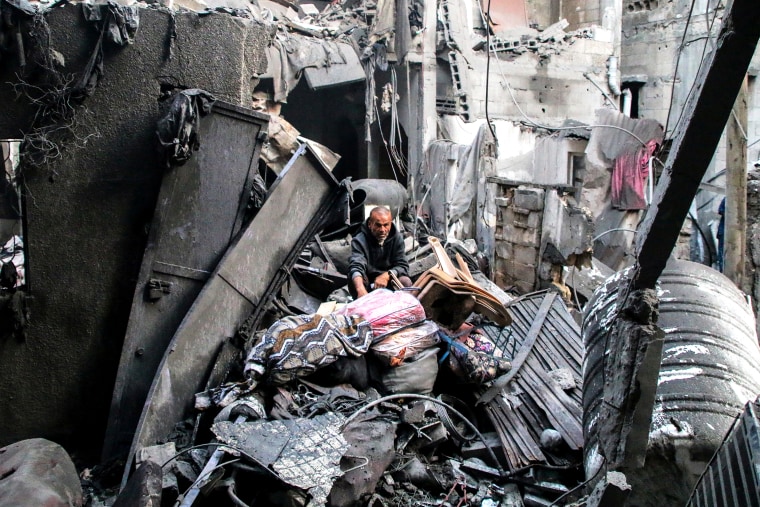 Palestinians inspect damage in the Al-Shati refugee camp after Israeli airstrikes on Saturday in Gaza City. Ahmad Hasaballah / Getty Images
While the boycott is keeping some broadcasters and fans away, and protests are planned throughout the week, the contest continues apace. Vuletic pointed to the fact that tickets sold out fast and that plenty of fans, even ones from countries that are boycotting, have flocked to Vienna.
On Tuesday afternoon, hundreds crowded into a room at the Wien Museum to see Cyprus’ Antigoni perform her upbeat dance track, “Jalla.” It was the first of the day’s free concerts from this year’s acts at the venue, which has been temporarily rebranded as the Eurofan House.
For the contestants, Eurovision remains an unparalleled opportunity to build a worldwide fanbase.
Delta Goodrem is already a superstar in her native Australia with a stack of No. 1 albums. She’s entering Eurovision with a dancy power ballad called “Eclipse.”
She said she was drawn to Eurovision’s international reach. “It’s such a monumental, iconic stage in itself,” she said in a phone interview this week. “I get to do what I love to do and be able to reach through and connect with millions of people.”
For Vuletic, the path out of the controversy clouding the contest has little to do with the rules.
“It’s not going to be determined by Eurovision. It’s going to be determined by broader international politics,” he said.
Contest executive Green hopes longtime viewers will stick around, and that new fans can still be won over.
“If you’ve never seen it before, try it for five minutes,” he said. “I guarantee you will still be there at the end.”


















 Bengali (BD) ·
  English (US) ·