.png)
 54 minutes ago
7
54 minutes ago
7
BEIJING — The exposed plastic and aluminum has kept even the most human-like robots feeling unmistakably artificial.
Subscribe to read this story ad-free
Get unlimited access to ad-free articles and exclusive content.

But X-Humanoid in Beijing is hoping that will change soon, as it gave NBC News a tour Thursday around its sprawling facility where it showed off a bionic face prototype, complete with hair and artificial skin.
“If the robots look more like humans, they can do a lot of stuff that humans can do,” said Nikita Gao, who handles the overseas market for the company.
Chinese robotics has advanced at a breathtaking pace as the tech race between the United States and China heats up in several key areas, including AI. Beijing has put the industry front and center of its national agenda, with its latest five-year plan vowing to “target the frontiers of science and technology.”
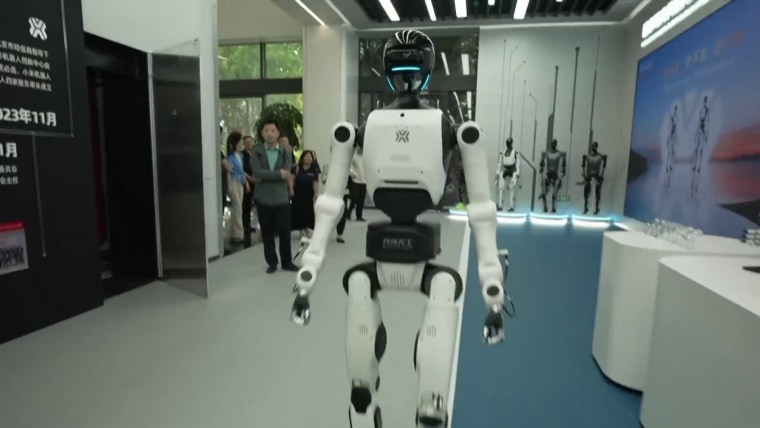
Humanoid robots are a big part of it, and Beijing is hoping that they can help take care of its rapidly aging population.
Just last year, robots in Beijing stumbled through a marathon with only six managing to cross the finish line in an almost comedic performance.
But this year, more than a hundred robots took to the streets for the same race, and the winner blazed through the 13-mile course in just over 50 minutes, even surpassing the human world record for a half-marathon by seven minutes, set by Ugandan long-distance runner Jacob Kiplimo in Lisbon earlier this year.
More from NBC News in China
- Xi warns Trump of possible conflict over Taiwan at grand Beijing summit
- Secretary of State Rubio on what Trump and Xi discussed in Beijing
- Young Chinese facing ‘life pressure’ resist government push to boost marriage rate
- Pandas set for 8,000-mile blind date in Atlanta
- Chinese EVs take the world by storm — except in the United States
- China’s Great Wall is being restored one brick at a time
This year, a Lunar New Year gala on Chinese state broadcaster CCTV featured notably more advanced robots than the one last year, with somersaults and coordinated martial arts movements.
But it’s not just the human-sized or the cute dog-sized robots that Chinese companies have unveiled. On Tuesday, China’s Unitree Robotics unveiled a nearly 9-foot-tall humanoid robot with a cockpit capable of carrying a human inside — a real-world nod to the mecha machines that many sci-fi fans have long dreamed of, or feared.
Standing beside the towering robot, Unitree’s chief executive, XingXing Wang, barely reached the end of its arm, a video posted by the company on X showed.
Unitree Robotics says its machine, priced at $650,000, is the first of its kind. Typically walking on its two legs, the GD01 can also transform into a quadruped machine, weighing more than 1,100 pounds with a person inside.
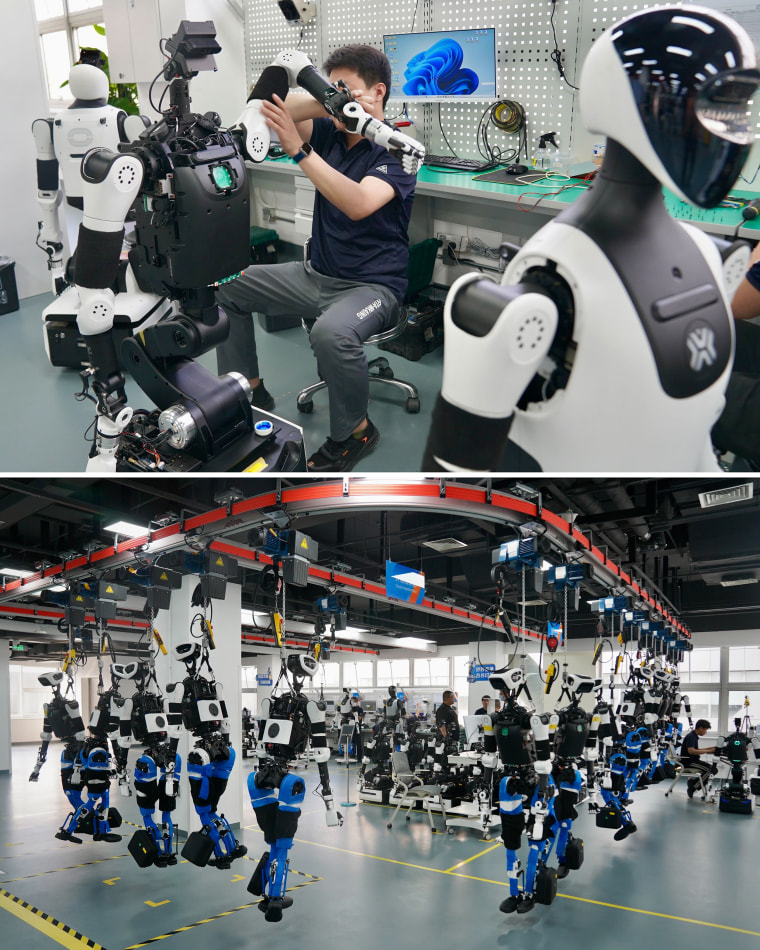 A production line at X-Humanoid in Beijing. Ignacio Torres / NBC News
Elon Musk, whose company Tesla also makes humanoid robots, has called the Chinese bots “cool.” Musk was in Beijing this week as part of President Donald Trump’s state visit. Trump said his meeting with President Xi Jinping went well and expressed hope for more American collaboration with China.
But there is still much room for improvement in what these robots can do physically and autonomously, meaning without remote direction.
“Where all of the robotics industry needs to improve is in the brains of these robots, in the software that allows these robots to actually do the things we want, whether they be in a house or an industrial setting,” said Joanna Stern, NBC News’ chief technology analyst.
Before these robots can wash dishes or fold laundry, manufacturers need vast amounts of real-world data to train them. Several companies, including U.S. firms, are now offering cash to people willing to strap iPhones to their bodies and record their every move.
Over at X-Humanoid, Gao said, though their robots are powerful, the company doesn’t want its robots to be militarized but added that there was real value in emergency or dangerous tasks.
At its facility, the robots move through each stage of production: assembled, tested and programmed. Designed to crawl through tight crevices or trudge across rough terrain, X-Humanoid says they’re being built for jobs that humans would rather not do. The company stresses that displacement is not the goal.
“We want the robot to help people, free people from this dangerous, harsh, repetitive working environment,” she said, pointing to tasks like power inspections.
In one part of the facility, several dozen half-finished humanoids were lined in a grid, waiting for their heads to be attached. They had no legs, but instead their torso tapered into a boxy wheeled unit.
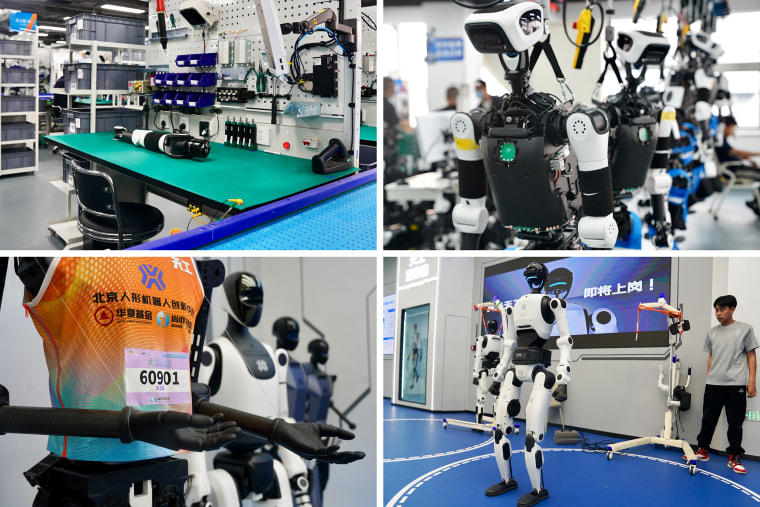 The X-Humanoid robotics lab, top, and humanoids on display, below.Ignacio Torres / NBC News
Chinese companies like X-Humanoid have emphasized the human-like qualities of their robots to consumers. However, experts say most tasks do not benefit from a humanoid structure.
“Not every robot in the factory really has to look like a person. They don’t all need legs,” said Dan Wang, an expert in Chinese technology and a research fellow at the Hoover Institution at Stanford University.
“So maybe this is more of a performance,” said Wang, the author of “Breakneck: China’s Quest to Engineer the Future.”

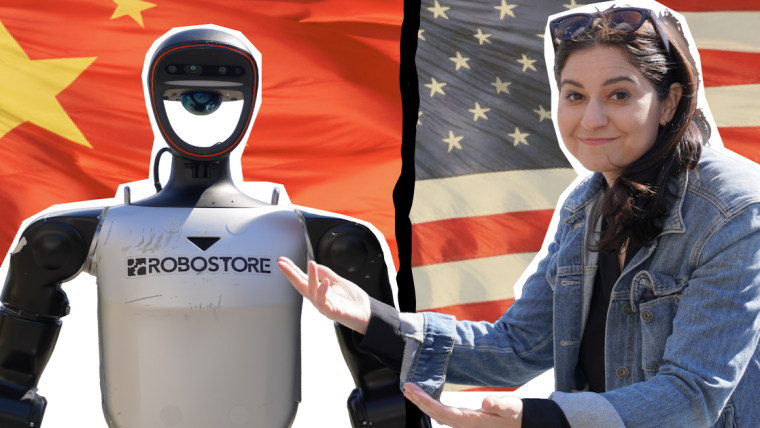
But he said, “I think the Chinese government definitely has this plan that more humanoid robots are going to be taking care of the elderly, taking care of the children, especially since society is aging super rapidly.”
Standing before a bionic face that still falls short of the lifelike standard the company is chasing, Gao says there’s work to be done before these robots can truly feel human.
“In the future, I think it will look more cute,” she said.
Tom Llamas and Dawn Liu reported from Beijing, and Mithil Aggarwal from Hong Kong.

























/https%3A%2F%2Fsportsmole-media-prod.s3.gra.io.cloud.ovh.net%2Fuploads%2F2026%2F05%2Fchamp-69fa166311171530187348.jpg)
 Bengali (BD) ·
  English (US) ·