.png)
 58 minutes ago
7
58 minutes ago
7
Government bonds around the world sold off sharply Friday as the price of oil jumped, both driven by an array of geopolitical developments in the Iran war, politics and trade.
Subscribe to read this story ad-free
Get unlimited access to ad-free articles and exclusive content.

The yield on a 30-year U.S. Treasury bond rose above 5.12%, its highest level in nearly a year. If it closes above that level, it would be its highest close since 2007.
On Wednesday, the Treasury Dept. also sold 30-year bonds above 5% for the first time since 2007. The 10-year Treasury note’s yield also surged to nearly 4.56%, its highest level since mid-May of last year.
U.S. crude oil jumped more than 4% Friday to more than $105, bringing its gain this week to more than 9%. International Brent oil rose nearly 3.5% to over $109 per barrel. Brent has gained 7% this week.
Stocks dropped sharply in early trading, with S&P 500 sliding 1%, the Nasdaq Composite falling 1.3% and the Dow Jones Industrial Average tumbling 430 points.
The latest market turmoil also puts further pressure on consumers. Oil’s rise threatens to drive retail gas prices higher, while spiking bond yields set the stage for higher consumer lending rates.
As of Friday morning, the average price of unleaded gas was holding steadily above $4.50 per gallon, up 51% since the Iran war started.
Few deliverables from Beijing
The moves in bonds, oil and stocks gained momentum as President Donald Trump and his top officials discussed their historic summit with Chinese officials in Beijing.
So far, the trip does not appear to have resulted in many major business or trade deals, known as “deliverables” in diplomatic-speak.
“Markets didn’t hear enough from Beijing to turn more optimistic on the [Persian] Gulf,” ING analysts wrote in a note to clients on Friday.
Earlier in the week, tech stocks had rallied after Nvidia CEO Jensen Huang joined Trump’s trip to China at the last minute. Markets viewed Huang’s participation as a sign that U.S. export controls to China might be partially lifted.
But those hopes were quickly dashed. “We did not talk about chip export controls at the meeting” between Trump and China’s President Xi Jinping, said U.S. Trade Representative Jamieson Greer on Bloomberg Television Thursday.
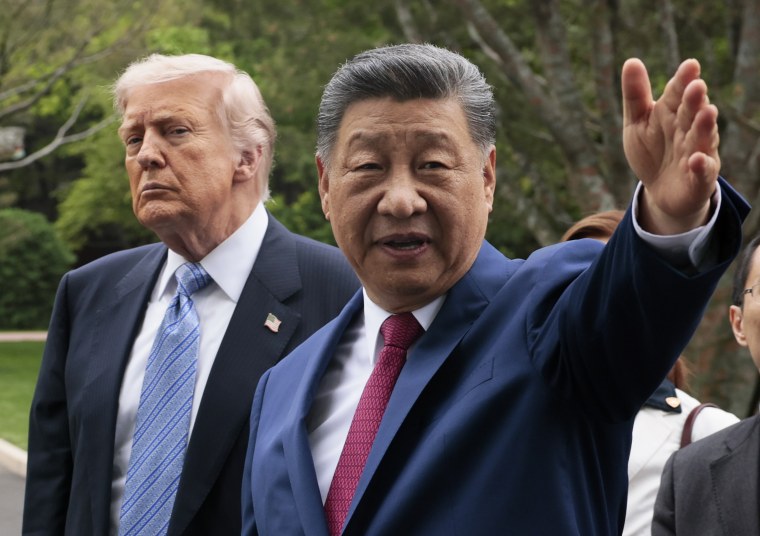 President Donald Trump and Chinese President Xi Jinping tour Zhongnanhai Garden in Beijing on Friday.Evan Vucci / Getty Images
Meanwhile, Trump himself said that tariffs — one of the central aspects of the U.S.-China relationship — did not come up in his meeting with Xi.
Several Trump administration officials said the delegations talked about creating a “board of trade” with China, but provided few further details.
The status of a U.S. trade truce with China, which eased export controls, lowered tariffs and cooled tensions was also not clear. The truce, which exists in the absence of a more formal trade deal, expires in November. Asked about the possibility that the truce would be extended, Greer replied “we’ll see about that” in the Bloomberg interview.
Little progress on Hormuz
U.S. officials have also given conflicting answers for days as to whether China will take a more active role in re-opening the critical Strait of Hormuz.
On Friday morning, Trump said he did not ask Xi to use China’s considerable leverage over Iran to encourage the country to open the strait to vessel traffic.
“I’m not asking for any favors, because when you ask for favors, you have to do favors in return,” the president told reporters aboard Air Force One. “We don’t need favors.”
But ever since the war with Iran was launched on Feb. 28, transits through the crucial waterway have effectively ground to a halt. Before the war, vessels used the strait to carry more than 20% of the world’s energy supply to the global market every day.
Trump also reiterated Friday that Iran’s most recent offer to end the war was “not enough.”
The closure of the Strait of Hormuz has caused oil prices to surge more than 80% this year and sparked inflation across the U.S. economy. The Consumer Price Index for April hit 3.8%, its highest level in three years. An index measuring wholesale prices hit 6% last month.
No details on a Boeing deal
Throughout his trip, Trump also floated a potential agreement in the private sector, a deal for China to buy hundreds of Boeing planes.
But was unclear Friday whether a deal had been reached between Boeing and a Chinese airline that would make the actual purchase of the planes.
“I think it was a commitment,” Trump said on Fox News Channel. “I mean, you know, sort of like a statement, but I think it was a commitment.”
Receiving an order for planes from an airline in China would be a boon for Boeing, which has not seen any major orders from the country in years.
That said, Boeing’s current order backlog stretches to thousands of planes. so any delivery of aircraft in a Chinese deal could take between five and 10 years.
Global markets sell off
Markets in Europe also sold off in Friday trading. The Stoxx 600 fell 1.5%, while benchmark indexes in Germany and Italy slid more than 2%.
A selloff in bonds around the world also contributed to the broader market woes. In the U.K., the yield on a 10-year government bond (called a gilt) surged to its highest level since 2008 amid political turmoil that could cost Prime Minister Keir Starmer his job. The 30-year gilt yield hit its highest since 1998, driven in part by investor fears that a new, more liberal prime minister could further hike government spending and loosen the country’s fiscal policy.
In Japan, which is heavily exposed to the Middle East energy shock, the yield on a 10-year government bond surged to its highest level since 1999. In Germany, bund yields haven’t been this high since 2011.
Anxiety over inflation is gripping European and Asian economies as energy prices continue to climb. European natural gas futures were higher by more than 4% early Friday, adding to its more than 80% jump so far this year.




















/https%3A%2F%2Fsportsmole-media-prod.s3.gra.io.cloud.ovh.net%2Fuploads%2F2026%2F05%2Fchamp-69fa166311171530187348.jpg)
 Bengali (BD) ·
  English (US) ·