.png)
 3 days ago
23
3 days ago
23

Article content
Nathan Buhler’s first request for an analog room came from an audiophile whose record collection was sizable enough to warp the floorboards. The client sought out Buhler’s Toronto-based firm, BLDG Workshop, to relocate the extensive vinyl library from the home’s basement to its main floor.

THIS CONTENT IS RESERVED FOR SUBSCRIBERS
Enjoy the latest local, national and international news.
- Exclusive articles by Conrad Black, Barbara Kay and others. Plus, special edition NP Platformed and First Reading newsletters and virtual events.
- Unlimited online access to National Post.
- National Post ePaper, an electronic replica of the print edition to view on any device, share and comment on.
- Daily puzzles including the New York Times Crossword.
- Support local journalism.
SUBSCRIBE FOR MORE ARTICLES
Enjoy the latest local, national and international news.
- Exclusive articles by Conrad Black, Barbara Kay and others. Plus, special edition NP Platformed and First Reading newsletters and virtual events.
- Unlimited online access to National Post.
- National Post ePaper, an electronic replica of the print edition to view on any device, share and comment on.
- Daily puzzles including the New York Times Crossword.
- Support local journalism.
REGISTER / SIGN IN TO UNLOCK MORE ARTICLES
Create an account or sign in to continue with your reading experience.
- Access articles from across Canada with one account.
- Share your thoughts and join the conversation in the comments.
- Enjoy additional articles per month.
- Get email updates from your favourite authors.
THIS ARTICLE IS FREE TO READ REGISTER TO UNLOCK.
Create an account or sign in to continue with your reading experience.
- Access articles from across Canada with one account
- Share your thoughts and join the conversation in the comments
- Enjoy additional articles per month
- Get email updates from your favourite authors
Sign In or Create an Account
or
Article content
“The plan was to create the ultimate listening space,” says Buhler. “We renovated the entire house and built the audio room right in the middle. Everything else, the kitchen, the bathrooms, every other living space wrapped around it.” The acoustics were so spectacular, according to Buhler, that you could sit in one prime spot and feel like the band was right there with you. To test the space, the client played a rare 4AD Dead Can Dance 180-gram vinyl pressing. “It really was mind-blowing,” Buhler says.
Article content
Article content
Article content
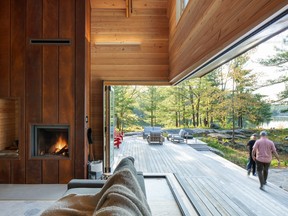
This interior design trend of working analog spaces into the plans reflects a return to tangible hobbies, a desire for more screen-free family time and a reduction in overstimulating interiors. “People are moving away from that sort of Calgary suburban home with the gas fireplace inlaid with thin stone tiles on it, and a gigantic television on top,” explains Buhler. As an alternative, and as a backlash, to digital overwhelm, he says people are requesting rooms that promote a digital detox: sofas that face each other rather than a screen, comfortable armchairs with proper reading lights, tables and storage for board games, even tables printed with a checkerboard on them.
Article content

Article content
Not all analog rooms are meant to be recreational, however. “In one of the homes I recently designed for a client, there was a stand-alone library and a work room with just an easel for jotting notes down,” he says. “Even though this was a physical office, it wasn’t centred around a computer.” Other popular analog or “screen free” room requests include bedrooms, meditation rooms, hot yoga rooms, party rooms with billiards, and libraries.
Article content
Article content
Canadian musician and author Dave Bidini turned his garage into an analog hangout for relaxing with friends and family. “Initially we had to empty it out,” laughs Bidini, noting that he had rented the space to someone who turned out to be a hoarder. “That meant getting rid of pylons, pool tables, chairs and everything else.”
Article content
Article content
Now Bidini uses it to house his prize possession, a 1973 Rowe AMI jukebox, and a ping-pong table. “It’s nice to have a tech-free zone,” he says. “Obviously for mental health reasons. So many of us don’t want to work on our screens all day long.” Bidini says that analog spaces like his also naturally invite conversation, and music-playing, in the company of friends.
Article content
According to Luke Havekes, principal at the Montreal-based Luke Havekes Design, “people are looking for houses with multiple screen-free rooms that are purpose-based – whether that means a bedroom for sleeping, a craft room for scrapbooking or a sunroom to cultivate house plants.” He’s also seeing libraries “coming back in a big way.”
Article content

Article content
“My clients don’t want high-tech homes,” he says. “They want an aesthetic environment where, if a screen is part of the room, it’s hidden.” He believes part of the appeal of material luxury – being surrounded by “noble materials like leather, marble, metal or natural fibres,” as opposed to synthetic materials and plastics that signal cheapness.



























 Bengali (BD) ·
  English (US) ·