.png)
 1 hour ago
7
1 hour ago
7
Although it has been nearly a week since the four Artemis II astronauts completed their mission around the moon, the crew said Thursday that they have not yet fully come down to Earth mentally or been able to reflect on the big moments of their journey.
Subscribe to read this story ad-free
Get unlimited access to ad-free articles and exclusive content.

“I haven’t spent a lot of time processing all of this,” NASA astronaut Victor Glover told NBC News in response to a question about the final moments of the flight, when the Orion capsule streaked through Earth’s atmosphere at more than 24,000 miles per hour.
“I will say it was just a very intense moment, because we had never seen or felt this before. Everything was important, every noise, every mechanism,” Glover said.
Glover and his crewmates — NASA astronauts Reid Wiseman and Christina Koch and Canadian astronaut Jeremy Hansen — were the first people to launch aboard NASA’s Space Launch System rocket and Orion capsule. Tensions were especially high during their final descent because the spacecraft had a known design flaw in its heat shield; NASA is still investigating the details of the shield’s performance.
“I could tell we were in a fireball,” Glover said, describing the plasma outside the spacecraft during atmospheric re-entry. He admitted his first thought was, “Is it supposed to be that big?”
When the hatch opened after they splashed down, Koch said, “I was completely overcome.”
“I just screamed. I was so happy,” she said. “It was just pure elation and just a visceral, emotional reaction to not only being home, but people there coming to us and bringing us out — just unspeakable joy.”
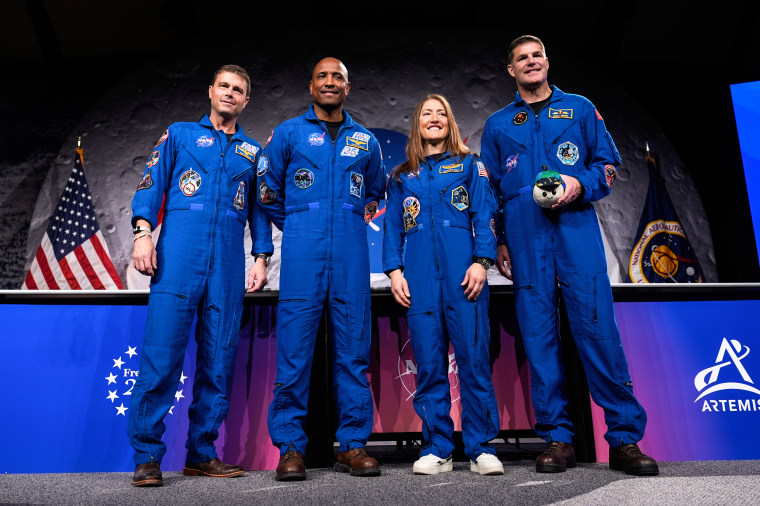 NASA's Artemis II crew — Reid Wiseman, Victor Glover, and Christina Koch and Jeremy Hansen pose for a photo during a press conference on Thursday in Houston. Ashley Landis / AP
The Artemis II mission notched a number of firsts. Wiseman, Koch, Glover and Hansen became the first people ever to see the entire far side of the moon with their own eyes, as well as the first astronauts to witness a solar eclipse from the moon. The crew set a new record for the farthest distance ever traveled from Earth.
During their lunar flyby, the astronauts snapped stunning photos of the eclipse, as well as of the moon’s cratered landscape and rugged terrain.
“When the sun eclipsed behind the moon, I turned to Victor and I said, ‘I don’t think humanity has evolved to the point of being able to comprehend what we were looking at right now,’ because it was otherworldly,” Wiseman said Thursday in a NASA briefing.
Besides the lunar flyby, one of the most attention-grabbing moments of the mission came when Hansen told mission controllers at NASA’s Johnson Space Center in Houston on April 6 that the crew wanted to “honor their mission by naming two craters on the moon.”
The astronauts proposed naming one crater Integrity, after the name they had given their Orion spacecraft. For the second crater, Hansen said in an emotional speech, the crew proposed the name Carroll, for Wiseman’s late wife, who died of cancer in 2020.
Wiseman said the dedication was not his idea. His three crewmates hatched the plan, he said, and Hansen pulled Wiseman aside to tell him before the launch.
“He was like, ‘Hey, the three of us talked. ... We think we can actually do this. We’ve talked to the science team,” Wiseman told NBC News.
“I thought it was the most beautiful thing I’d heard in my entire life,” he continued. “She was an amazing human being, and she’s the mother of my two daughters. And what man on this planet deserves a gift like that, to have your crew be so thoughtful and to do something so caring and so deep and so meaningful.”
During the NASA briefing, Wiseman and Glover said that since landing, they have had a whirlwind of medical testing and debriefs with the Artemis II science team.
“We have not had that decompression,” Wiseman said. “We have not had that reflection time.”
Shortly after splashing down, the astronauts were flown to a U.S. Navy ship for medical evaluations. While on board, Wiseman said he requested a visit from ship’s chaplain, despite not being a religious person.
“When that man walked in — I’d never met him before in my life, but I saw the cross on his collar, and I just broke down in tears,” Wiseman said during the NASA briefing. “It’s very hard to fully grasp what we just went through.”
After journeying a total of more than 695,000 miles during their mission, all four astronauts described the joy of returning to their families.
“That moment just has so much anticipation behind it,” Koch told NBC News, adding that she started thinking about reuniting with her family early in the mission, while on the way to the moon.
Still, once back on Earth, it took time to readjust.
“Every time I’ve been waking up, or in the first few days, I thought I was floating,” Koch said during the NASA briefing. “I truly thought I was floating, and I had to convince myself I wasn’t.”
During their first night back on Earth, the astronauts said, they slept near each other in the Navy ship’s medical bay, separated by curtains, but it felt strange after sleeping so close in space.
“I asked them to open the curtains,” Hansen said, “but then I fell asleep and they closed them.”
The astronauts said they were largely unaware during the mission that their trip and personal stories had garnered so much attention.
“What we were told really, through talking a couple times with our families, was that there was an impact,” Koch said during the NASA briefing. “When my husband looked me in the eye on that video call and said, ‘No, really, you’ve made a difference,’ it brought tears to my eyes, and I said, ‘That’s all we ever wanted.’”































 Bengali (BD) ·
  English (US) ·