.png)
 10 hours ago
6
10 hours ago
6
Head away from city lights in the predawn hours of April 17 for your best chance to see the naked eye comet C/2025 R3 (PanSTARRS) shining low on the eastern horizon, before it disappears from the Northern Hemisphere night sky for good!
Canon EOS R7 camera

The Canon EOS R7 is the best camera for beginners hoping to capture shooting stars. Read our full Canon EOS R7 review.
The icy wanderer has already reached an estimated magnitude of +4.7 based on observations logged in the Comet Observation Database, which makes it bright enough to be seen as a small blur of light to the unaided eye from a dark sky location. Magnitude is the value used by astronomers to measure the brightness of objects in the night sky, the lower the number, the brighter the object! The human eye has the ability to see objects as dim as magnitude +6.5 under ideal dark sky conditions.
Use a pair of 10X50 binoculars to spot C/2025 R3's glowing nucleus, or long-exposure photography to capture striking details in Comet PanSTARRS' tail as it's buffeted by the solar wind.
Comet PanSTARRS is expected to brighten further in the run-up to its perihelion passage on the night of April 19, when it makes its closest approach to the sun.
Unfortunately, each passing moment will also see it draw closer to the overwhelming glare of our parent star.
Where and when to look
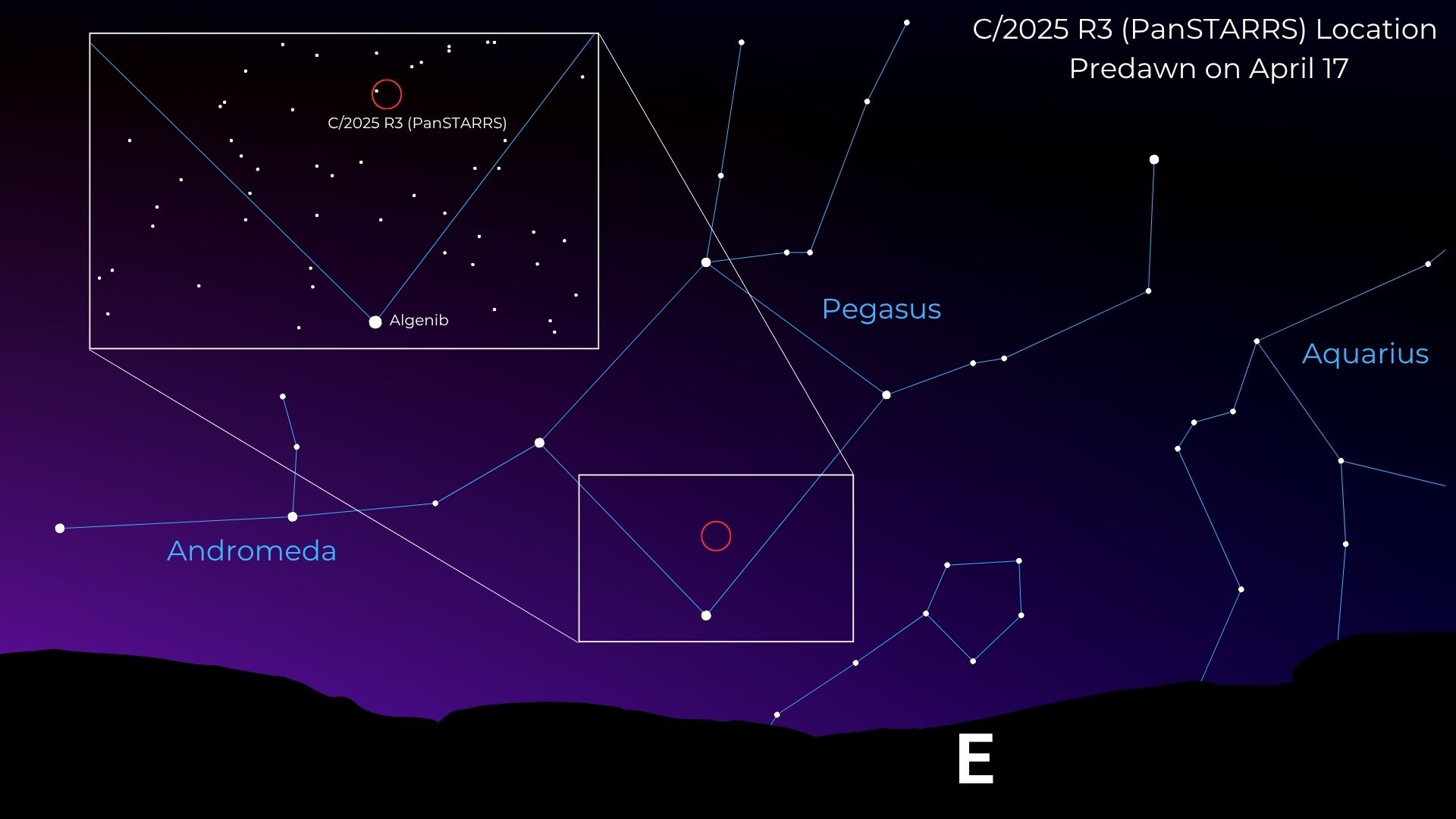
The early morning hours of April 17 should give you the shot at spotting Comet PanSTARRS before it slips from our sight for good. Try to find a spot with a clear view of the eastern horizon and be in position 90 minutes before sunrise.
First, locate the four bright stars of the "Great Square of Pegasus" rising low in the eastern sky. Comet PanSTARRS is visible in the patch of sky five degrees above the lowest of the four stars, Algenib — roughly the width of your three middle fingers held at arm's length against the sky.
Following its perihelion passage, Comet PanSTARRS will transition from the Northern to the Southern Hemisphere night sky, tracing a path through the constellations of Pisces, Cetus, Eridanus and Orion as it travels away from the sun, never to be seen again in our lifetimes.
Editor's Note: If you capture a photo of comet C/2025 R3 (PanSTARRS) and want to share it with Space.com's readers, then please send your photo(s), comments, name and location to [email protected].



















 Bengali (BD) ·
  English (US) ·