.png)
 1 hour ago
10
1 hour ago
10
Justin Trudeau's failed climate strategy was neither well-intentioned nor right for the time.
Published Jul 01, 2026 • 3 minute read
See more Toronto Sun on Google — save as a Preferred Source
Advertisement 2

THIS CONTENT IS RESERVED FOR SUBSCRIBERS ONLY
Subscribe now to read the latest news in your city and across Canada.
- Unlimited online access to articles from across Canada with one account.
- Get exclusive access to the Toronto Sun ePaper, an electronic replica of the print edition that you can share, download and comment on.
- Enjoy insights and behind-the-scenes analysis from our award-winning journalists.
- Support local journalists and the next generation of journalists.
- Daily puzzles including the New York Times Crossword.
SUBSCRIBE TO UNLOCK MORE ARTICLES
Subscribe now to read the latest news in your city and across Canada.
- Unlimited online access to articles from across Canada with one account.
- Get exclusive access to the Toronto Sun ePaper, an electronic replica of the print edition that you can share, download and comment on.
- Enjoy insights and behind-the-scenes analysis from our award-winning journalists.
- Support local journalists and the next generation of journalists.
- Daily puzzles including the New York Times Crossword.
REGISTER / SIGN IN TO UNLOCK MORE ARTICLES
Create an account or sign in to continue with your reading experience.
- Access articles from across Canada with one account.
- Share your thoughts and join the conversation in the comments.
- Enjoy additional articles per month.
- Get email updates from your favourite authors.
THIS ARTICLE IS FREE TO READ REGISTER TO UNLOCK.
Create an account or sign in to continue with your reading experience.
- Access articles from across Canada with one account
- Share your thoughts and join the conversation in the comments
- Enjoy additional articles per month
- Get email updates from your favourite authors
Article content
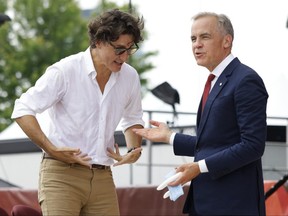
Prime Minister Mark Carney’s pre-Canada Day pivot away from Justin Trudeau’s failed $200-billion-plus climate strategy, after supporting it up to late last year, is a classic example of what makes the public cynical about politics.
Article content
Recommended Videos
Article content
The timing was strategic, after Parliament had adjourned for the summer and the day before Canada Day, when Canadians were thinking about barbecues and fireworks, not industrial greenhouse gas emission targets.
On one level, it’s the right decision, assuming Carney can be trusted, which is open to question given that prior to entering politics, he was the UN’s special envoy for climate change, co-chair of the Glasgow Financial Alliance for Net Zero, and the leading global corporate advocate for higher carbon taxes.
Now he says Trudeau’s plan, while well-intentioned, and suited for the time it was created, would in today’s world reduce Canada’s economic growth and increase western alienation.
In the real world, that’s sugar-coating it, which Carney has promised not to do, because in the real world the federal Liberals either misled Canadians about their ineffective and ruinously expensive climate policies, or were grossly incompetent and driven by ideology alone.
By signing up you consent to receive the above newsletter from Postmedia Network Inc.
Article content
Advertisement 3
Article content
As late as 2023, the federal environment department claimed Canada was “projected to exceed Canada’s interim objective of 20 percent below 2005 levels by 2026” and “remains firmly on track to meet our ambitious but achievable 2030 target.”
That was utter nonsense.
In fact, to meet the 2026 interim target to reduce Canada’s missions to 20% below 2005 levels, we would have to shut down the equivalent of all annual emissions from Canada’s buildings sector by the end of this year.
To meet the 2030 target of reducing emissions to at least 40% below 2005 levels, we would have to shut down the equivalent of Canada’s entire oil and gas sector, provoking a massive recession, and still coming up short.
Then again, the Liberals have been fudging their numbers ever since then prime minister Jean Chretien signed the United Nations’ Kyoto accord in 1998, committing Canada to reducing our emissions to an average of 6% below 1990 levels between 2008 and 2012.
A decade later in 2007, with the Liberals out of power, Chretien’s top political aide, Eddie Goldenberg, acknowledged the Liberals knew they couldn’t achieve Chretien’s target when he set it and it was an aspirational goal rather than a real one.
Advertisement 4
Article content
After the Liberals resumed power in 2015, Trudeau and a string of his environment ministers, from Catherine McKenna to Jonathan Wilkinson to Steven Guilbeault, kept insisting Canada was on track to meet its emission targets, when no credible, independent body, from the federal environment commissioner to the parliamentary budget officer, agreed with their claims.
Eventually, neither did think tanks from across the political spectrum, from the Fraser Institute, to the Canadian Climate Institute, the Trottier Energy Institute and the C.D. Howe Institute.
By early 2026, with the Carney government now in power, even the federal environment department acknowledged that Canada was not on track to meet its 2030 and 2035 targets.
By then, Carney himself had already said in a December 2025 year-end interview with CBC that Canada would not meet its 2030 and 2035 targets under Trudeau’s plan because it had “too much regulation, not enough action” with a lot of talk “and then nothing happens.”
Advertisement 5
Article content
On Tuesday, Carney making a virtue of necessity, said Canada won’t meet Trudeau’s climate targets under his own plan, either,
That was obvious given that since coming to power, he has been dismantling Trudeau’s plan, including cancelling the consumer carbon tax, eliminating the cap on oil and gas emissions, reducing methane regulations, allowing natural gas to be part of his national electricity strategy and cancelling EV mandates.
The truth is that Trudeau’s failed climate strategy was neither well-intentioned nor right for the time.
It was never the right time for Canada, a big, cold, northern, resource rich country with a relatively small population, to accept ideological restraints on our economy imposed by the UN and a prime minister, Trudeau, who had no concept about Canada’s energy needs.
Article content




















/https%3A%2F%2Fsportsmole-media-prod.s3.gra.io.cloud.ovh.net%2Fuploads%2F2026%2F06%2Fimago-xinhua-nestory-irankunda-celebrates-scoring-for-australia-in-the-world-cup-on-june-14-2026-6a2f348854d1b663111439.jpg)
/https%3A%2F%2Fsportsmole-media-prod.s3.gra.io.cloud.ovh.net%2Fuploads%2F2026%2F06%2Fkyle-rodden-cal-sport-media-sipa-usa-ivory-coast-winger-yan-diomande-gestures-on-june-25-2026-6a417eae132a5831825833.jpg)
 Bengali (BD) ·
  English (US) ·