.png)
 1 day ago
16
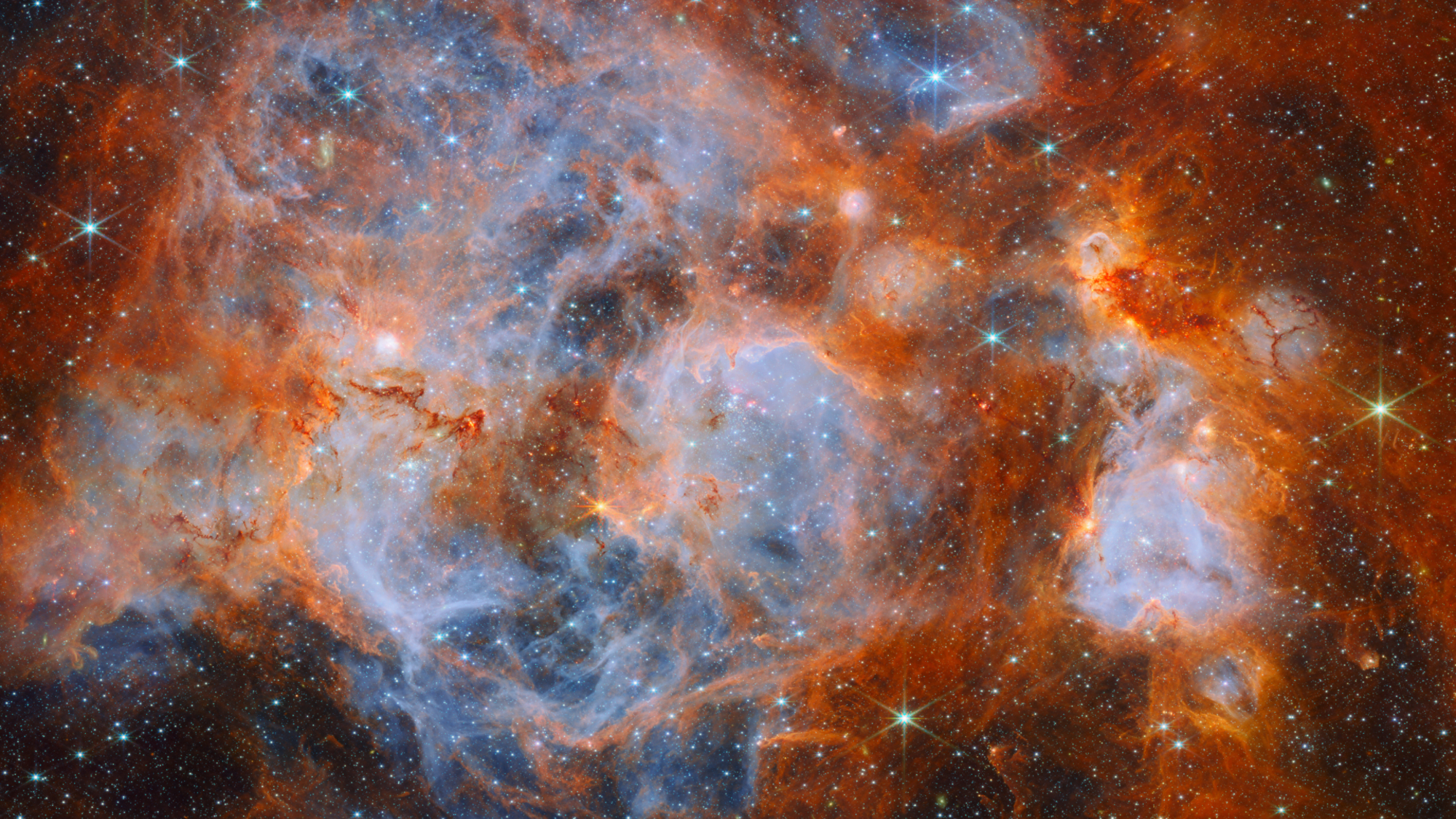
The NASA/ESA James Webb Space Telescope has captured a breathtaking view of a majestic star-forming region shining 161,000 light-years from Earth in a satellite galaxy of the Milky Way known as the Large Magellanic Cloud.
What is it?
The deep-space image reveals a 230-light-year-wide swathe of the glowing emission nebula N159, threaded with denser filaments of reddish molecular hydrogen that hide countless energetic young stars.
Ghostly blue clouds of ionized hydrogen gas (H II) glow in the center of the image, having been energized by the ultraviolet radiation pouring out from nearby stars, whose winds helped create the chaotic structure of the vast stellar nursery.
The ethereal pockets are surrounded by roiling orange clouds of polycyclic aromatic hydrocarbons — a type of organic molecule that may account for 30% of all carbon in the universe, according to the U.S. Department of Energy.
Why is it incredible?
N159 is estimated to be less than 3 million years old, making it one of the youngest star-forming regions in the Large Magellanic Cloud. It also has a markedly different composition than the stellar nurseries that spawn stars in our Milky Way, boasting a lower metal content that could mirror environments that existed in the early universe.
By pointing JWST at N159, astronomers open a window to the distant past. They can compare the characteristics of stars at varying stages of evolution, including pre-main-sequence stars that are still in the process of forming, or accreting from the vast interstellar cloud.
Want to know more?
Be sure to check out our JWST explainer page to discover everything that you need to know about the space telescope, and peruse our astronomy coverage for the latest discoveries made possible by its 21.3-foot-wide (6.5-meter) golden eye.

























 Bengali (BD) ·
 English (US) ·