.png)
 1 hour ago
6
1 hour ago
6
Article content
First Reading is a Canadian politics newsletter curated by the National Post’s own Tristin Hopper. To get an early version sent directly to your inbox, sign up here.

THIS CONTENT IS RESERVED FOR SUBSCRIBERS
Enjoy the latest local, national and international news.
- Exclusive articles by Conrad Black, Barbara Kay and others. Plus, special edition NP Platformed and First Reading newsletters and virtual events.
- Unlimited online access to National Post.
- National Post ePaper, an electronic replica of the print edition to view on any device, share and comment on.
- Daily puzzles including the New York Times Crossword.
- Support local journalism.
SUBSCRIBE FOR MORE ARTICLES
Enjoy the latest local, national and international news.
- Exclusive articles by Conrad Black, Barbara Kay and others. Plus, special edition NP Platformed and First Reading newsletters and virtual events.
- Unlimited online access to National Post.
- National Post ePaper, an electronic replica of the print edition to view on any device, share and comment on.
- Daily puzzles including the New York Times Crossword.
- Support local journalism.
REGISTER / SIGN IN TO UNLOCK MORE ARTICLES
Create an account or sign in to continue with your reading experience.
- Access articles from across Canada with one account.
- Share your thoughts and join the conversation in the comments.
- Enjoy additional articles per month.
- Get email updates from your favourite authors.
THIS ARTICLE IS FREE TO READ REGISTER TO UNLOCK.
Create an account or sign in to continue with your reading experience.
- Access articles from across Canada with one account
- Share your thoughts and join the conversation in the comments
- Enjoy additional articles per month
- Get email updates from your favourite authors
Sign In or Create an Account
or
Article content
TOP STORY
Article content
Article content
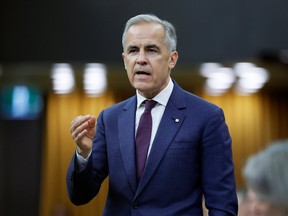
When asked about Canada’s official slide into recession, Prime Minister Mark Carney attributed it in part to his government’s dial down of immigration.
Article content
“We see some weakness, in part because of clear decisions by the government,” he told reporters on Tuesday, before noting his government’s lowered immigration targets.
Article content
Article content
The comment reveals something about the Canadian economy that analysts and critics have been warning about for years.
Article content
By signing up you consent to receive the above newsletter from Postmedia Network Inc.
Article content
Namely, that Canada’s post-COVID economic growth has been predominantly based on packing unprecedented numbers of new consumers into the country.
Article content
As such, when weighing the growth of the Canadian economy against the outsized growth of the Canadian population, the country has already been in a “per-capita recession” for much of the last four years.
Article content
It’s a term that CIBC Deputy Chief Economist Benjamin Tal used in October, telling a conference in Ottawa that Canada was already in recession. “If it’s not a formal recession, it’s a per-capita recession,” he said.
Article content
GDP is a measure of total economic activity. So while it can track whether a country is becoming richer and more productive, it can also increase simply if the number of consumers in an economy is getting larger.
Article content
Every migrant to Canada consumes shelter, food and services in some capacity, all of which gets added to total GDP figures without necessarily signaling a growth in overall economic health.
Article content
Article content
In 2024, for instance, Canadian GDP grew by 1.6 per cent. But population grew by 1.8 per cent, fuelled by record-breaking surges in everything from temporary foreign workers to asylum seekers to foreign students to permanent residents.
Article content
Article content
The net result was a year in which per-capita GDP went down, which is generally an indicator that overall living standards are on the decline.
Article content
“Our GDP per capita has been on the decline for two years,” Jasraj Singh Hallan, the Conservatives’ shadow finance minister, told the House of Commons in November 2024. He added, “in simple terms, Canadians are getting poorer.”
Article content
The Bank of Canada would admit as much in 2025. After a year that saw GDP grow by 1.7 per cent, the central bank concluded in a monetary policy report that the growth in wealth was “essentially flat on a per-person basis.”
Article content
The Fraser Institute has called this phenomenon Canada’s “ugly” growth experience.
Article content
Across 2020 and 2024, the institute calculated in a 2025 report that Canada’s aggregate GDP growth was 1.5 per cent per year, working out to total growth of about six per cent over the four years.



























/https%3A%2F%2Fsportsmole-media-prod.s3.gra.io.cloud.ovh.net%2Fuploads%2F2026%2F05%2Fimago1077546153-2-6a0b8bbf76f8f531157643.jpg)
 Bengali (BD) ·
  English (US) ·