.png)
 11 hours ago
11
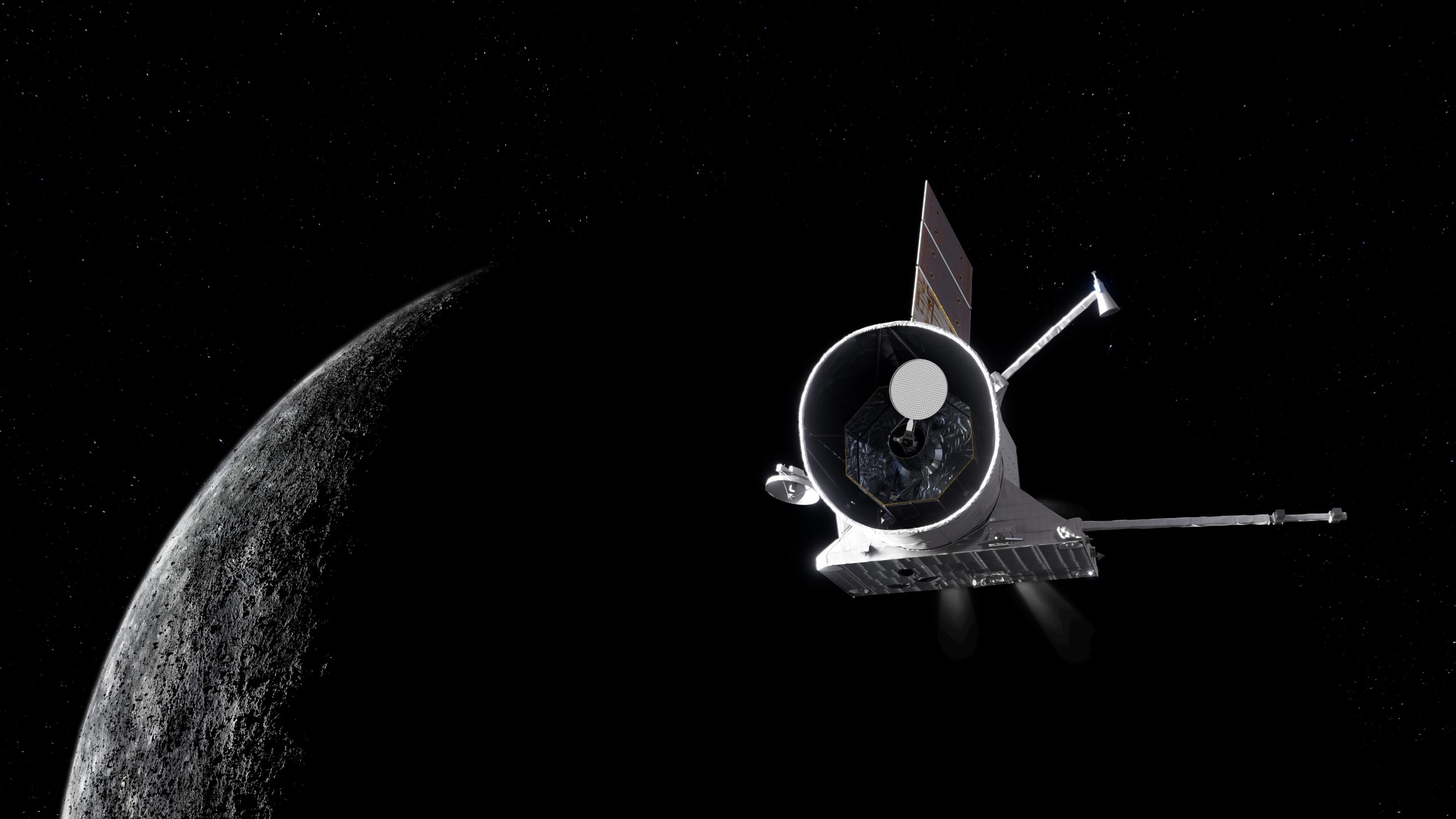
Mercury is about to receive a robotic visitor from Earth.
The BepiColombo mission — a joint effort of the European Space Agency (ESA) and the Japanese Aerospace Exploration Agency (JAXA) — will arrive in orbit around Mercury today (Nov. 21), more than eight years after leaving its home planet.
The big moment will come after an orbit-insertion burn, which is scheduled to begin today at 1:24 p.m. EST (1824 GMT) and last for 37 minutes.
BepiColombo consists of two main spacecraft: ESA's Mercury Planetary Orbiter (MPO) and JAXA's Mercury Magnetospheric Orbiter (MMO), also known as Mio.
The duo launched — along with a power and propulsion element called the Mercury Transfer Module (MTM) — aboard an Ariane 5 rocket from French Guiana in October 2018, beginning a long and looping trip through the inner solar system.
Mercury is a difficult planet to reach because it's so close to the sun. Spacecraft approaching the solar system's innermost planet are accelerated to high velocities by the immense gravitational pull of our star and must shed a great deal of kinetic energy to be captured by Mercury's much weaker tug.
So the BepiColombo team designed a trajectory that featured one flyby of Earth, two of Venus and six of Mercury over the course of about seven years. That flight time was increased by a year, however, after the mission suffered an issue with its solar panels, which reduced the power available for the MTM's electric thrusters.
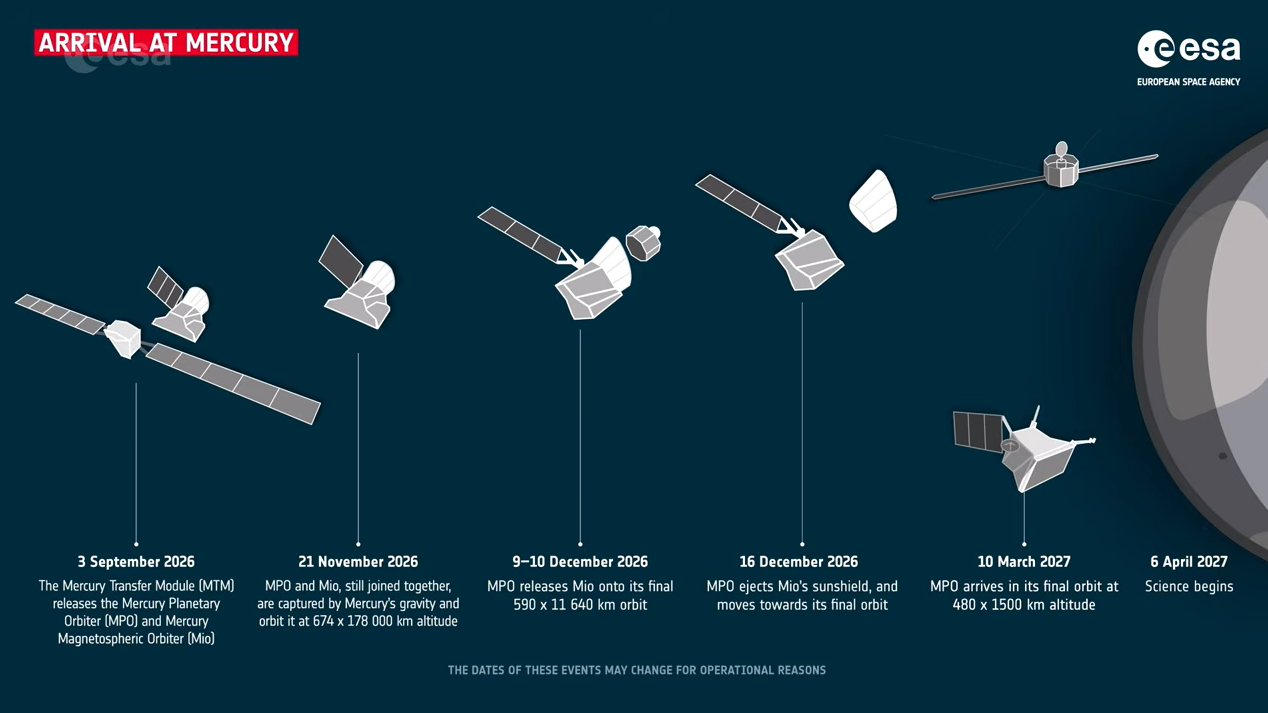
Today's orbital insertion is the latest milestone in BepiColombo's Mercury arrival phase, which is expected to take about six months in total.
Arrival began on Sept. 3, when the MTM released MPO and Mio. The two orbiters remain connected today; they won't separate until Dec. 9 or thereabouts.
Shortly thereafter, Mio will settle into its final orbit, a highly elliptical path that will take it over Mercury's poles. MPO is also destined for a polar orbit, though a much less elliptical one than Mio's; the ESA probe will conduct a series of engine burns before finally getting there on March 10, 2027.
BepiColombo won't start doing science work until April 6, 2027. The two probes will gather complementary data from their two different vantage points, shedding a great deal of light on a mysterious world.
"The mission will study all aspects of Mercury, from the structure and dynamics of its magnetosphere and how it interacts with the solar wind, to its internal structure with its large iron core, and the origin of the planet’s magnetic field," ESA officials wrote in a BepiColombo mission description.
"The data will enable scientists to understand more about the origin and evolution of a planet located close to its parent star, and a better understanding of the overall evolution of our solar system," they added.























 Bengali (BD) ·
 English (US) ·