.png)
 1 day ago
42
Article content
The remaining provinces were roughly in the same territory on their expressions of attachment to Canada.
Article content
The proportion of respondents saying they felt very attached in the remaining provinces were: 62 per cent in B.C.; 63 per cent in Manitoba and Saskatchewan pooled together; and 65 per cent in Ontario. Those saying they felt somewhat attached were: 24 per cent in Manitoba and Saskatchewan; 28 per cent in Ontario; and 29 per cent in B.C.
Article content
Those expressing some alienation accounted for: 10 per cent in Manitoba and Saskatchewan; six per cent in B.C.; and five per cent in Ontario. Those expressing complete alienation were four per cent in Manitoba and Saskatchewan; three per cent in B.C.; and two per cent in Ontario.
Article content
The findings suggest that Quebecers continue to negotiate (provincial and Canadian) identities rather than simply choosing one over the other
Article content
Those in the Atlantic provinces not only have the strongest expression of attachment to Canada, but they also had the strongest attachment to their home province — 62 per cent said they felt very attached to their province.
Article content
Those who had the lowest proportion expressing strong attachment to their province were in Ontario, where only 27 per cent said they felt very attached, significantly lower than anywhere else.
Article content
Advertisement 3
Article content
The next lowest was Alberta, where 38 per cent said they felt very attached to their province, followed by Manitoba and Saskatchewan with 41 per cent, B.C. with 45 per cent, and Quebec with 47 per cent.
Article content
The national average was 39 per cent.
Article content
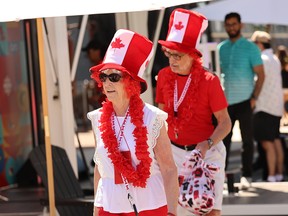
Despite disagreements and rivalries, the poll shows that Canadians feel a strong attachment to other Canadians.
Article content
Nationally, 63 per cent said they felt very strong attachment towards other Canadians and another 31 per cent said they felt somewhat attached. Only two per cent said they didn’t feel much attachment, and none said they felt no attachment at all.
Article content
The weakest in expressing affinity with other Canadians were Albertans.
Article content
Only 59 per cent of respondents in Alberta said they felt very much attachment to other Canadians, compared to 73 per cent in Atlantic Canada, 63 in Ontario, 62 in Quebec and B.C., and 60 in Manitoba and Saskatchewan.
Article content
Albertans were also most likely to say they felt not very much attachment to other Canadians, but it was still only five per cent, where it was either one or two per cent everywhere else.
Article content
“Quebec remains the exception in the extent to which provincial and Canadian identities compete, but that’s hardly new,” Jedwab said. “The findings suggest that Quebecers continue to negotiate these identities rather than simply choosing one over the other. Indeed, while only 45 per cent of Quebecers say they’re very attached to Canada, 62 per cent feel very strongly attached to other Canadians. That’s an important distinction that often gets lost in debates over sovereignty.”
Article content
Advertisement 4
Article content
Curiously, in the context of Alberta’s separation referendum, more respondents in Alberta said they felt no attachment at all to their province than said they felt no attachment to their country.
Article content
Alberta had the highest proportion of respondents feeling alienated from their province, at 11 per cent, followed by Manitoba and Saskatchewan at 10 per cent, six per cent in both Quebec and Ontario, three per cent in Atlantic provinces, and two per cent in B.C.
Article content
“There’s an important distinction between political alienation and national identification,” said Jedwab. “Whatever frustrations some Albertans may have with Ottawa, an important majority remain attached to Canada and to other Canadians. The concerns are more with governance and much less so with identity.”
Article content
Article content
Poll respondents were also asked which description best fits with how they see themselves: Canadian only, Canadian first but also provincial, equally Canadian and provincial, provincial first but also Canadian, or provincial only.
Article content
Nationally, the average of those saying Canadian only was 29 per cent. The regional breakdown showed those in Ontario to be the outliers, at 46 per cent, followed by 29 per cent in Alberta, 24 per cent in Manitoba and Saskatchewan, 22 per cent in B.C., 13 per cent in the Atlantic provinces, and 10 per cent in Quebec.






















 Bengali (BD) ·
 English (US) ·