.png)
 2 hours ago
8
2 hours ago
8
Article content
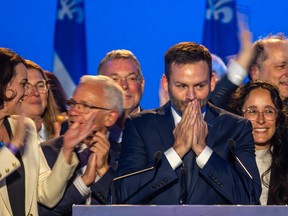
Monday’s election in Quebec produced the most fragmented result in the province’s history, where three parties had between 20 and 28 per cent of the vote, and two others between 12 and 14 per cent. The previously governing Coalition Avenir Québec (CAQ), after eight years in office, though led by the well-liked new premier Christine Fréchette, emerged with no members in the national assembly but approximately 14 per cent of the vote. The complete elimination from the legislature of the governing party is a rare event that surpassed even Kim Campbell when she replaced Brian Mulroney in 1993 and led the Progressive Conservative party from a caucus in the 150s to two. Richard B. Hatfield succumbed to this fate in New Brunswick at the hands of Frank McKenna in 1987, but nothing like it has occurred before in Quebec.

THIS CONTENT IS RESERVED FOR SUBSCRIBERS
Enjoy the latest local, national and international news.
- Exclusive articles by Conrad Black, Barbara Kay and others. Plus, special edition NP Platformed and First Reading newsletters and virtual events.
- Unlimited online access to National Post.
- National Post ePaper, an electronic replica of the print edition to view on any device, share and comment on.
- Daily puzzles including the New York Times Crossword.
- Support local journalism.
SUBSCRIBE FOR MORE ARTICLES
Enjoy the latest local, national and international news.
- Exclusive articles by Conrad Black, Barbara Kay and others. Plus, special edition NP Platformed and First Reading newsletters and virtual events.
- Unlimited online access to National Post.
- National Post ePaper, an electronic replica of the print edition to view on any device, share and comment on.
- Daily puzzles including the New York Times Crossword.
- Support local journalism.
REGISTER / SIGN IN TO UNLOCK MORE ARTICLES
Create an account or sign in to continue with your reading experience.
- Access articles from across Canada with one account.
- Share your thoughts and join the conversation in the comments.
- Enjoy additional articles per month.
- Get email updates from your favourite authors.
THIS ARTICLE IS FREE TO READ REGISTER TO UNLOCK.
Create an account or sign in to continue with your reading experience.
- Access articles from across Canada with one account
- Share your thoughts and join the conversation in the comments
- Enjoy additional articles per month
- Get email updates from your favourite authors
Sign In or Create an Account
or
Article content
Advertisement 1
Article content
The fifth of the parties in electoral strength was Québec solidaire (QS), led by Ruba Ghazal, a Lebanese-Palestinian and foaming-at-the-mouth anti-Israelite leading a party that advocates immediate secession with a minimal interest in any continuing relationship with Canada. This unambiguously rejectionist movement received about 12 per cent off the vote and nine members in the national assembly. The Conservatives elected candidates for the first time in 91 years, since Maurice Duplessis was their leader and joined forces in the 1935 election campaign with reformed Liberals to form what became the Union Nationale, which he led to victory for an unequalled five terms.
Article content
Article content
By signing up you consent to receive the above newsletter from Postmedia Network Inc.
Article content
The Conservatives garnered approximately 20 per cent of the total vote and elected 19 members in the 127-seat provincial legislature, a remarkable feat for a federalist free-enterprise party. The shopworn but more or less imperishable Quebec Liberal Party, which governed for 39 years prior to the first election of Duplessis in 1936, and for about half of the time since the Union Nationale was replaced by the Parti Québecois in 1970, came in second with 24 per cent of the vote and nearly 40 legislators. The Parti Québecois managed to elect 59 members (46 percent of the total) with only 28 per cent of the popular vote.
Article content
Advertisement 2
Article content
For many years, the Quebec electorate was divided approximately into five roughly equal blocks: around 20 per cent non-French, who were almost entirely Liberal as they were federalists; approximately 20 per cent French Liberal federalists, giving the Quebec Liberals almost 40 per cent of the vote out of the gate; about 20 per cent of Quebecers were conservatives, who were generally also federalist; around 20 per cent were nationalists; and there was a floating vote of about 20 per cent.
Article content
Article content
The genius of Duplessis was to get the nationalists and the conservatives to vote together, which required great dexterity to avoid becoming so nationalistic that the conservatives were frightened, as happened in Duplessis’s one significant electoral defeat in 1939, an election he called abruptly to try to get a mandate to fight any attempt to reimpose conscription, as the federal government had done in 1917. Prime Minister Mackenzie King’s Quebec ministers — Ernest Lapointe, Arthur Cardin, Charles Power and Raoul Dandurand — all threatened to resign if conscription were imposed, while King solemnly announced that there would be no conscription for overseas service in an attempt to disarm and defeat Duplessis.


























 Bengali (BD) ·
  English (US) ·